
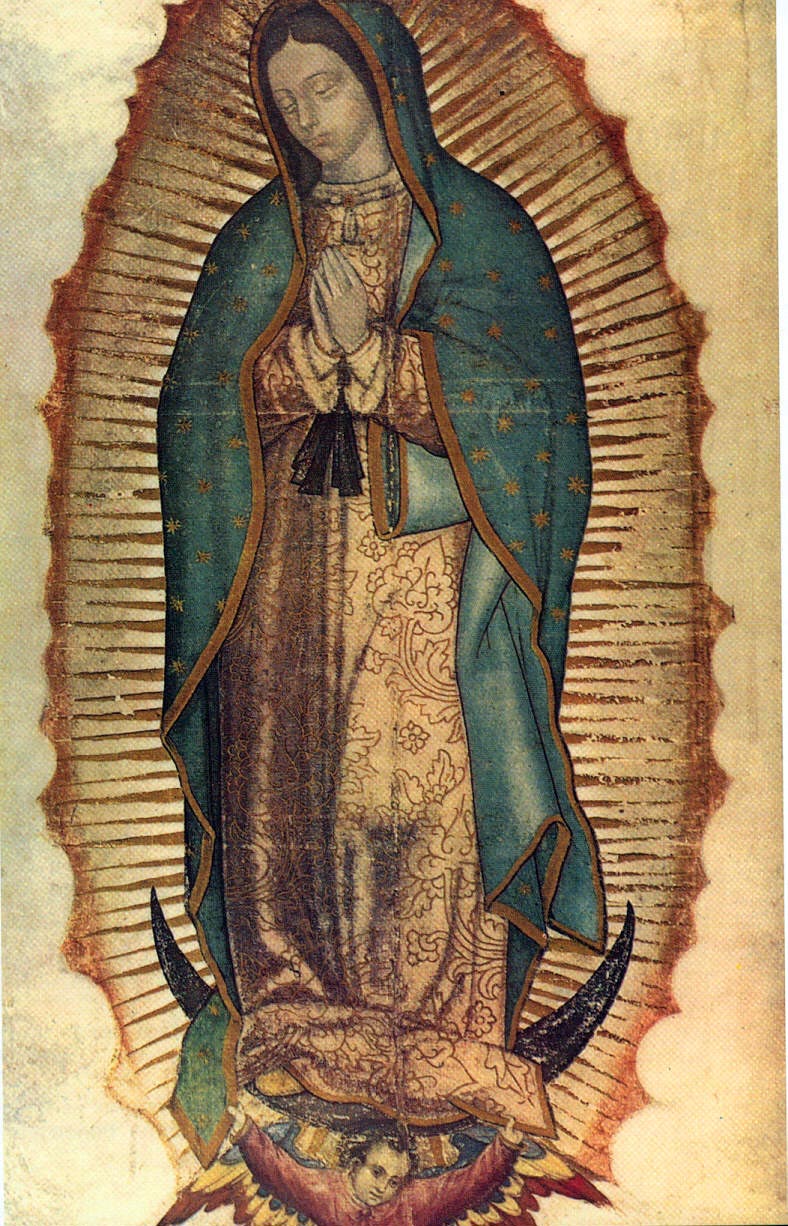
The tilma is a roughly woven cloak of ayate (cactus-fibre), of the kind worn by Aztec commoners in the 16th century. Cloaks of this material normally disintegrate within twenty to forty years. The tilma of Guadalupe is now nearly five hundred years old and shows no decay. The Virgin's image — a young pregnant Marian figure robed in stars and crescent moon — was reportedly impressed upon it on December 12, 1531, when Juan Diego unfolded the cloak before Bishop Zumárraga.
Scientific examinations include those of Richard Kuhn (Nobel laureate in chemistry, 1936 study, found no underlying sketch and no known organic or mineral pigment), Philip Callahan (1979 infrared study, identified the image as unique in technique with no brushstrokes), and the repeated discovery — first reported by Carlos Salinas (1929), confirmed by ophthalmologists Lavoignet, Aste-Tonsmann, and others — of microscopic reflections in the eyes of the figure resembling those who would have been present at the moment Juan Diego unrolled the cloak. The basilica receives some 20 million pilgrims annually.