
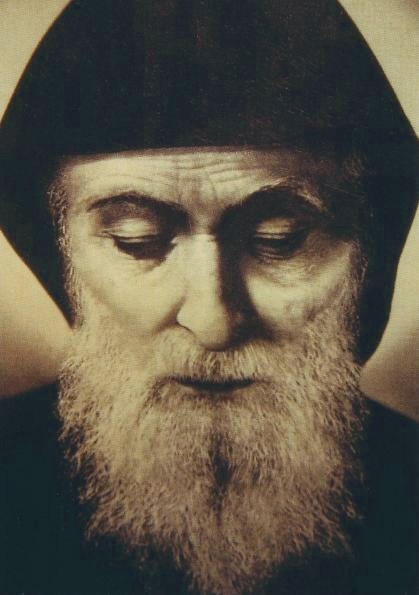
Youssef Antoun Makhlouf, born in 1828 at Beqaa Kafra in Mount Lebanon, entered the Maronite Lebanese Order in 1851 and took the religious name Charbel. From 1875 until his death he lived as a hermit in the small stone Hermitage of Sts. Peter and Paul above the monastery of St. Maron at Annaya, speaking almost not at all, living on bread and water, and celebrating the Maronite Divine Liturgy each day at noon, often in long ecstasy. He collapsed at the altar during the elevation with the consecrated Host in his hands and died on 24 December 1898.
For forty-five nights after his burial in the common monks' cemetery at Annaya, monks and villagers reported a luminous radiance around the grave. The body was exhumed on 15 April 1899: it was completely incorrupt, with no sign of decay, the wooden coffin floating in an oily, blood-like liquid, and the body discharging a blood-and-water-like fluid that soaked his vestments, which had to be changed periodically. Further exhumations in 1927, in 1950, and in 1965 at his beatification each documented the same fluid.
Charbel was beatified by Paul VI on 5 December 1965 and canonised on 9 October 1977. The monastery of St. Maron at Annaya has kept a formal register of medically documented cures attributed to his intercession since 1950; a Lebanese-French medical commission first published it in 1975, and as of a 2024 report it lists over 29,000 depositions from around the world, including approximately 500 that Lebanese medical committees have classified as unexplained — the most famous the cure of Nohad El-Shami in 1993. Annaya remains one of the principal pilgrim destinations of the Middle East.