
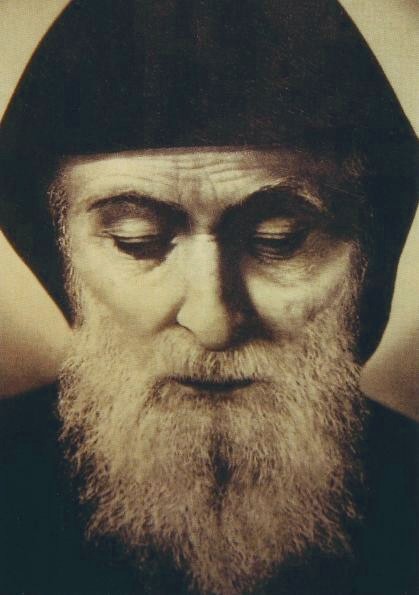
Youssef Antoun Makhlouf was born in 1828 — probably on 8 May, says the Dicastery for the Causes of Saints — in Bekaa Kafra, the highest village in Lebanon, to a family of poor farmers. His father died when he was three. Two of his uncles were hermits, and in 1851, at twenty-three, he left home at night without a word to anyone, 'never to return' as Paul VI put it, and entered the Lebanese Maronite Order at the monastery of Our Lady of Mayfouq. He took the name Charbel, after a martyr of Edessa, studied theology at Kfifan, and was ordained priest on 23 July 1859.
Then, in Paul VI's words, came 'sixteen years of community life among the monks of Annaya and twenty-three years of entirely solitary life in the hermitage of Saints Peter and Paul.' From 1875 he lived in the hermitage above the monastery in silence, fasting, prayer and manual work. On 16 December 1898, at the elevation of the Host, he was struck down at the altar; after eight days' agony he died on Christmas Eve, aged seventy.
He is a special case because of what followed. Monks swore to lights over his grave in the months after his burial. When it was opened in April 1899 the body was found incorrupt and exuding a fluid like blood and water, and it went on doing so through the openings of 1927 and 1950 — the second drawing such crowds that cures were reported among them. In the Dicastery's words, after the beatification 'the body no longer exuded'; by the common account, when the tomb was opened before the canonisation only the bones remained.
Since 1950 the monastery has kept a register of the cures reported through him. A cure is entered when the person comes to Annaya with medical records of the illness and of its end. The register held more than 29,000 entries in 2019 and more than 30,000 by 2026, Muslims and Druze among those who came to record them. These are the monastery's records, not judgements of the Church; the Church has examined and approved three cures, the ones his cause required, and is silent on the rest. On the 22nd of every month thousands of pilgrims climb to Annaya, as Pope Leo XIV said when he prayed at the tomb on 1 December 2025 — the first pope to do so.
The devotion has travelled with the Lebanese emigration, and nowhere further than Mexico, where statues of 'San Charbel' in the churches of Mexico City are hung with coloured ribbons, each carrying a petition. The face on every image of him is said to come from a photograph taken at the hermitage on 8 May 1950, in which, the story goes, an extra monk appeared whom the old monks recognised; that is a devotional story, and no document of the monastery or the Church vouches for it.