By 1571 the Ottoman Empire under Sultan Selim II had taken Cyprus and stood at the threshold of Italy. Pope St. Pius V — himself a Dominican, an order founded on the preaching of the Rosary — assembled a fragile Holy League of Spain, Venice, the Papal States, Genoa, Malta, and several smaller Italian states. He called for Rosary processions in every parish of Christendom on the day of battle and asked the confraternities of the Rosary to pray without ceasing.
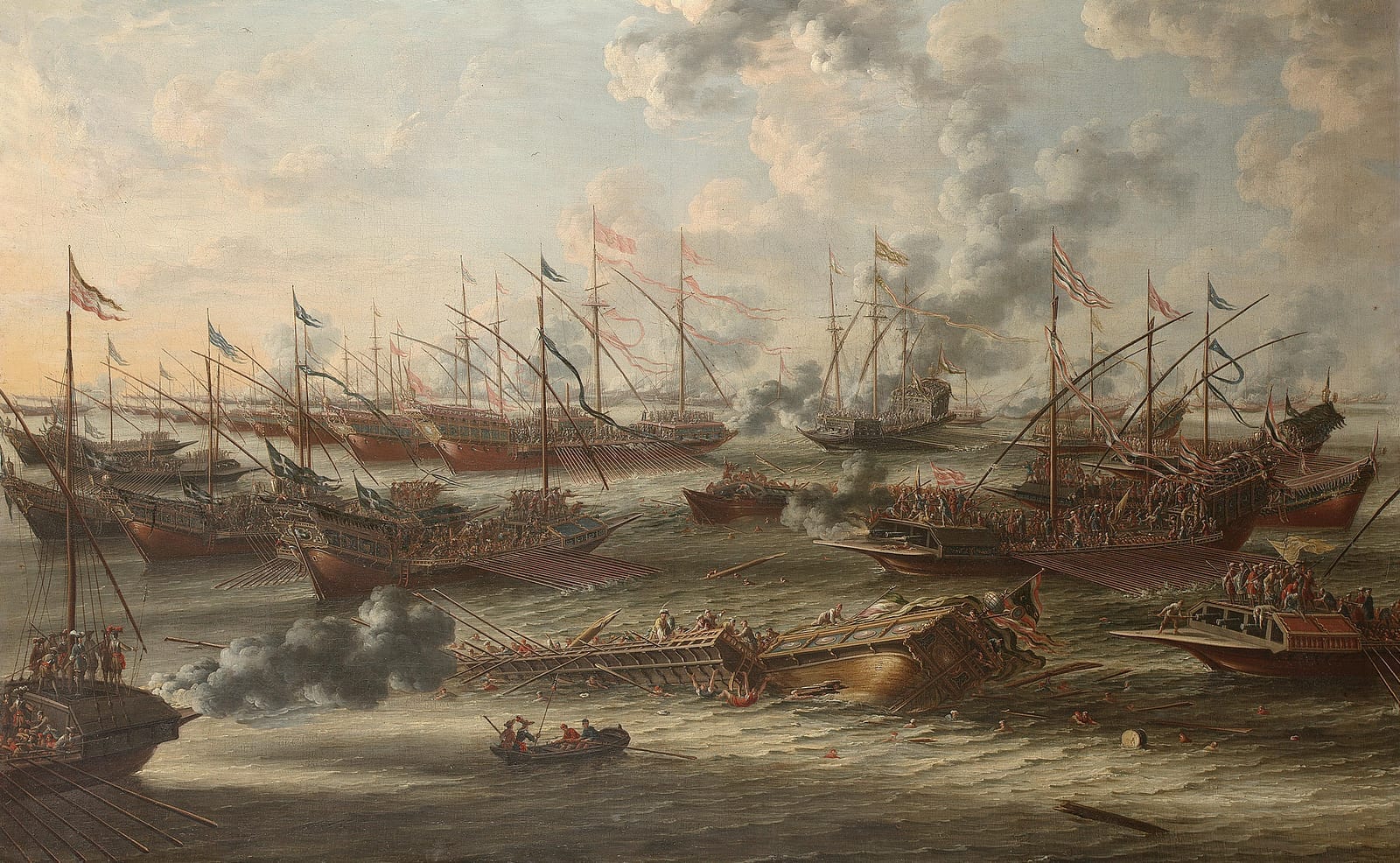
On October 7, 1571, the Holy League fleet of some 200 galleys, commanded by Don John of Austria, met the larger Ottoman fleet of roughly 270 ships in the Gulf of Patras off Lepanto, in western Greece. Against every expectation, the Holy League won decisively, sinking or capturing about 200 Ottoman vessels and freeing approximately 12,000 Christian galley-slaves.
Pope Pius V, then in Rome and several hundred miles from the battle, is said to have suddenly stopped a meeting with cardinals, walked to the window, and announced: 'It is not the time for business; let us go and thank God for the victory He has just given to the Christian arms.' Word of the actual battle did not reach Rome for two weeks.
In thanksgiving, Pius V instituted the feast of Our Lady of Victory, soon renamed Our Lady of the Rosary, which the Church still celebrates on October 7.
The Holy League brought 212 ships against 274 and was outnumbered in hulls, but it carried about 1,815 guns against some 750, and its Spanish arquebusiers outranged the Ottoman composite bows. Six Venetian galleasses — floating gun platforms stationed ahead of the Christian line — broke the Ottoman battle order at the moment of contact, and naval historians credit them first among the causes of the victory.
The Church has made no judgement that the victory itself was a miracle; what it did was keep the day. Pius V ordered that a commemoration of the Rosary be made on it. Gregory XIII in 1573 allowed the feast wherever a church had an altar of the Rosary; Clement X extended it to the whole of Spain in 1671; Clement XI commanded it for the universal Church in 1716, after Prince Eugene's victory at Peterwardein; Pius X fixed it on 7 October in 1913. Leo XIII, writing on the Rosary in 1883, described what Pius V had intended by it — a feast 'in honour of Our Lady of Victories' to 'celebrate the anniversary of so memorable a struggle', kept 'to preserve the memory of this great boon thus granted.'
The account of Pius V at the window is not contemporaneous with the battle. It was examined, with its documents, in the proceedings for his canonization: he was beatified by Clement X in 1672 and canonized by Clement XI in 1712, more than a century after Lepanto.
Among the wounded was a Spanish soldier of twenty-four named Miguel de Cervantes, who took two shots in the chest and a third that crippled his left hand for the rest of his life. He thought the wound beautiful, he wrote afterwards, 'for the reason that it was received on the most memorable and sublime occasion that past ages have known.' Don Quixote was written with the other hand.