
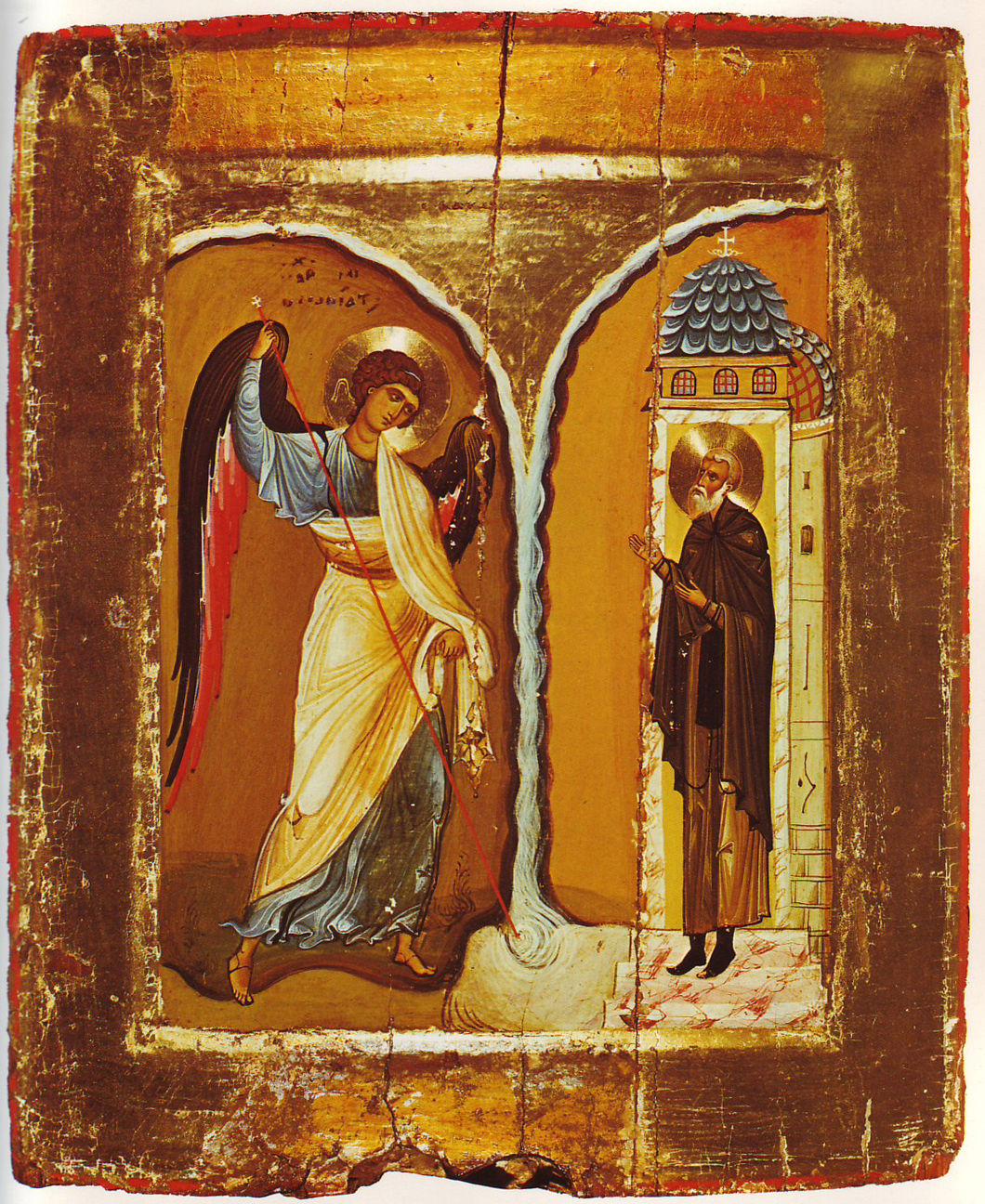
The story is told in a Greek text, the Narration of Archippus the church-guardian concerning the miracle performed by Michael the Archangel at Chonae. The apostles John and Philip, it says, came from Ephesus and Hierapolis to a place called Chairetopa and foretold that Michael would descend there; after they had gone, 'a spring of healing water immediately bubbled up in that place'. Years later an idolater of Laodicea, whose only daughter had been born mute, was told in a dream to take her to the water. He asked the sick whom they invoked — 'the Father, the Son and the Holy Spirit and Michael the Archangel' — threw it on the girl's face, and she cried out. He was baptised with his household and built a small oratory over the spring. Ninety years after that, a boy of ten named Archippus came from Hierapolis and stayed sixty years as guardian, eating boiled herbs once a week, sleeping on sharp stones, beaten by pagans who could not stop the water.
Then came the rivers. Two of them, the Lykokapros and the Kouphos, ran down from the east three miles off, and the devil put it into the pagans' minds to turn them on the shrine. Some five thousand gathered at Laodicea, cut a channel to the rock, dammed the water ten days, and let it go. Archippus, prostrate ten days without food, rose to sing 'The rivers have lifted up their voice, O Lord', and with a roar of thunder the Archangel stood on the rock: 'I am the Archangel of the Lord, who stands before God.' He rebuked the rivers by name, signed the cross, and they stood still; then he struck the rock with his staff, split it with a crack 'a hundred times louder than thunder', and ordered the flood into the chasm, 'roaring until the end of time'. The watching pagans turned to stone. The Greek for a funnel is chōnē; the place took the name, and the city with it. Herodotus had already written (7.30) that at Colossae the Lycus vanishes into a chasm and comes up five stades on: the tale is, among other things, an explanation of the ground.
The feast stands on 6 September in every Byzantine calendar and is already in the Menologion of Basil II, about the year 1000; the Roman Martyrology has no entry. The September fair at Chonae drew, wrote Michael Choniates, 'Lydians and also Ionians, Carians and Pamphylians and Lycians, even those from among the barbarian Iconians'. His brother Niketas, the historian, born there about 1155, saw Manuel I enter 'the enormous Church of the Archangel, incomparable in beauty and a marvel of craftsmanship' in 1176, and recorded its end: in 1189 the rebel Theodore Mangaphas, with Turks hired from the Sultan of Iconium, let it 'be destroyed by fire', and in 1191–92 the first false Alexios 'defiled the all-hallowed tabernacle of God by entering with Turks', who smashed the pulpit, the mosaics and the altar. The town is Honaz today. No remains of the church have been identified.
The dating should be stated plainly. The Narration survives in more than ninety Greek manuscripts, the oldest an eighth-century palimpsest (Paris, suppl. gr. 480); Max Bonnet edited it in the Analecta Bollandiana for 1889 and reissued it at Paris in 1890 with Symeon Metaphrastes' tenth-century rewriting. Scholars read it in two layers: the first three chapters, the apostles and the spring, composed in the fourth century; the eight chapters of Archippus and the rivers added around the eighth. What they see behind it is older than the book. The Council of Laodicea, ten miles from Colossae, ruled in its 35th canon that 'Christians must not forsake the Church of God, and go away and invoke angels'; and Theodoret, on Colossians 2:18 in the fifth century, wrote that 'this disease remained long in Phrygia and Pisidia … and even to the present time oratories of the holy Michael may be seen among them'. The historians — Glenn Peers, Clive Foss, Alan Cadwallader — read the tale as a healing spring and a chasm that the Archangel's cult took over from the pagan countryside, and that the bishops first fought and then adopted. What happened at the rock is beyond the historian; that pilgrims came to a church of Michael beside those waters for most of a thousand years is not.