
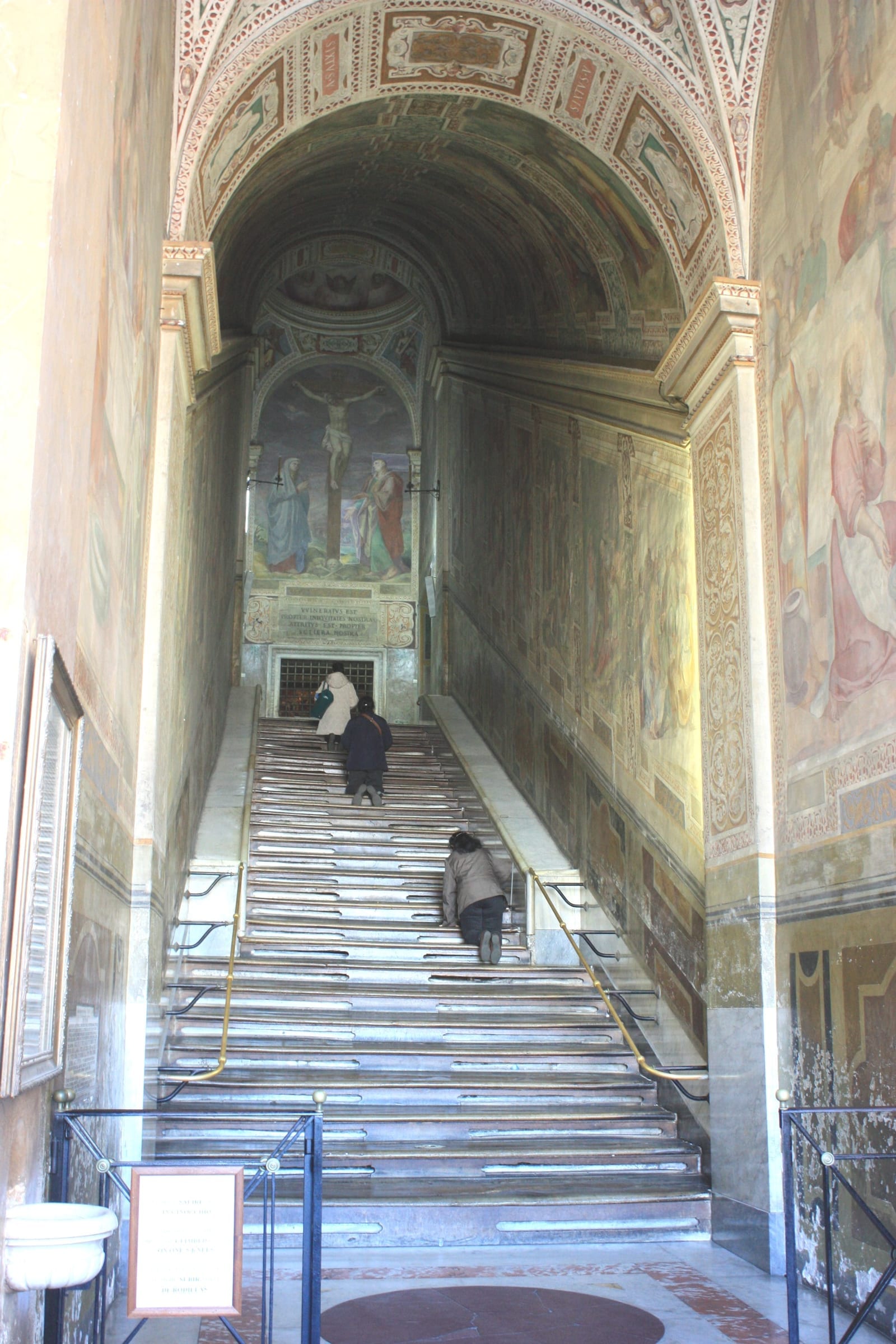
By tradition, in 326 St. Helena had the twenty-eight white marble steps of the Praetorium of Pontius Pilate, on which Christ had ascended to His judgement, dismantled and shipped to Rome. They were placed in front of the Lateran Palace (then the papal residence) and have been there since. The Reformation period scepticism notwithstanding, the original marble has been confirmed by mineralogical study to be of Levantine, not Italian, origin.
Since at least the 4th century, pilgrims have climbed the Scala Santa only on their knees, in penance, praying at each step. The stairs were encased in walnut panels in 1723 to protect them; in 2019, for the first time in nearly three centuries, the wood was removed and the original marble exposed for an eleven-week public veneration. Drops of what tradition holds to be the blood of Christ have been visible on several of the steps for centuries, covered by small bronze crosses. Climbing the Scala Santa carries a plenary indulgence under the usual conditions. The sanctuary at the head of the stairs — the Sancta Sanctorum — was the private chapel of the medieval popes and holds the Acheropita, an ancient Byzantine icon of Christ 'not made by human hands.'