
MIRACULOUS MIRACLES™

Saint — Andrew the Apostle

St. Andrew the Apostle
early 1st century, Bethsaida — c. AD 60, Patras
The First-Called (Protokletos)
Cathedral of St. Andrew, Patras, Greece
Feast
November 30
✠ MartyrCrucified at Patras by the Roman proconsul Aegeas, traditionally on an X-shaped cross, c. 60 → The Martyrs
Life

Andrew, the brother of Simon Peter, was a fisherman of Bethsaida and a disciple of John the Baptist before becoming the first to follow Christ — for which the Greek Church calls him Protokletos, 'the First-Called.' It was Andrew who brought his brother Simon to Jesus, saying: 'We have found the Messiah' (John 1:41).

Tradition, attested in early sources, says Andrew preached the Gospel across Scythia and the lands north of the Black Sea — territories that would become Russia, Ukraine, and Romania, where he is honoured as principal patron. Eusebius records that his mission ended at Patras in Achaea (Greece), where he was crucified by the Roman proconsul Aegeas.

A later tradition, dating from the medieval period, holds that he was crucified on an X-shaped cross at his own request, considering himself unworthy of the same form of death as Christ. This 'saltire' became the cross of St. Andrew, the flag of Scotland.

Miracles & Phenomena
  • The Multiplication of Loaves

    In John's Gospel, Andrew is the apostle who finds the boy with the five barley loaves and two small fish — and asks, 'What are these among so many?' (John 6:8–9). Jesus took them and fed five thousand.

  • Healings at Patras

    Apocryphal Acts of Andrew describe healings and conversions across his Greek mission, including the wife of the proconsul Aegeas — the conversion that led directly to Andrew's arrest and martyrdom.

Relics
  • Bodily relic
    Skull of St. Andrew
    Cathedral of St. Andrew, Patras, Greece

    Returned to Patras from the Vatican by Paul VI on 24 September 1964 — a major ecumenical gesture toward the Greek Orthodox Church. Displayed in a precious reliquary in the new cathedral.

  • Body
    Body of St. Andrew
    Duomo di Sant'Andrea, Amalfi, Italy

    Translated from Constantinople to Amalfi in 1208 after the Fourth Crusade. Beneath the high altar of the cathedral.

  • Object
    Fragments of the X-shaped Cross
    Cathedral of St. Andrew, Patras
Iconography
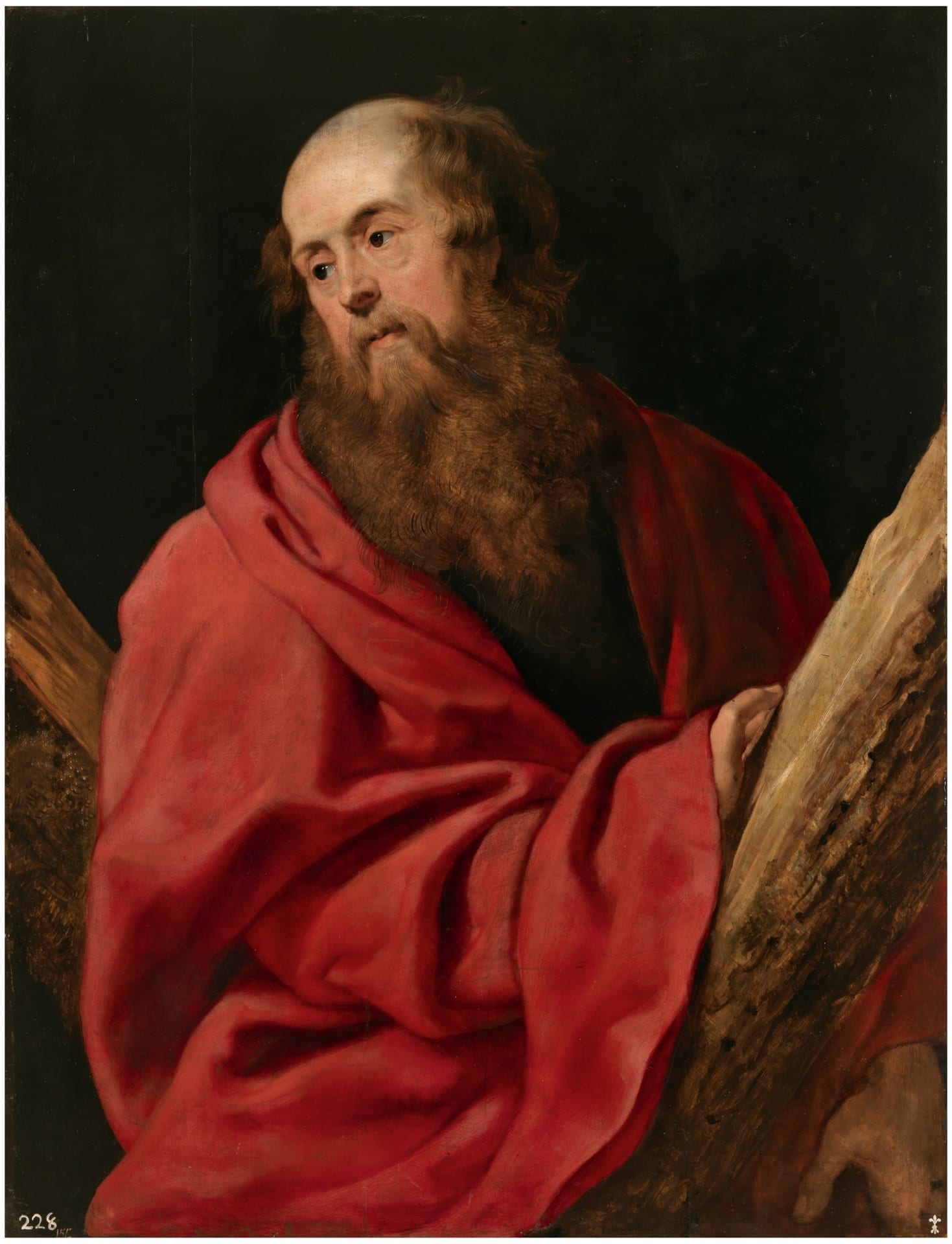
  • St. Andrew with the Saltire Cross

    His invariable attribute: the X-shaped cross (the saltire), often shown immense behind him or held in his hand. Used as the national flag of Scotland and the naval ensign of Russia.

Patronages
ScotlandGreeceRussiaUkraineRomaniaFishermenSingers
Sources & Further Reading