
MIRACULOUS MIRACLES™

Saint — Bartholomew the Apostle

St. Bartholomew the Apostle
early 1st century — 1st century, traditionally Armenia
Nathanael — Apostle of Armenia and India
Basilica of St. Bartholomew on the Island, Rome, Italy
Feast
August 24
✠ MartyrFlayed alive and beheaded by King Astyages of Armenia → The Martyrs
Life

Bartholomew ('son of Tholmai') is named among the Twelve in all three Synoptic lists and Acts. Most modern scholars and ancient commentators (from Augustine onward) identify him with Nathanael of John's Gospel — the man from Cana whom Philip brought to Jesus, and to whom Jesus said: 'Behold, an Israelite indeed, in whom there is no guile!' (John 1:47).

Tradition, attested by Eusebius citing Pantaenus, says he preached the Gospel as far as India, leaving behind a copy of Matthew's Gospel in Hebrew. Other sources direct his mission to Armenia, where he is one of the two co-founding apostles (with Jude) of what is the world's oldest Christian state — Armenia having been the first nation to adopt Christianity, in 301.

His martyrdom is uniformly described as gruesome: he was flayed alive and then beheaded by King Astyages of Armenia. His relics were translated from Armenia to the island of Lipari in 809, to Benevento in 838, and then to Rome in 983, where Otto III built the church of St. Bartholomew on the Tiber Island over them.

Miracles & Phenomena
  • Nathanael under the Fig Tree

    Before Philip brought him to Jesus, Nathanael was sitting under a fig tree. Jesus said, 'Before Philip called you, when you were under the fig tree, I saw you.' Nathanael confessed at once: 'Rabbi, you are the Son of God! You are the King of Israel!' (John 1:48–49).

  • Exorcism of King Polymius's Daughter

    Apocryphal traditions describe Bartholomew exorcising a demon from the daughter of an Indian or Armenian king named Polymius, who then converted. The conversion provoked Polymius's brother Astyages, who ordered the apostle's death.

Relics
  • Body
    Relics of St. Bartholomew
    Basilica of San Bartolomeo all'Isola, Tiber Island, Rome

    Translated from Benevento (where they had been since 838) to Rome in 983 by Otto III. Preserved beneath the main altar in a porphyry urn that was originally a pagan tub. The basilica is now also a memorial to 20th–21st century Christian martyrs.

  • Bodily relic
    Skull of St. Bartholomew
    Cathedral of Frankfurt, Germany

    Brought to Frankfurt in the 14th century. The cathedral is dedicated to him.

Iconography
  • St. Bartholomew Flayed

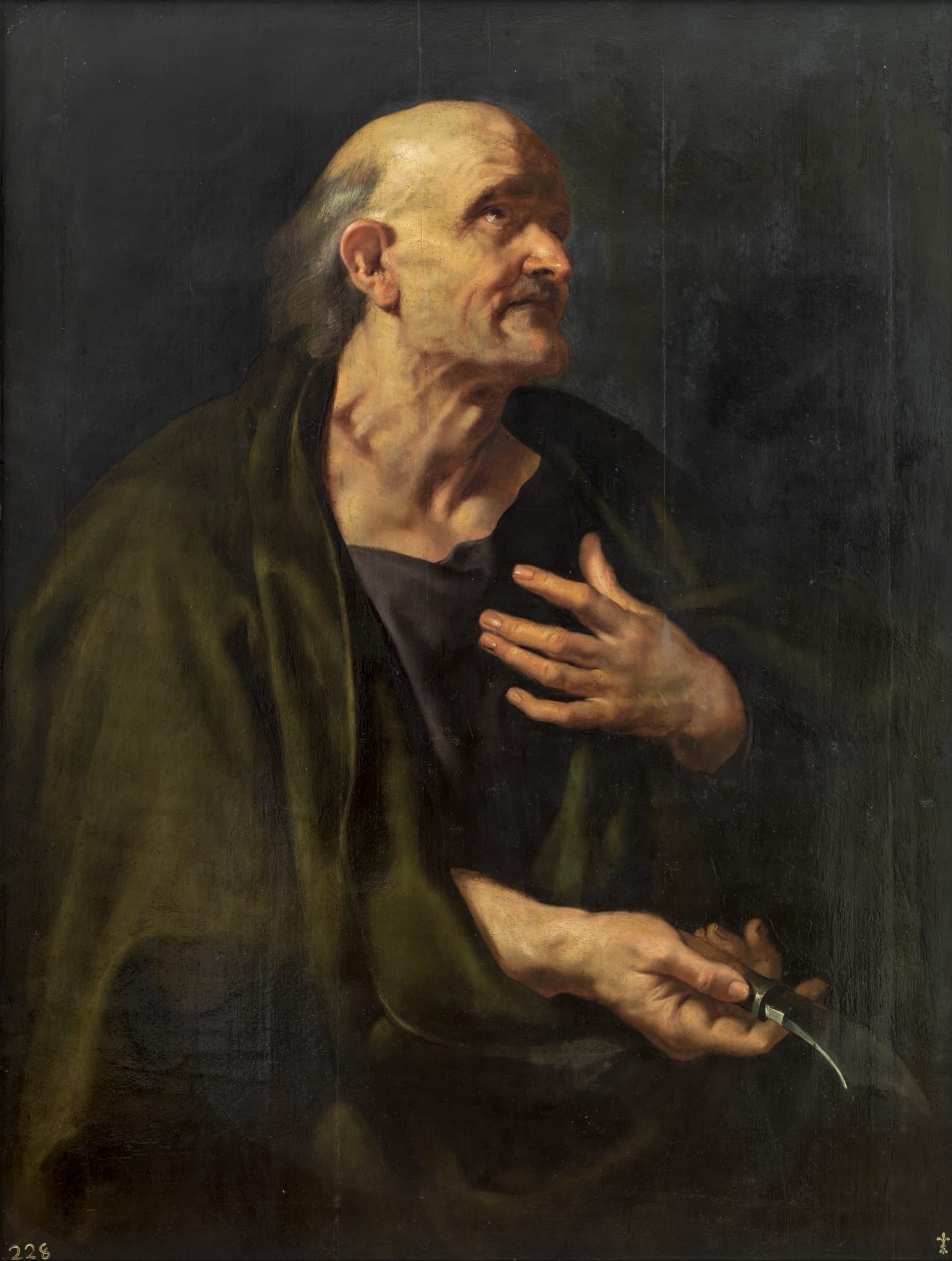
    His invariable attribute — a flaying knife, and often his own flayed skin draped over an arm. Most famously in Michelangelo's Last Judgment in the Sistine Chapel, where the face on the flayed skin is widely interpreted as a self-portrait of Michelangelo.

Patronages
ArmeniaPlasterersTanners and leather workersBookbindersFlorentine salt merchants
Sources & Further Reading