
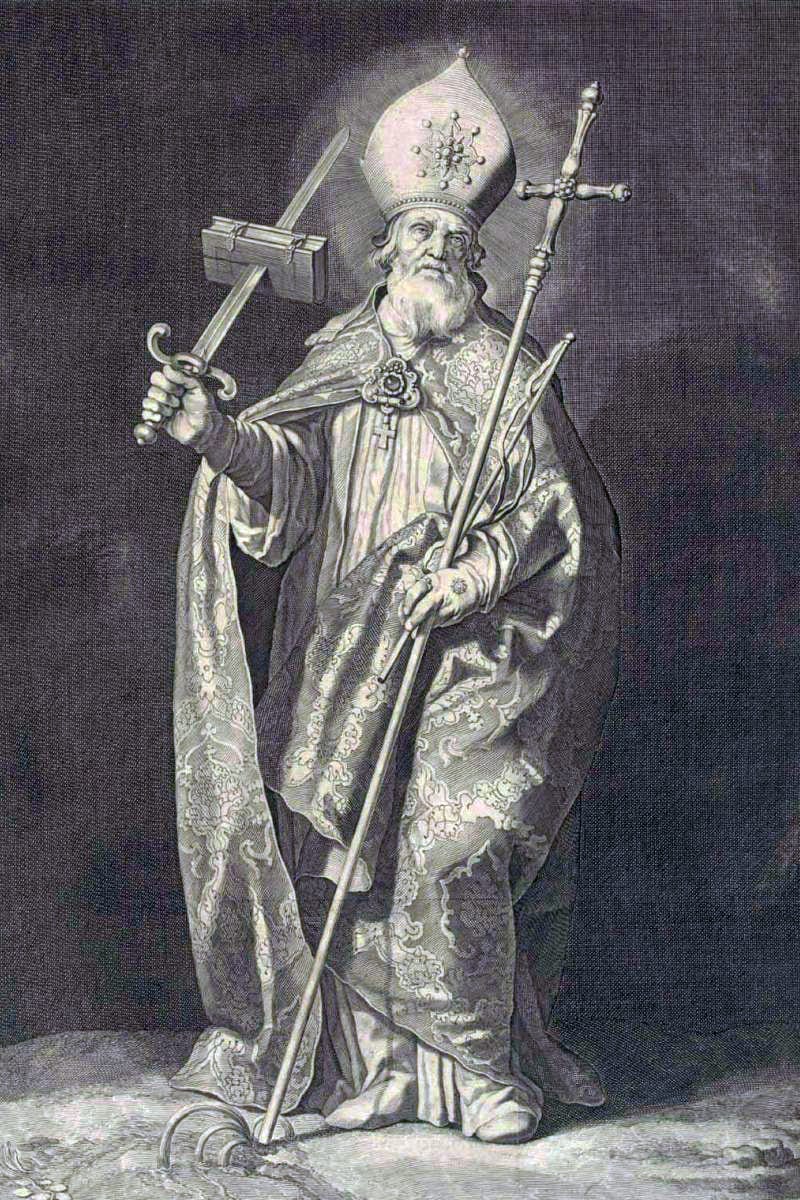
Wynfrith was an Anglo-Saxon Benedictine monk of Exeter and Nursling who in 718 came to Rome and was commissioned by Pope Gregory II to evangelize the still-pagan Germans east of the Rhine. The pope renamed him Boniface ('doer of good'). Working under the protection of Charles Martel and his Carolingian successors, he traveled for nearly forty years through Hesse, Thuringia, Bavaria, and Frisia, founding bishoprics, ordaining clergy, and rooting out paganism.
His most famous act was the felling of the Donar Oak at Geismar around 723. The sacred oak of the Germanic thunder-god Thor stood inviolate; Boniface, in the presence of a crowd of pagans expecting divine vengeance, took an axe and struck the tree. After his first stroke, by Willibald's contemporary account, a great wind came up and the oak fell in four pieces. The pagans, seeing that Thor had not defended his tree, accepted baptism in numbers, and Boniface used the timber to build a chapel to St. Peter on the spot.
He founded the great Abbey of Fulda in 744, under St. Sturm, as the headquarters of his German mission — destined to become one of the principal monasteries and cultural centers of medieval Germany. He brought from England a generation of Anglo-Saxon nuns and monks — Lull, Lioba, Walburga, Willibald, Wynnebald, Tetta, Edburga — to staff the new German monasteries.
At nearly eighty he returned to Frisia for one last mission to the pagans. On Pentecost Tuesday, June 5, 754, at Dokkum, he was killed with fifty-three companions by a pagan war-band — covering his head with the gospel-book that survives, still cut by the sword stroke that killed him, at the treasury of Fulda. He is the principal patron saint of Germany.