
MIRACULOUS MIRACLES™

Saint — Christina of Markyate (Theodora the Recluse)

St. Christina of Markyate (Theodora the Recluse)
c. 1097 AD, Huntingdon, Mercia (Anglo-Saxon noble family) — c. 1155 AD, Markyate Priory, Hertfordshire
English anchorite-prioress; author of the St. Albans Psalter circle
Markyate Priory, Hertfordshire, England — her personal foundation; ruins survive; the St. Albans Psalter (c. 1130, one of the greatest medieval English illuminated manuscripts) produced for her personal devotional use, United Kingdom
Feast
December 5
Canonized
Pre-congregation; venerated as a principal English 12th-century anchorite-prioress saint (the Vita Sanctae Christinae preserves the principal biographical record)
Life

Christina (baptismal name Theodora) was born around 1097 to an Anglo-Saxon noble family of Huntingdon — daughter of Autti and Beatrix, members of the Anglo-Saxon urban noble class of mid-Mercian England.

From early childhood — per the Vita Sanctae Christinae, the principal 12th-century Latin biography preserved in an unique manuscript at the British Library — Theodora-Christina undertook the decision to remain a virgin consecrated to God, rejecting the marriage that her parents had arranged with the young nobleman Burhred of Bedfordshire.

The consequent family crisis extended through her young adult years: her parents repeatedly attempted to force the marriage; the young Burhred attempted to rape her in the nuptial chamber; the corrupt local bishop Ranulf Flambard of Durham also attempted to seduce her. Christina escaped from Huntingdon in male disguise around 1115 — fleeing to the anchorite cell of the hermit Eadwin at Flamstead in Hertfordshire.

After years of hidden anchorite-life under several successive hermit-mentors (Eadwin of Flamstead, then Roger of Markyate), Christina established her own anchorite cell at the forest-hermitage of Markyate in Hertfordshire around 1131. The community that gathered around her cell became the Benedictine women's-priory of Markyate — affiliated with the nearby Abbey of St. Albans (the principal English Benedictine abbey of the period, the head-abbey of the English Benedictine reform).

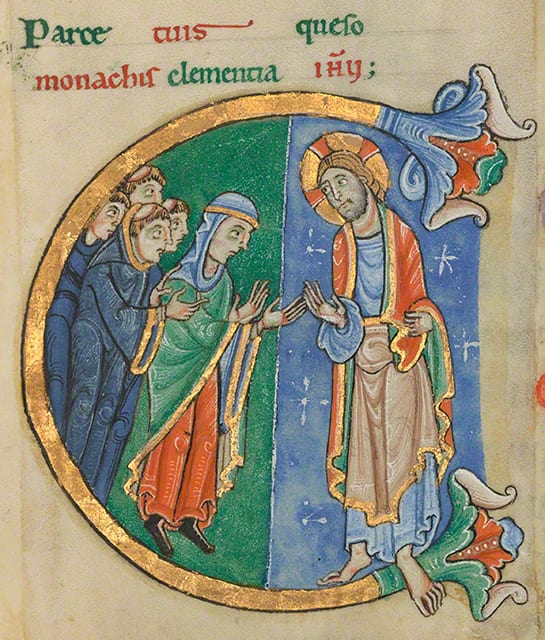
Christina became the personal spiritual confidante of Abbot Geoffrey of Gorham of St. Albans (abbot 1119–1146) — and the deep spiritual friendship between the anchorite-prioress and the Benedictine abbot produced the famous St. Albans Psalter (c. 1130, one of the greatest medieval English illuminated manuscripts), produced at the St. Albans scriptorium for Christina's personal devotional use. The St. Albans Psalter — now preserved at the Cathedral of St. Godehard in Hildesheim, Germany — includes the unique opening illustration portraying the Christina-Geoffrey personal friendship.

Christina died at Markyate around 1155. Her Vita Sanctae Christinae, composed shortly after her death, survives in an unique manuscript at the British Library (London, BL Cotton Tiberius E I) and is one of the principal English 12th-century women's-anchorite hagiographical texts.

Miracles & Phenomena
  • The St. Albans Psalter (c. 1130)

    Christina of Markyate's deep personal spiritual friendship with Abbot Geoffrey of Gorham of St. Albans produced the St. Albans Psalter (c. 1130) — one of the greatest medieval English illuminated manuscripts and the principal personal devotional book of Christina herself. The St. Albans Psalter includes the unique opening illustration portraying the Christina-Geoffrey personal friendship (the principal documented Anglo-Norman period spiritual-friendship between a sitting abbot and a woman anchorite-prioress), and is now preserved at the Cathedral of St. Godehard in Hildesheim, Germany.

  • The defended chastity narrative

    Christina's documented resistance to forced marriage and sexual coercion — preserved in vivid narrative detail in the Vita Sanctae Christinae — is one of the principal medieval English documents of young Catholic women's-defended-chastity tradition. The text documents the family pressure, the episcopal coercion, the male-disguise escape, and the anchorite-hidden-life of the young Christina with distinctive psychological-spiritual realism rare in medieval women's hagiography.

Relics
  • Body
    Tomb of St. Christina of Markyate
    Markyate Priory, Hertfordshire, England — destroyed in the 1539 Reformation dissolution; the St. Albans Psalter (her personal devotional book) survives at the Cathedral of St. Godehard, Hildesheim, Germany

    Her tomb at the Markyate Priory was destroyed in the 1539 Reformation dissolution; fragmentary ruins of the priory survive. The principal surviving 'relic' of her life is the St. Albans Psalter (c. 1130) — her personal devotional book — now preserved at the Cathedral of St. Godehard in Hildesheim, Germany.

Iconography
  • Christina of Markyate with Abbot Geoffrey of St. Albans

    The early-12th-century English anchorite-prioress in Benedictine habit at the scene of the St. Albans Psalter opening illustration: Christina and Abbot Geoffrey of St. Albans united in spiritual conversation, the Psalter between them — the standard medieval English iconography of the distinctive Christina-Geoffrey personal friendship.

Patronages
Catholic English women anchorites and recluses (in continuity with St. Wulfric of Haselbury and the anchorite-tradition of Julian of Norwich, Margery Kempe)Catholic Markyate (Hertfordshire), Huntingdon, and the central English Catholic-medieval traditionCatholic illuminated-manuscript patrons (the St. Albans Psalter circle)