
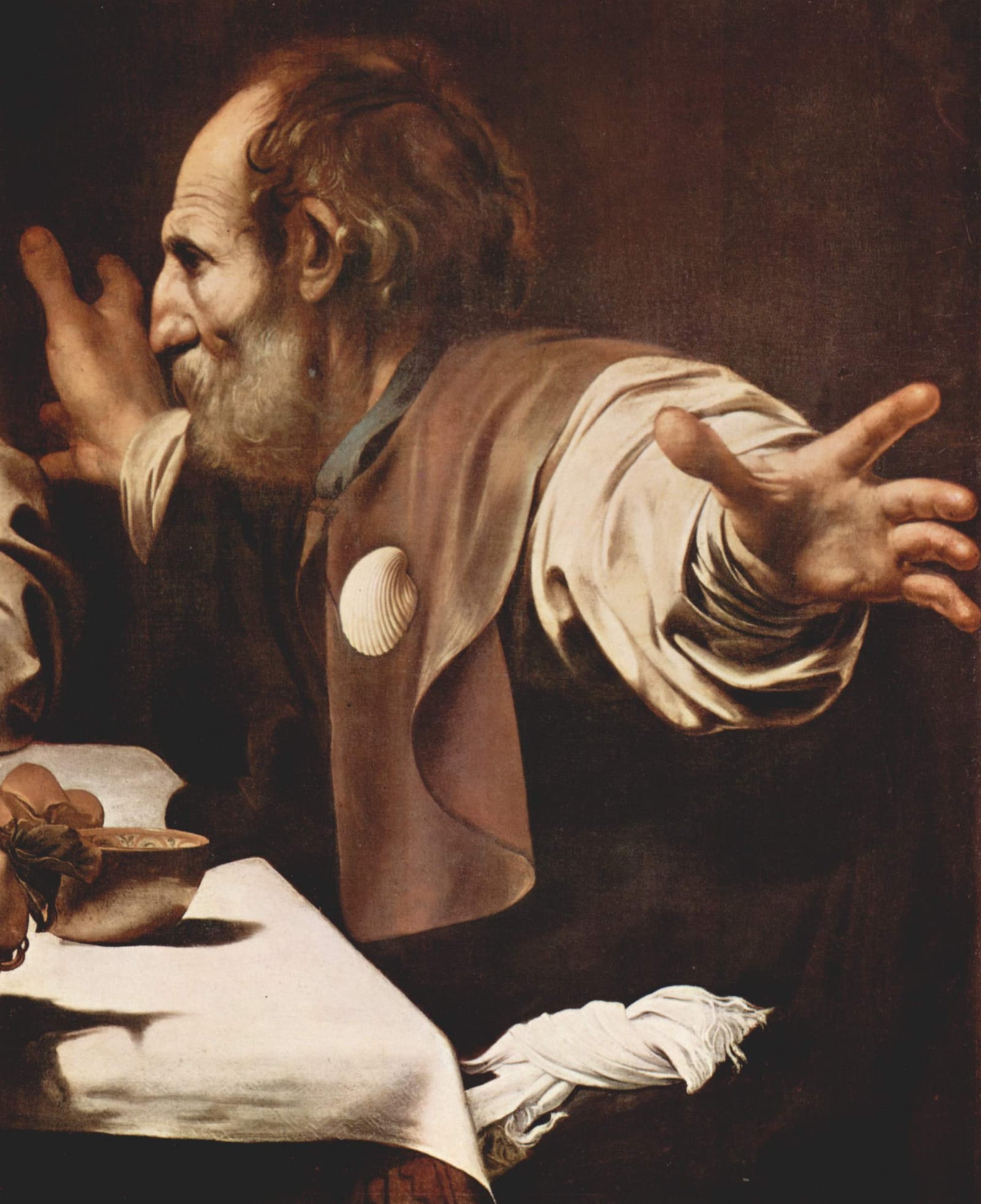
Cleopas (Greek Kleopas) is the named disciple of the two who encountered the risen Christ on the road from Jerusalem to Emmaus on the afternoon of Easter Sunday (Luke 24:13–35). The other disciple is unnamed in Luke; substantial early tradition identifies him with Luke himself (which would explain the first-person detail of the account). Some traditions identify Cleopas with the Cleophas (or Clopas) named in John 19:25 as the husband of one of the Marys at the foot of the Cross (the Mary of Cleophas mentioned below); the question of whether Cleopas and Cleophas are the same Greek name is debated.
On the Emmaus road encounter Christ joined the two disciples as they walked, listened to their account of the events of Good Friday and Easter morning, and 'beginning at Moses and all the prophets, expounded to them in all the Scriptures the things that were concerning him' (Luke 24:27). At the village of Emmaus the two disciples invited the unrecognized traveller to stay for the evening meal. Christ took the bread, blessed and broke it, and gave it to them — at which moment their eyes were opened and they recognized him, and he vanished from their sight. The two disciples returned at once that night to Jerusalem to inform the gathered Eleven, finding the apostles already in possession of the news (the Lukan account of Peter's separate appearance) and announcing their own Emmaus experience.
The episode is foundational for Catholic Eucharistic theology: the recognition 'in the breaking of the bread' (Luke 24:35) became the standard early Christian designation for the celebration of the Eucharist (the 'fractio panis,' the early liturgical name preserved in the Roman Canon and in the early Christian inscriptions of Rome and Greece). Cleopas is venerated as one of the Seventy in the Byzantine tradition.