
MIRACULOUS MIRACLES™

Saint — Bl. Diana d'Andalò

Bl. Diana d'Andalò
c. 1201 AD, Bologna, Papal States (noble Andalò family — Bolognese aristocratic-consular family) — June 10, 1236 AD, Sant'Agnese Monastery, Bologna
foundress of the Dominican Monastery of Sant'Agnese, Bologna; correspondent of Bl. Jordan of Saxony
Basilica of San Domenico, Bologna, Italy — the shrine of St. Dominic himself; near the site of the Sant'Agnese Monastery (destroyed in the 19th century), where Bl. Diana spent her monastic life, Italy
Feast
June 8
Canonized
Beatified 1888 by Pope Leo XIII
Life

Diana was born around 1201 at Bologna to the noble Andalò family — her father a consul of Bologna, the Andalò family among the principal Bolognese aristocratic-consular families of the period.

Around 1219, at the age of 18, Diana first met St. Dominic de Guzmán at Bologna — Dominic then in the course of the founding-mission of the Order of Preachers at Bologna. Captivated by Dominic's personal magnetism and the new-Order's apostolic vision, Diana sought Dominican-affiliated religious life.

In 1222, after Dominic's death (August 6, 1221) and the election of Bl. Jordan of Saxony as second Master of the Order, Diana was received as a Dominican-affiliated woman-religious by Bl. Jordan.

In 1223, Diana founded (with support from Bl. Jordan) the Dominican Monastery of Sant'Agnese at Bologna — one of the earliest Dominican women's-monastic foundations (preceded only by the Dominic-founded Roman convent of San Sisto of 1221). The Sant'Agnese Monastery became one of the principal early Dominican women's-monastic communities.

Diana's personal correspondence with Bl. Jordan of Saxony — fifty surviving Latin letters composed 1222–1236 — is one of the principal medieval Catholic spiritual-friendship correspondences. The letters illustrate the specifically Catholic 13th-century spiritual-friendship between the Master-General of the Dominican Order and the foundress of the first Dominican women's-monastic community, in the parallel of the contemporary Franciscan Francis-and-Clare spiritual friendship.

Diana was joined at Sant'Agnese by Bl. Cecilia Cesarini (former abbess of the Roman San Sisto) and Bl. Amata — the three Bolognese Dominican women's-monastic saints of the early Order.

She died at Sant'Agnese on June 10, 1236.

Miracles & Phenomena
  • The Sant'Agnese Monastery and the Bolognese Dominican women's tradition

    Bl. Diana d'Andalò's founding of the Dominican Monastery of Sant'Agnese at Bologna in 1223 — one of the earliest Dominican women's-monastic foundations — institutionally established the Bolognese Dominican women's tradition. The Bolognese Dominican women's tradition, together with the Roman San Sisto foundation and the Dominican women's-monastic foundations, produced the full Dominican women's-monastic tradition that extends to the present day.

  • The correspondence with Bl. Jordan of Saxony

    Diana's correspondence with Bl. Jordan of Saxony — fifty surviving Latin letters composed 1222–1236 — is one of the principal medieval Catholic spiritual-friendship correspondences, analogous to the contemporary Franciscan Francis-and-Clare spiritual friendship and in institutional parallel with the earlier Bernard-of-Clairvaux-and-William-of-Saint-Thierry and Christina-of-Markyate-and-Geoffrey-of-Saint-Albans spiritual-friendship correspondences.

Relics
  • Body
    Tomb of Bl. Diana d'Andalò
    Sant'Agnese Monastery, Bologna (destroyed in the 19th century Italian-unification-era dissolutions); relics translated to the Basilica of San Domenico, Bologna

    Her principal relics rest at the Basilica of San Domenico at Bologna — the principal Dominican pilgrim destination of the Order (housing the tomb of St. Dominic himself, the famous 1264–1267 marble shrine by Nicola Pisano).

Iconography
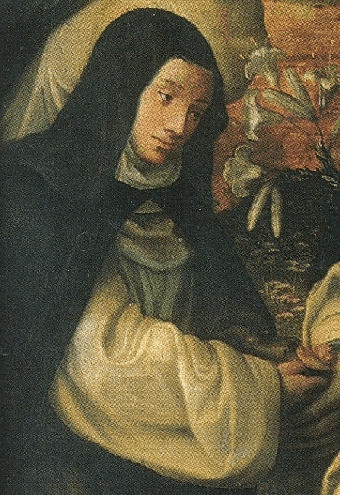
  • Diana d'Andalò receiving the Dominican habit

    The early-13th-century Bolognese noblewoman in Dominican black-and-white habit at the Sant'Agnese Monastery receiving the Dominican habit from Bl. Jordan of Saxony, the Bolognese Dominican women's community gathered around, the Rule of St. Augustine (the Dominican rule-source) visible — the iconography of Catholic Dominican women's-monastic foundation tradition.

Patronages
Order of Preachers (Dominicans) — foundress of the Dominican women's-monastic tradition of BolognaCatholic medieval spiritual-friendship correspondents (her correspondence with Bl. Jordan of Saxony)Bologna (university-city, Papal States) and the Italian Catholic tradition