
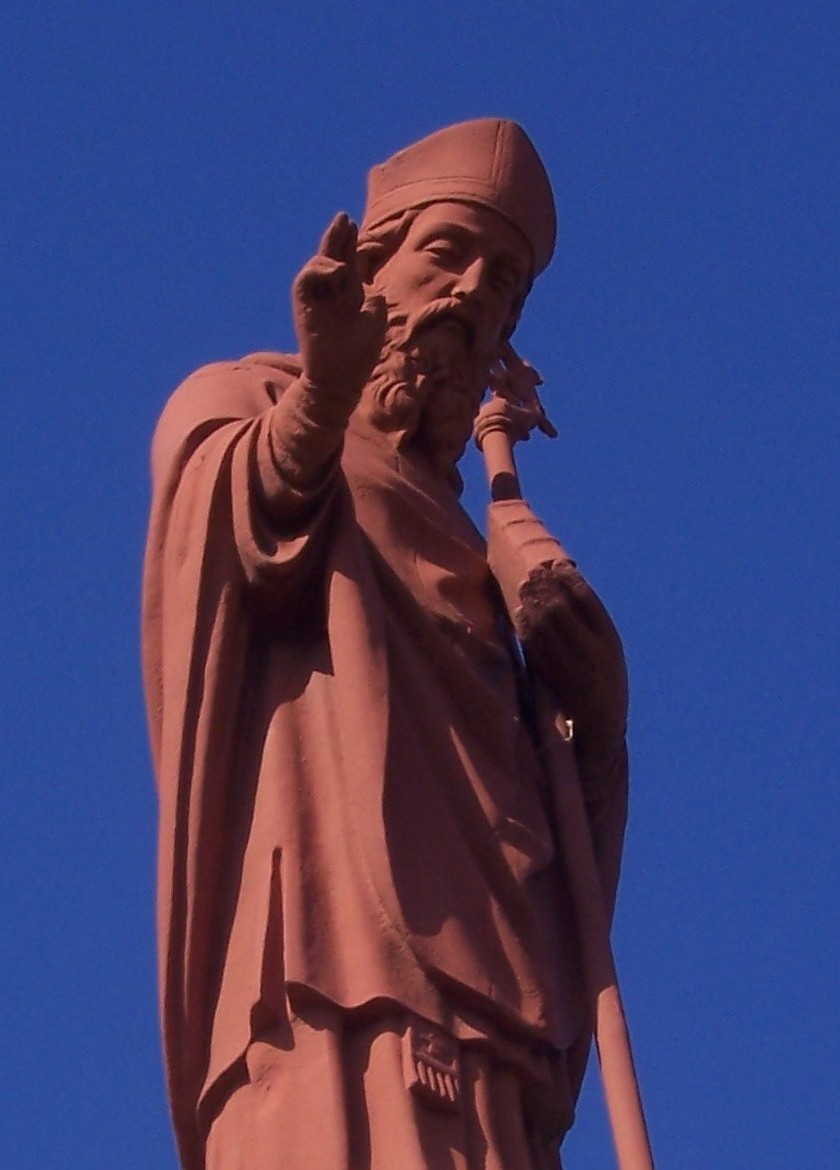
Eucherius (Latin Eucherius) was a Roman senatorial of Gaul in his late twenties or early thirties when, around 410 AD, he and his wife Galla mutually decided to embrace the religious life — a decision unprecedented in their senatorial class. They entrusted their two sons (Salonius and Veranus, both of whom would become bishops) to the monastery of Lérins (see Honoratus of Arles above), and themselves withdrew to a small hermit-life on the island of Lero (modern Île Sainte-Marguerite, the larger of the Lérins Islands).
After several years on Lero, Eucherius's combined scholarly-theological reputation and senatorial standing drew the attention of the Catholic episcopate of Roman Gaul. He was elected Bishop of Lyon around 434 AD — the most senior metropolitan see of southern Gaul outside Arles — and governed the see for some fifteen years until his death around 449.
His historical importance comes from his two foundational literary works: the Formulae Spiritalis Intelligentiae ('Formulas of Spiritual Understanding') — a systematic dictionary of Latin biblical allegorical interpretations, which became the foundational Latin handbook of medieval biblical allegoresis and was a principal source for the medieval-monastic four-fold sense of Scripture tradition; and his Passio Acaunensium Martyrum ('Passion of the Martyrs of Agaunum') — the foundational hagiographical text on St. Maurice and the Theban Legion (see Maurice's entry in the 3rd-c. catalogue), composed around 440 AD on the basis of the local Provençal-Burgundian living tradition of the cult.
Eucherius's Passion of the Theban Legion is the foundational source for the entire medieval Western European cult of Maurice and the Theban Legion — including the foundational Holy Lance of Maurice tradition that was used at every Holy Roman Emperor's coronation from Otto I in 962 to the dissolution of the Holy Roman Empire in 1806.