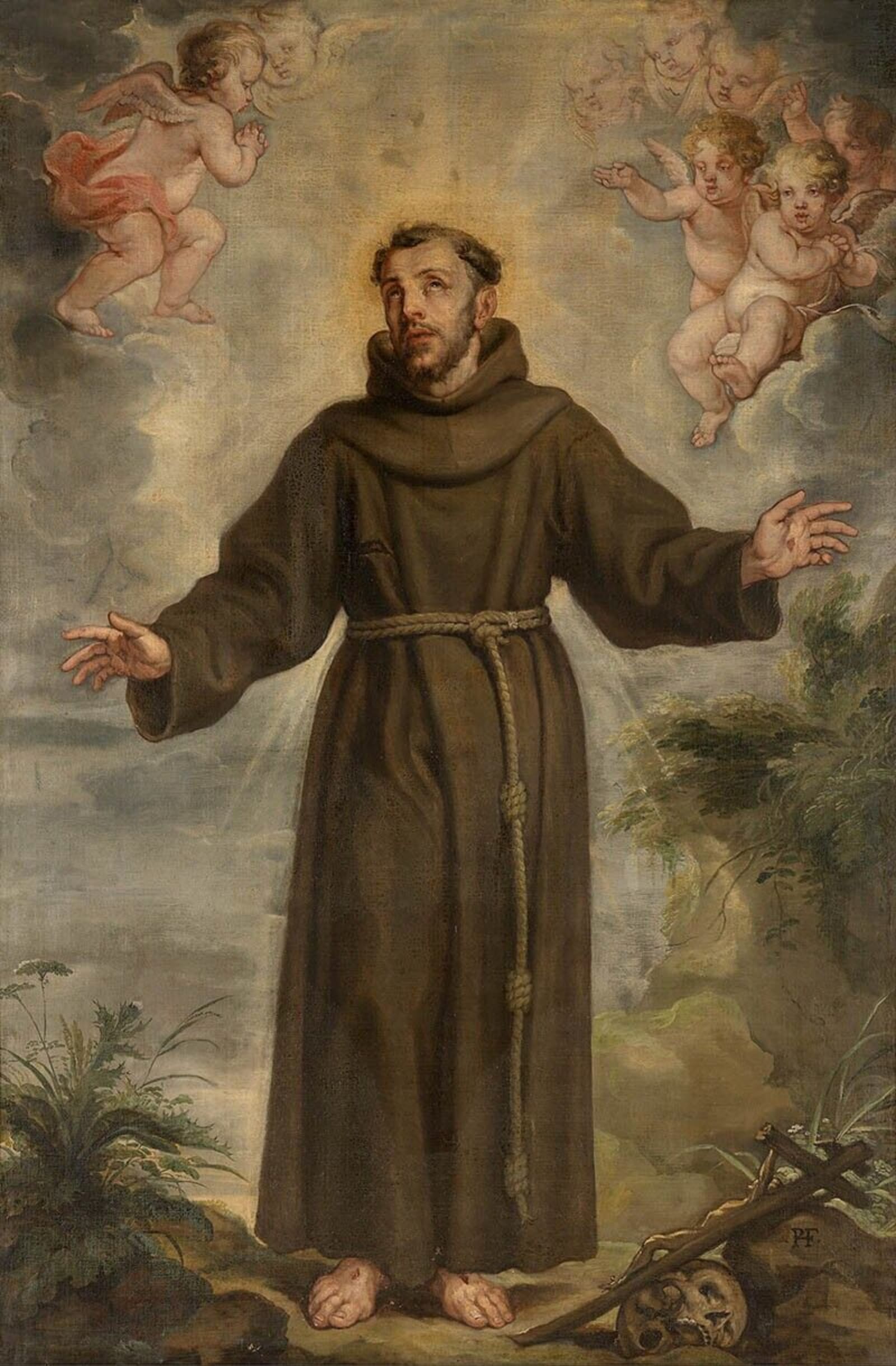
Francesco di Pietro di Bernardone was born in Assisi to a wealthy cloth merchant, baptised Giovanni but soon nicknamed Francesco. A worldly youth followed: he led the songs of Assisi's young revellers, fought in the war with Perugia, was taken prisoner, and during his year of captivity fell ill. The illness, and a series of disturbing dreams that followed, began the slow undoing of his old life.
Around 1205, while praying before a crucifix in the half-ruined church of San Damiano, he heard Christ say: 'Francis, go and repair my house, which, as you see, is falling into ruin.' He took the words literally at first, selling cloth from his father's shop to buy stones. A public confrontation with his father followed; before the bishop in the public square, Francis stripped himself of his clothes and returned everything he had received from his family.
From that day he embraced 'Lady Poverty,' founded the Franciscan order (approved by Innocent III in 1209), helped St. Clare establish the Poor Clares, and travelled to Egypt during the Fifth Crusade to preach before the Sultan al-Kamil. He composed the Canticle of the Sun, created the first live Nativity scene at Greccio (1223), and received the wounds of Christ on Mount La Verna in 1224 — the first recorded stigmata in Church history. He died at the Porziuncola in 1226, asking to be laid naked on the bare earth so that he might die in the embrace of his Lady Poverty.
The Stigmata of La Verna
September 14, 1224In September 1224, while in 40-day fast before the Feast of the Holy Cross, Francis saw a six-winged seraph crucified and received the visible wounds of Christ — hands, feet, and side. He bore them for the remaining two years of his life. The first recorded stigmata in the history of the Church.
→ Full miracle pageThe Wolf of Gubbio
A great wolf had been terrorising the town of Gubbio. Francis went out to meet it, made the sign of the cross, and addressed the wolf as 'Brother Wolf.' The wolf bowed, laid its paw in his hand, and accepted a covenant of peace — the townspeople would feed it, and it would harm no one. An 1872 renovation of a Gubbio church uncovered the skeleton of an unusually large wolf beneath its wall.
Preaching to the Birds at Bevagna
Outside the town of Bevagna, Francis was struck by the number of birds in the fields. He stepped among them and preached: 'My little sisters, the birds, much bounden are ye unto God, your Creator.' The birds, his early biographers tell us, neither moved nor flew until he finished and blessed them.
The Crib of Greccio (1223)
At Christmas 1223, Francis arranged a live Nativity scene in a cave near Greccio with an ox, an ass, and a manger filled with hay. A nobleman present, John of Velita, testified that he saw a sleeping child appear in the manger; Francis approached and seemed to awaken him with his embrace. The origin of the Christmas crèche.
Sources & Further Reading