
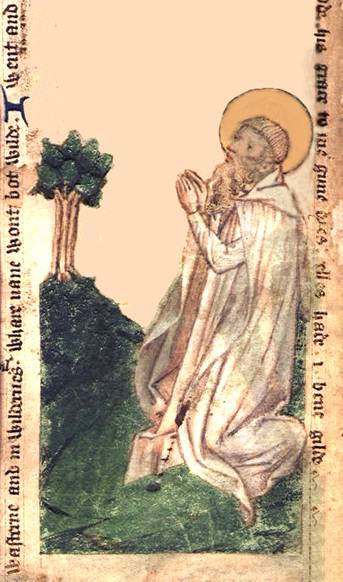
Godric was a Norfolk peasant who in his youth became a peddler, then a merchant sailor and shipmaster — sailing as far as Jerusalem, Compostela, and possibly Iceland, and (some sources say) commanding the ship that carried the future King Baldwin I to the Holy Land in 1099. After two decades at sea, on a return pilgrimage to Compostela he received the call to penance and abandoned commerce for the eremitical life.
He settled around 1110 at Finchale on the river Wear in County Durham, in a deep wooded gorge, where he lived for sixty years as a solitary on terms of obedience to the prior of Durham. He kept a cow, fasted ferociously, wrestled (his hagiographer Reginald of Durham insists) with demons in animal form, and was visited by half the great religious figures of twelfth-century England including Aelred of Rievaulx, Bishop William of Durham, and the boy King David I of Scotland.
He is also the earliest English vernacular lyric poet whose work survives: four short hymns to the Virgin and to St. Nicholas, taught to him (he said) in visions and notated with melodies — the oldest known English songs with their music intact, predating any other surviving Middle English lyric by over a century. He died at his cell in 1170, his cult was approved locally, and the priory of Finchale was founded over his hermitage by the Durham monks who had befriended him.