
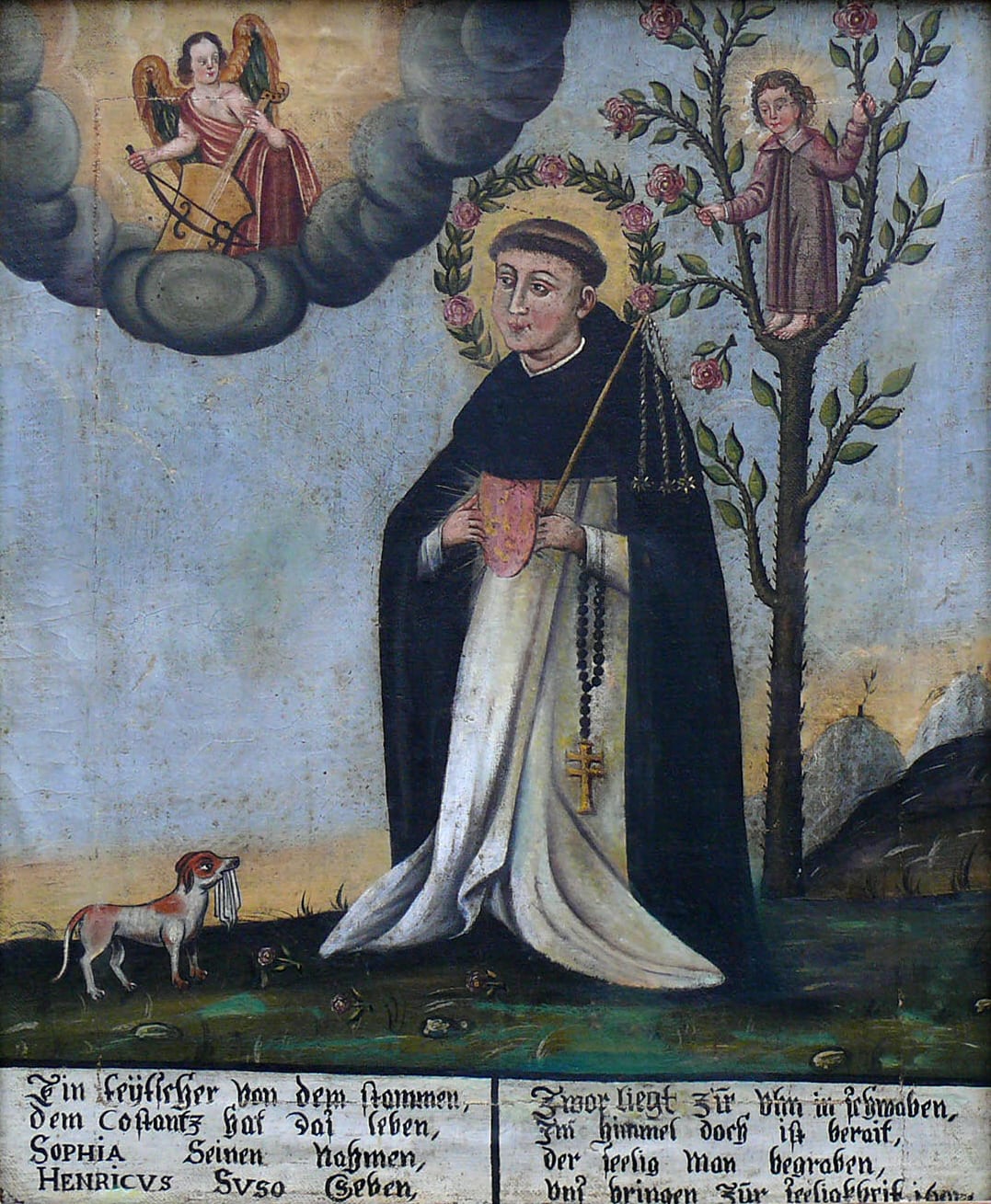
Heinrich Seuse — Latinized as Henricus Suso — entered the Konstanz Dominican convent at thirteen and was sent to Cologne to study under Meister Eckhart in the 1320s. Eckhart's death in 1328 and the posthumous condemnation of some of his propositions (1329) placed Suso in a delicate position: he wrote the Little Book of Truth (Büchlein der Wahrheit) to defend Eckhart's underlying intentions while reformulating the most contested propositions in safer language.
His Little Book of Eternal Wisdom (Büchlein der ewigen Weisheit, c. 1328) became the single most widely read German devotional book of the late medieval centuries — a dialogue between the 'Servant' (Suso himself) and Eternal Wisdom (a feminine figure, identified with the eternal Word of John 1) on the imitation of the Passion of Christ. Translated into Latin as the Horologium Sapientiae and circulated in hundreds of manuscripts, it was a key bridge between Rhineland mysticism and the later Devotio Moderna of the Low Countries.
He was prior at Konstanz, then preached widely in southern Germany and the Bodensee as a 'father of nuns' to the Dominican women's houses of the region (especially Töss, where his great correspondent Elsbeth Stagel kept the records that became part of his Life). Suspected, harassed, and twice transferred under suspicion of unorthodoxy, he eventually settled at Ulm where he died in January 1366. Gregory XVI beatified him in 1831.