
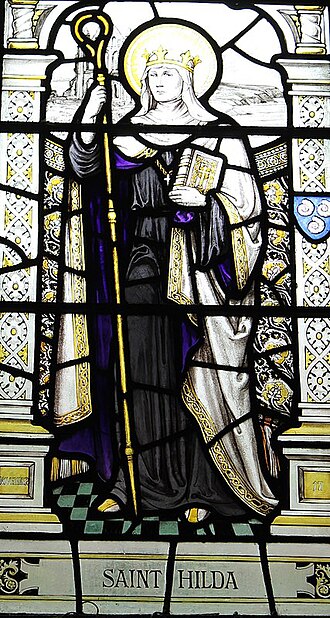
Hilda was the daughter of a king of Deira, baptized as a child of thirteen by Paulinus at York with the rest of King Edwin's household. After his death and the temporary restoration of paganism she lived in obscurity for some twenty years, considering withdrawing to a monastery in Gaul.
St. Aidan of Lindisfarne urged her to remain in England. She accepted a small monastery in Northumbria, was named abbess of Hartlepool (649), and around 657 founded the great double monastery of Streonshalh — which after the Norman Conquest came to be called Whitby — on the high cliffs above the North Sea.
Whitby became under her thirty-year governance the principal monastic center of English Christianity. Six bishops were trained there. The poet Cædmon, a humble lay brother whose gift for sacred song appeared by miracle one night in the cattle barn, became the first known English Christian poet under her formation.
In 664 she hosted the Synod of Whitby — the council at which the English Church accepted the Roman computation of Easter over the Irish one, decisively aligning English Christianity with continental Rome rather than with Ireland and Iona. Hilda herself supported the Irish position but accepted the council's decision in unity. She died at Whitby in 680 after a long illness.