
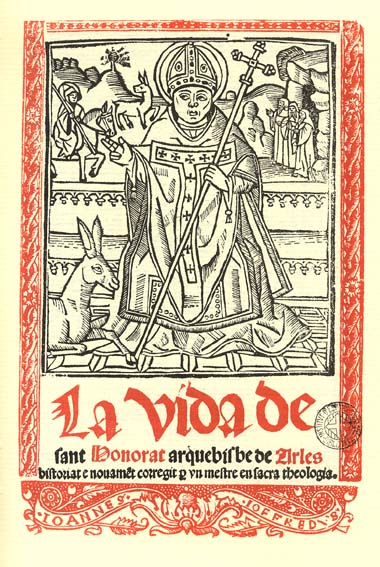
Honoratus (Latin Honoratus) was the son of a high-ranking Roman senatorial family of Gaul — probably of the imperial-administrative tradition of Roman Trier (the great northern imperial capital). He was raised pagan; his Christian conversion as a young adult was bitterly opposed by his pagan father. With his elder brother Venantius he undertook in the late 380s a long Eastern Mediterranean ascetic-monastic pilgrimage to learn directly the desert-monastic traditions of Egypt and Syria.
After his brother's death during the eastern journey, Honoratus returned to Provence around 400 AD and — with a small group of companions — established a hermit-cell community on the small uninhabited island of Lerina (modern Île Saint-Honorat, the second-largest of the small Lérins Islands group off the Côte d'Azur near Cannes). The community he founded around 410 became the Monastery of Lérins, the foundational Catholic monastic community of southern Gaul and the principal Western-Latin monastic foundation of the entire 5th century.
Across the 5th and 6th centuries the Monastery of Lérins produced a substantial portion of the bishops of southern Gaul (Hilary of Arles, Caesarius of Arles, Faustus of Riez, Eucherius of Lyon, Lupus of Troyes, Salvian of Marseille, Vincent of Lérins, and many others — see the Lérins-connected entries above and below). The Lérins tradition is one of the foundational continuous Catholic monastic foundations of the entire patristic-to-medieval transition.
Honoratus was elected Bishop of Arles in 426 — the most senior metropolitan see of southern Gaul — but governed for only three years. He died at Arles on January 16, 429. His former pupil and cousin Hilary of Arles (see Hilary's entry below) composed his foundational biography, the Sermo de Vita Sancti Honorati of c. 430 — one of the most extensive 5th-century Latin saint's lives and a foundational document of Provençal Catholic identity.