
MIRACULOUS MIRACLES™

Saint — Jerome

St. Jerome
c. AD 342 — September 30, 420
Translator of the Vulgate — Doctor of the Church
Basilica of the Nativity, Bethlehem, West Bank
Feast
September 30
Doctor of the Church
Yes
Life

Sophronius Eusebius Hieronymus was born in Stridon, on the border of Pannonia and Dalmatia. Educated in Rome under the famous grammarian Donatus, he travelled widely, was baptised at about age twenty, and after a sojourn in the desert of Chalcis (where he learned Hebrew from a converted Jew) was ordained at Antioch.

Brought to Rome by Pope Damasus, he served as secretary and was entrusted with the great work of his life: producing a single authoritative Latin translation of the Bible from the original Hebrew and Greek. After Damasus's death he settled with a group of Roman noblewomen disciples (including St. Paula and her daughter Eustochium) at Bethlehem, where he lived in a cave next to the Grotto of the Nativity for the rest of his life — over thirty years of relentless labour.

The Vulgate — his translation of the Old Testament from Hebrew (the first major Latin translation directly from the Hebrew, not the Septuagint) and his revision of the Latin New Testament — became, after slow acceptance, the Bible of the Western Church for over a thousand years. It was declared the official Latin Bible by the Council of Trent in 1546. He also wrote vast commentaries on the prophets and Gospels, fierce polemics against heretics, and the foundational Latin work on celibate life — and he was famously irascible, scolding bishops and friends alike.

Miracles & Phenomena
  • The Vulgate

    c. AD 382–405

    His translation of the Bible into Latin — undertaken over a quarter-century at Bethlehem, drawing on Hebrew sources never before used in the West — is the central labour of his life. The Vulgate has shaped Latin Christianity, the liturgy, the imagery of Western art, and the development of the European vernaculars more than any other single literary act.

  • The Lion of Jerome (legend)

    A medieval legend (probably borrowed from the story of Androcles) tells of a great lion that came limping into Jerome's monastery in Bethlehem. The monks fled; Jerome calmly removed a thorn from the lion's paw, and the grateful lion lived ever after as the monastery's guardian. The tale is the source of his lion attribute.

Relics
  • Body
    Tomb of St. Jerome
    Crypt of the Basilica of Santa Maria Maggiore, Rome

    Buried at Bethlehem, his bones were translated to Rome and laid in Santa Maria Maggiore — the great Marian basilica that, traditionally, also houses fragments of the wood of the manger of Bethlehem.

Iconography
  • St. Jerome in the Wilderness with the Lion

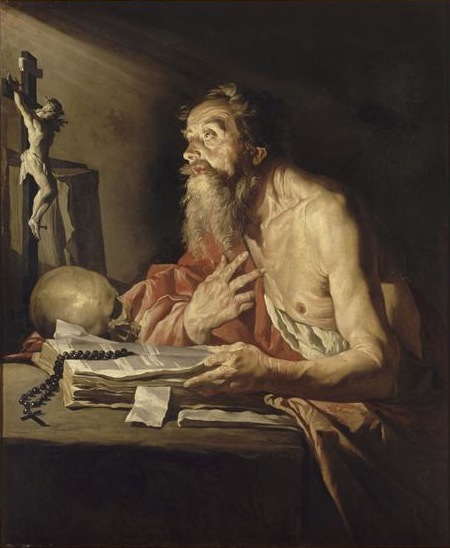
    His invariable attributes — the lion at his feet (the legend), the cardinal's red hat (an anachronism — he was secretary to a pope and shown as a 'cardinal' in medieval art), the skull and crucifix (penitential), and his Vulgate Bible open before him.

  • St. Jerome in His Study
    Albrecht Dürer (engraving 1514, painting 1521); Caravaggio; many others

    An immensely popular type — Jerome at his desk surrounded by books, writing his translation, the lion sleeping at his feet. Albrecht Dürer's 1521 engraving is the most famous version.

Patronages
TranslatorsLibrariansScripture scholarsArchaeologistsEncyclopedists
Sources & Further Reading