
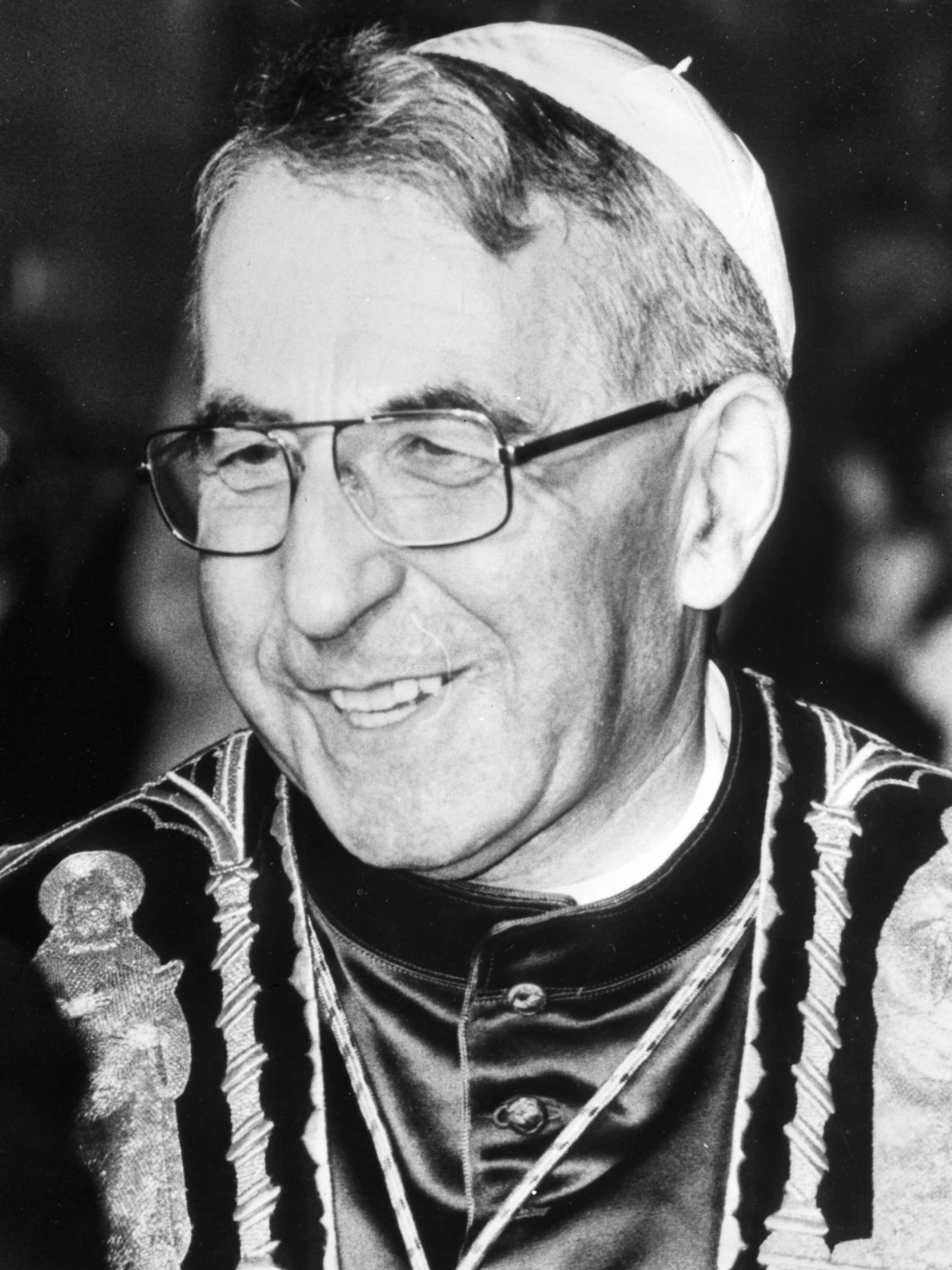
Albino Luciani was born to a Veneto peasant-class family — his father a migrant glassblower of socialist convictions, his mother a deeply devout Catholic. From his earliest years his exceptional intellectual gifts marked him for the priesthood despite the family's poverty. Ordained in 1935, he served as parish priest, seminary professor and vice-rector, then bishop of Vittorio Veneto (1958), then Patriarch of Venice (1969), then Cardinal (1973).
He was a tender pastoral writer — his Illustrissimi, fictional letters to literary and historical figures (Pinocchio, Mark Twain, G. K. Chesterton, Goethe), is a Catholic classic — and combined warmth with doctrinal firmness. At the 1978 conclave following the death of Paul VI, he was elected pope on the fourth ballot of the first day. He took both names — the only pope to do so in two thousand years — combining John XXIII (Vatican II) and Paul VI (its execution) in his choice.
He refused the papal coronation and the traditional sedia gestatoria, replacing the coronation with a simpler inauguration Mass. He spoke informally at audiences, often holding up dialogues with imagined children, surprising the Curia and delighting the world. In thirty-three days as pope he became — through television — beloved by Catholics and non-Catholics worldwide.
He died unexpectedly during the night of September 28–29, 1978, of acute myocardial infarction (his official cause of death). His body was found in his bed at dawn by his personal secretary. He had been pope for thirty-three days. The brevity, the suddenness, and the absence of an autopsy generated decades of conspiracy speculation, all of which subsequent investigations have not substantiated. Beatified by Pope Francis on September 4, 2022.