
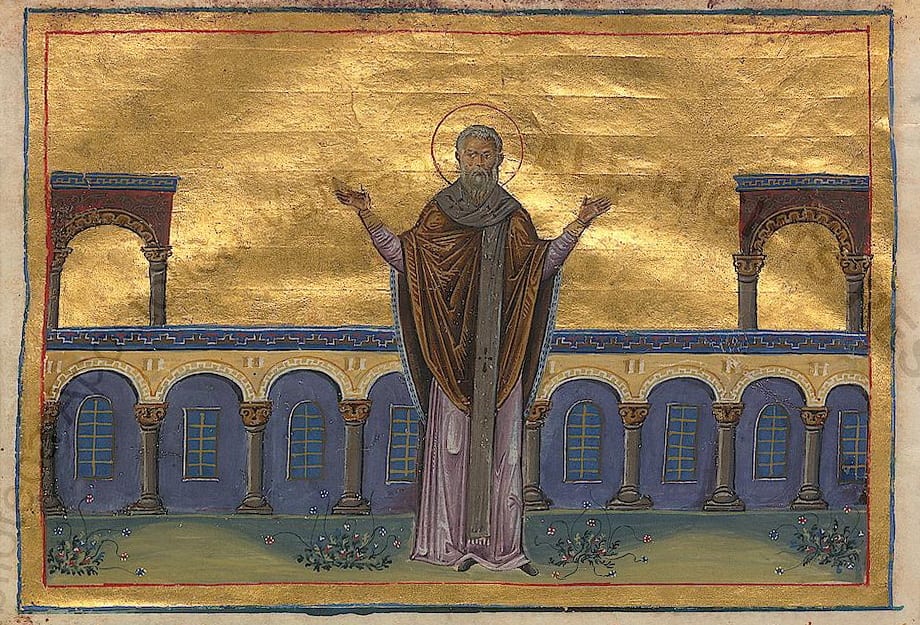
John (Greek Iōannēs; the epithet Nēsteutēs, 'the Faster,' was his standard title because of the extreme dietary asceticism he maintained throughout his ecclesiastical career) was a Constantinopolitan metal-worker who entered the religious life in his middle years and rose through the Constantinopolitan ecclesiastical hierarchy through his substantial reputation for personal asceticism. He was elected Patriarch of Constantinople in April 582, succeeding Eutychius, and governed the see for 13 years until his death on September 2, 595.
He is venerated in the Byzantine tradition as the foundational compiler of the standard Byzantine-Eastern penitential — the systematic Eastern Christian handbook of post-Confession penitential disciplines, which became the foundational text of the entire Eastern Christian sacramental-penitential tradition and is in continuous use to this day in the Eastern Orthodox and Byzantine-Catholic Churches.
His foundational controversy with the Roman papacy was over his use of the title Oecumenicus Patriarcha ('Ecumenical Patriarch') — a Greek title that had been used informally for the Patriarch of Constantinople since the 5th century but which John IV substantially formalized in 587 by adopting it as his official title in formal ecclesiastical documents. Pope Pelagius II (see Pelagius II's entry above) and his successor Pope Gregory I the Great (see Gregory's entry already in the catalogue) both objected vigorously: Gregory I argued that the title — interpreted in its most natural Latin sense — implicitly claimed universal-Catholic-ecclesiastical jurisdiction in a way that was incompatible with the Roman papal primacy. The Constantinopolitan response was that the Greek term oecumenicus meant only 'imperial' (i.e., applying to the Eastern Roman Empire) rather than 'universal,' and that no Roman primacy challenge was intended. The dispute over the title — substantial in itself — was an early symptom of the much larger long-term divergence between the Roman Catholic and Constantinopolitan-Byzantine ecclesiastical traditions that would eventually produce the Great Schism of 1054.
Despite the controversy, John IV the Faster has been continuously venerated as a saint in both the Byzantine and the Roman traditions. His personal asceticism was extreme (he is said to have died, like many extreme ascetics, of starvation-related complications of his own perpetual fasting), and his foundational penitential-tradition compilation has been the foundational document of Eastern sacramental-penitential practice for the past 1,430 years.