
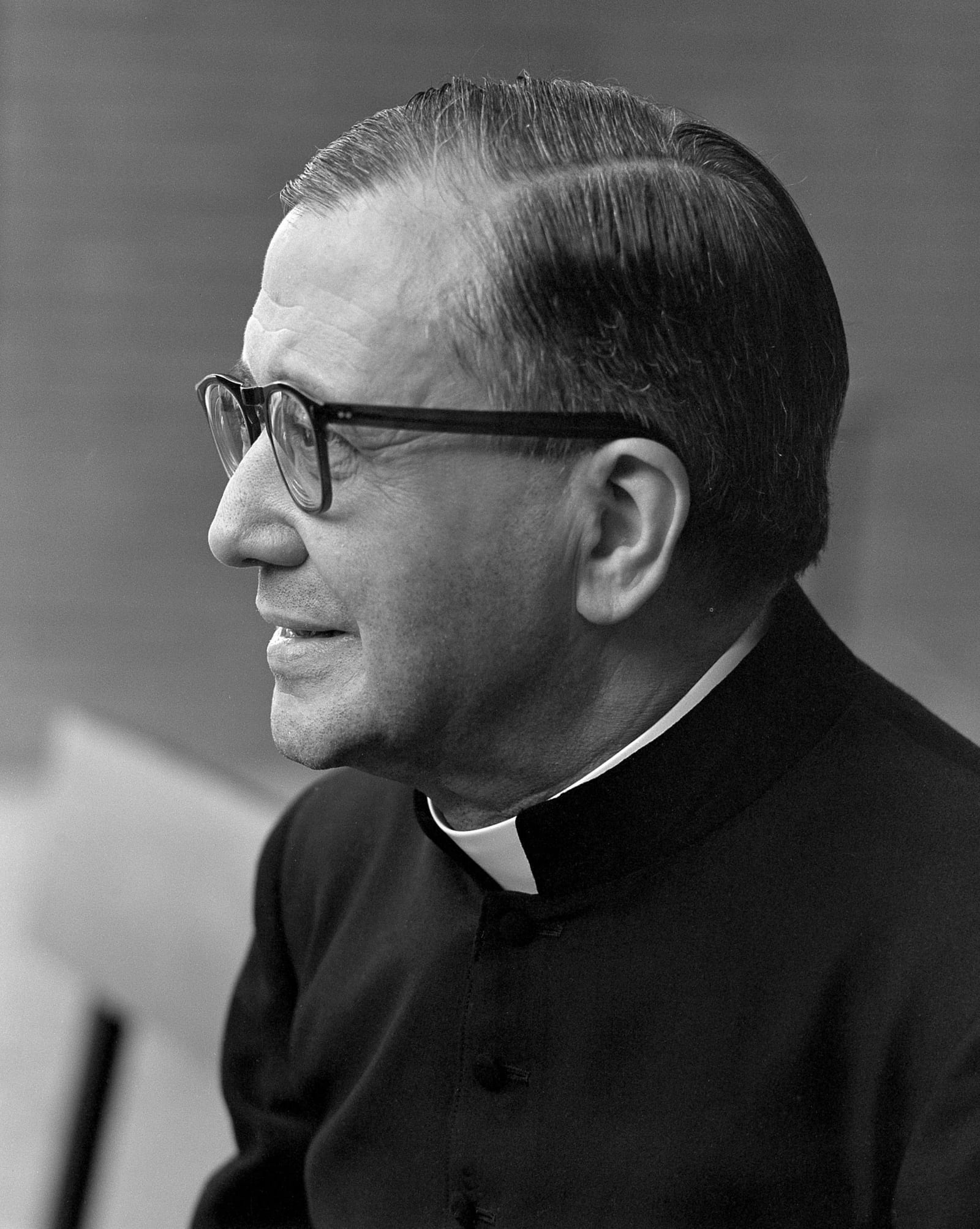
José María Escrivá y Albás was born to a small Aragonese textile-merchant family at Barbastro and ordained priest at Zaragoza in 1925 at twenty-three. He moved to Madrid in 1927 to pursue doctoral studies in canon law and theology, where he served as chaplain at the Foundation for the Sick at the Patronato de Enfermos in the Madrid working-class district of Cuatro Caminos.
On October 2, 1928 — the feast of the Guardian Angels — Escrivá, then twenty-six, received during a retreat at the Vincentian House in Madrid the interior inspiration he later called the foundational vision of Opus Dei: that ordinary Catholic laypeople in their ordinary professional secular work could be called to seek personal sanctity precisely through their ordinary work, and that a specifically lay-focused Catholic institution should be founded to facilitate this universal call to holiness. The Opus Dei (Latin: 'the work of God') was constituted at Madrid in 1928, formally approved by Bishop Eijo y Garay of Madrid in 1941, and given pontifical approval by Pius XII in 1947 as the first Catholic 'secular institute' under Pius XII's 1947 constitution Provida Mater (which formalized the new juridical category).
After surviving with extraordinary difficulty through the Spanish Civil War (1936–39 — when about a third of his early Madrid Opus Dei members were killed and Escrivá himself was forced to make a clandestine escape across the Pyrenees in 1937), Escrivá moved to Rome in 1946 to be near the Holy See. He governed Opus Dei from its Roman generalate at Villa Tevere until his death in 1975. The Opus Dei was made the first 'personal prelature' under the 1983 Code of Canon Law by John Paul II in 1982 — a new juridical category created specifically for it.
His best-known devotional book The Way (Camino, 1939) — 999 short paragraphs of spiritual counsels — has been translated into over 40 languages with over 5 million copies in circulation. His foundational message of the universal call to holiness through ordinary work and ordinary state of life was substantially incorporated into the Second Vatican Council's Lumen Gentium (1964) — a fact subsequently emphasized by John Paul II in the canonization Mass. He died of cardiac failure at the Villa Tevere on June 26, 1975 at seventy-three. Canonized 2002 by John Paul II in one of the largest open-air canonization Masses ever held at St. Peter's Square (an estimated 300,000 attended).