
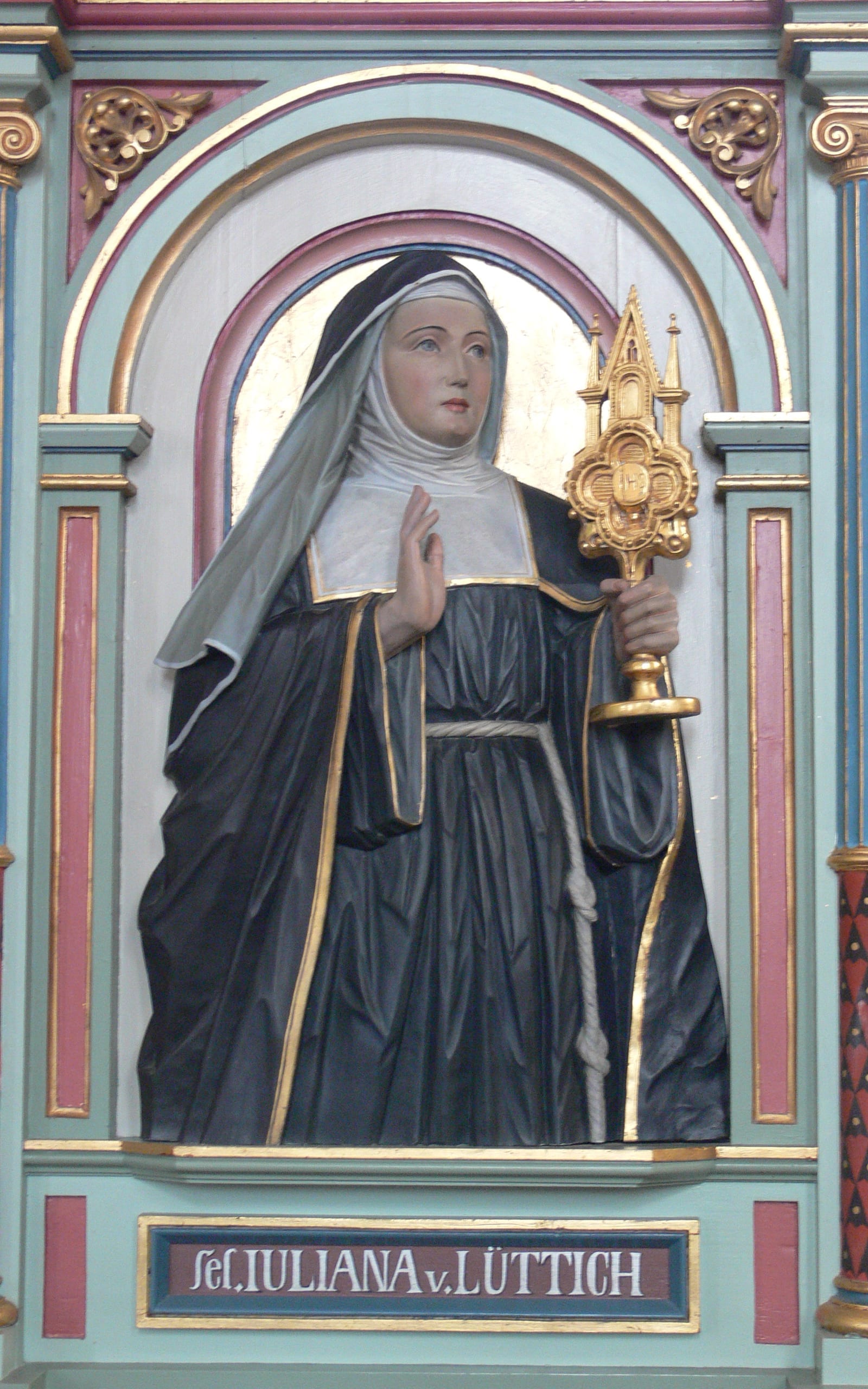
Juliana was orphaned at five and educated at the Augustinian convent of Mont-Cornillon outside Liège, where her older sister Agnes was a nun. She entered the same community at thirteen and took vows shortly after. From the age of sixteen she began to receive a recurring vision: a full moon with a single dark stripe across it. Christ eventually explained to her in further visions that the moon was the Church, and the dark stripe was the absence in the liturgical calendar of a feast specifically honouring the Holy Eucharist.
For twenty years she said nothing, only studied. Then she presented the matter to her confessor Canon John of Lausanne, to the Dominican Hugh of St-Cher (future cardinal), and to the archdeacon of Liège — a Frenchman named Jacques Pantaléon. The bishop of Liège, Robert of Thourotte, instituted the feast for his diocese in 1246, celebrating the first Corpus Christi on the Thursday after Trinity Sunday.
Juliana suffered the rest of her life from the opposition of Mont-Cornillon's lay administrators; she was driven out of her convent, and lived her final years in poverty at the Cistercian abbey of Salzinnes and then at Fosses-la-Ville, where she died in 1258. Her work was completed posthumously: her old advocate Jacques Pantaléon became Pope Urban IV, and in 1264 he extended the feast of Corpus Christi to the whole Latin Church with the bull Transiturus, commissioning the Mass and Office from Thomas Aquinas (Pange Lingua, Tantum Ergo, Adoro Te Devote, Sacris Solemniis, Lauda Sion). The entire Eucharistic liturgical apparatus of the medieval Latin Church flows from her vision.