
MIRACULOUS MIRACLES™

Saint — Ladislaus I of Hungary

St. Ladislaus I of Hungary
June 27, 1040, Kraków, Poland (in exile) — July 29, 1095, Nyitra (modern Nitra, Slovakia)
László — the chivalrous king
Cathedral Basilica of Győr, Hungary
Feast
June 27
Canonized
1192 (by Pope Celestine III)
Life

Ladislaus was born in exile in Poland to King Béla I of Hungary, a member of the Árpád dynasty. Returning to Hungary as a young man, he proved himself an unusually able military commander; after the death of his brother Géza I, he was elected king in 1077 over the protests of the dispossessed claimant Solomon.

His seventeen-year reign reorganised Hungary after the disasters of the previous decade: codifying the kingdom's law, defending its borders against the Pechenegs, Cumans, and Bohemians, conquering Croatia and Dalmatia, founding the diocese of Zagreb, and reasserting the religious settlement of his sainted predecessor Stephen. He sided with Pope Gregory VII in the Investiture Controversy against Henry IV.

He died at Nyitra in 1095 while preparing for the First Crusade, which he had been invited to lead. Canonised by Celestine III in 1192. The vast popular devotion to Ladislaus shaped much of medieval Hungarian visual culture; cycles of his life were painted on parish-church walls across the kingdom in the 14th–15th centuries.

Miracles & Phenomena
  • Water from the Rock at Cserhalom (Kerlés, 1068)

    1068

    Pursuing the Cumans after the battle of Cserhalom, his army was overcome by thirst. Tradition holds that Ladislaus struck the rock with his lance and water flowed from it for the soldiers and horses — an act consciously echoing Moses at Meribah.

  • The Vision of the Holy Cross at Battle

    Recurring in the medieval Hungarian Lives — Ladislaus is shown receiving battlefield apparitions of angels, the Holy Cross, or the Virgin Mary at moments of military crisis.

  • The Choosing of Győr

    Tradition: at his death the royal carriage carrying his body could not be moved from its course; the oxen led the procession instead to Várad (Oradea), the see he had founded — by his own desire and providential sign.

Relics
  • Bodily relic
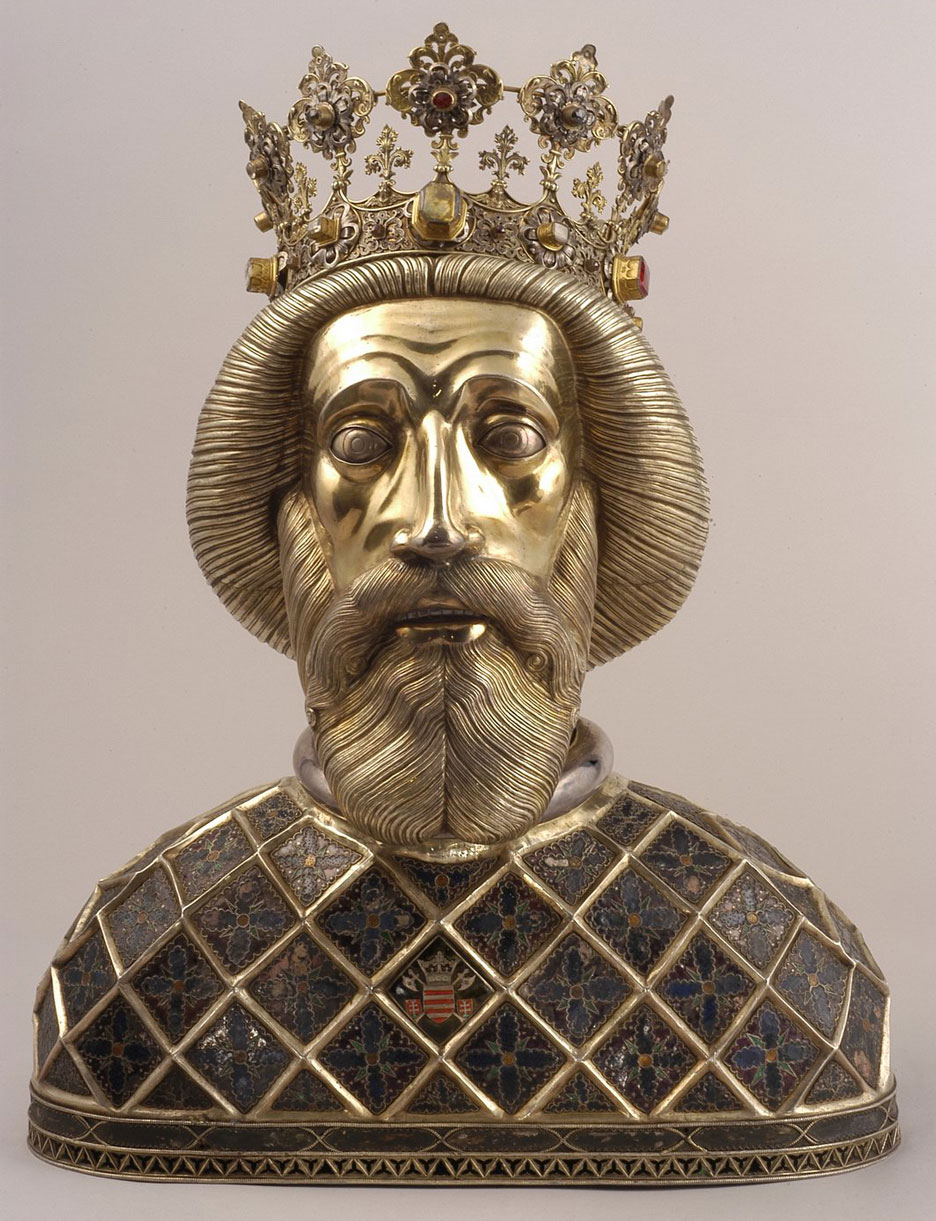
    The Herm (Skull-Reliquary) of St. Ladislaus
    Cathedral Basilica of Győr, Hungary

    His silver-gilt skull reliquary (Hermes) — a 15th-century masterpiece — preserves his skull. Originally at Várad (Oradea), translated to Győr to escape the Ottoman occupation. Among the supreme treasures of Hungarian liturgical art.

Iconography
  • The Cycle of St. Ladislaus

    Long parish-church fresco cycles in 14th–15th-century Hungarian Romanesque and Gothic churches show the saint as a young knight-king on horseback rescuing a captive Hungarian girl from a Cuman raider — the so-called 'Ladislaus legend.' Preserved in dozens of village churches across Hungary, Slovakia, Romania, and Transylvania.

Patronages
Hungary (with St. Stephen)Soldiers and knightsThe Székely peopleHungarian cavalry
Sources & Further Reading