
MIRACULOUS MIRACLES™

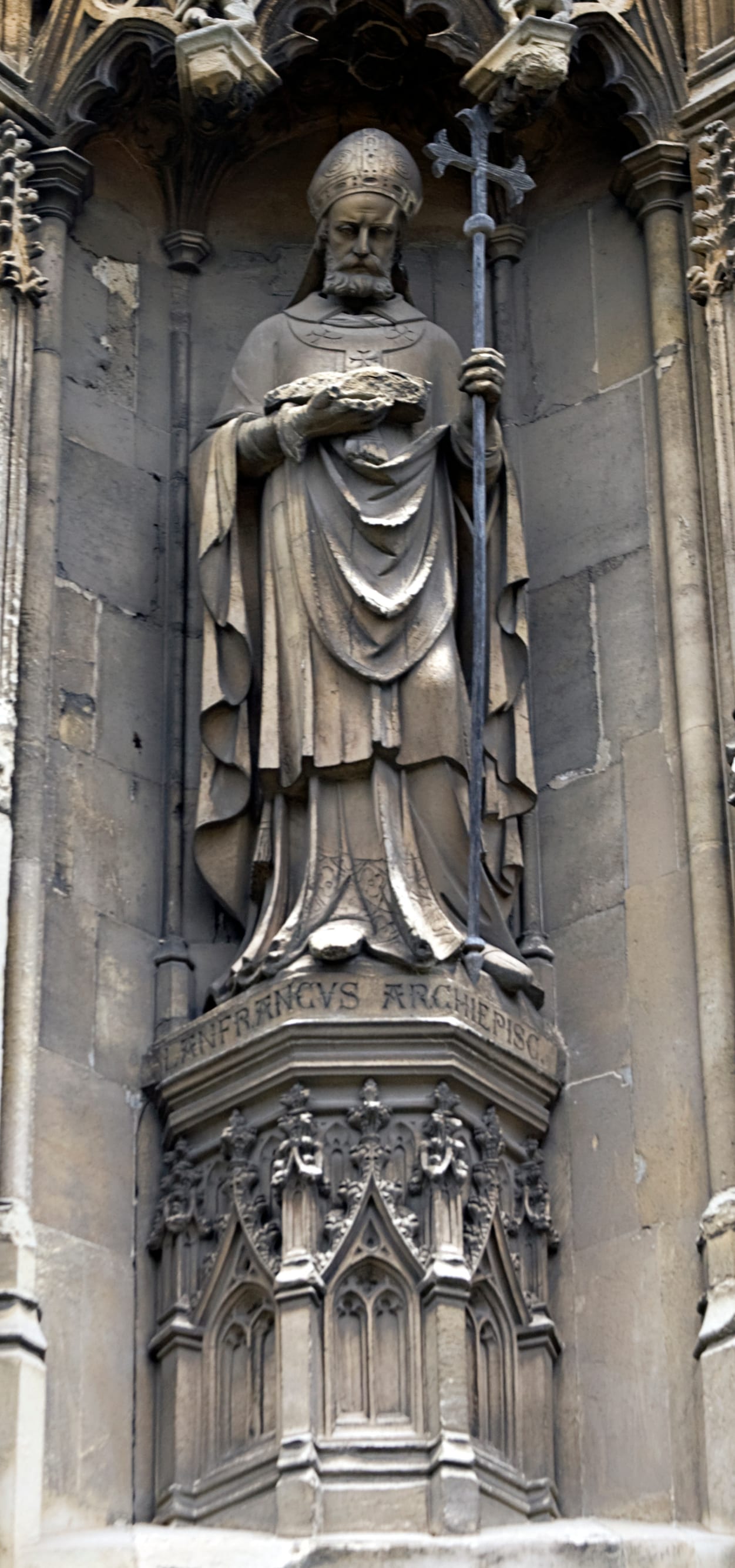
Saint — Lanfranc of Bec

St. Lanfranc of Bec
c. 1005 AD, Pavia, Lombardy (noble Lombard family of Pavia) — May 24, 1089 AD, Canterbury
Archbishop of Canterbury 1070–1089; first Norman Archbishop of England; theologian of transubstantiation
Canterbury Cathedral, Kent, England — his archiepiscopal see; he rebuilt the Norman cathedral 1070–1077 after the fire of 1067; the mother-church of the Anglican Communion, United Kingdom
Feast
May 24 (Catholic and Anglican calendars)
Canonized
Pre-congregation locally; venerated in the Anglican and Catholic calendars
Life

Lanfranc was born around 1005 in Pavia, Lombardy, to a noble Lombard family — the son of a magistrate of Pavia. Educated at the law-school of Pavia (the principal Italian legal centre of the early 11th century), he became a distinguished jurist before undertaking religious life.

Around 1042, crossing the Alps to teach rhetoric and law at the French cathedral schools, he was robbed and beaten by brigands on a road in Normandy — and, after miraculous deliverance, entered the obscure new Abbey of Bec (founded c. 1034 by the former soldier-knight Herluin) as a monk.

Under Lanfranc's direction, the small Abbey of Bec became one of the principal intellectual centres of the 11th-century Catholic Latin West — drawing students from across Catholic Europe to study at the Bec cathedral school. Among Lanfranc's pupils were St. Anselm of Canterbury (future Archbishop of Canterbury, successor of Lanfranc) and Pope Alexander II.

In the Berengarian Eucharistic controversy of the 1050s–1070s — when Berengar of Tours denied the substantial Eucharistic Real Presence — Lanfranc composed the principal Catholic refutation: the De Corpore et Sanguine Domini contra Berengarium Turonensem ('On the Body and Blood of the Lord against Berengar of Tours', c. 1063). The text articulated for the first time the Latin scholastic vocabulary of substantia and accidentia in Eucharistic theology — laying the direct linguistic-conceptual foundation for the doctrine of transubstantiation that would be formally defined by the Fourth Lateran Council in 1215.

In 1063 Lanfranc was appointed Abbot of the new Abbey of Saint-Étienne at Caen — the principal Norman ducal monastic foundation of Duke William of Normandy (the future William the Conqueror).

After the Norman Conquest of England in 1066, Duke William appointed Lanfranc as Archbishop of Canterbury (consecrated August 29, 1070) — succeeding the deposed Stigand, the first Norman Archbishop of England.

Lanfranc's nineteen-year archiepiscopate (1070–1089) was devoted to the Catholic ecclesiastical reorganization of the Norman-conquered Anglo-Saxon Catholic Church: reorganizing the diocesan boundaries (dioceses re-located from small rural villages to fortified Norman towns), instituting the principle of Canterbury's primacy of York (the York-Canterbury jurisdictional dispute that would persist through the medieval centuries), introducing the Norman-Cluniac liturgical and disciplinary reforms, rebuilding the Canterbury Cathedral in the Norman style after the 1067 fire (the Norman cathedral, subsequently rebuilt in the Early English Gothic style 1175–1184 by William of Sens and William the Englishman after the Becket-murder fire of 1174).

He died at Canterbury on May 24, 1089. His pupil and successor St. Anselm of Canterbury (Archbishop 1093–1109) would continue the Bec-Canterbury intellectual tradition into the High Medieval scholastic culture.

Miracles & Phenomena
  • The De Corpore et Sanguine Domini and the institutional birth of transubstantiation theology

    Lanfranc of Bec's De Corpore et Sanguine Domini (On the Body and Blood of the Lord against Berengar of Tours, c. 1063) — composed in refutation of the Berengarian denial of the substantial Eucharistic Real Presence — articulated for the first time the Latin scholastic vocabulary of substantia and accidentia in Eucharistic theology. The Lanfrancan terminology laid the direct linguistic-conceptual foundation for the doctrine of transubstantiation that would be formally defined by the Fourth Lateran Council in 1215 — the principal definitive doctrinal definition of the Catholic Eucharistic theology that has remained the definitive Catholic teaching to the present day.

  • The Norman-Catholic ecclesiastical reorganization of England

    Lanfranc's nineteen-year archiepiscopate at Canterbury (1070–1089) produced the principal Catholic ecclesiastical reorganization of Anglo-Saxon-Catholic England under the Norman conquest. The Lanfrancan reforms — diocesan re-organization, York-Canterbury primacy, Norman-Cluniac liturgical-disciplinary reform, rebuilding of the Canterbury Cathedral — produced the characteristic Anglo-Norman Catholic ecclesiastical structure that would extend through the medieval English Catholic centuries to the English Reformation. The Lanfrancan diocesan boundaries (with modifications) substantially survive in the current Catholic and Anglican diocesan-architectural structures of England.

Relics
  • Body
    Tomb of St. Lanfranc
    Canterbury Cathedral, Kent, England — the medieval shrine destroyed in the Reformation; fragmentary relics survive at the Catholic Cathedral of St. George, Southwark, and at the Abbey of Bec (re-founded 1948 by French Benedictines after the French Revolutionary destruction)

    His medieval tomb at Canterbury Cathedral was destroyed in the 16th-century Reformation; fragmentary relics survive at the Catholic Cathedral of St. George in Southwark (the principal English Catholic cathedral after the Catholic Emancipation Act of 1829) and at the re-founded Abbey of Bec.

Iconography
  • Lanfranc consecrating the Norman Canterbury Cathedral

    The late-11th-century Archbishop of Canterbury in archiepiscopal vestments at the consecration of the rebuilt Norman Canterbury Cathedral, the Romanesque Norman architecture visible behind, the De Corpore et Sanguine Domini in his hand (the Lanfrancan transubstantiation-treatise) — the iconography of Catholic Anglo-Norman archiepiscopal-theological tradition.

Patronages
Archdiocese of Canterbury (Catholic and Anglican)Catholic Norman-English Catholic ecclesiastical-reorganization traditionCatholic transubstantiation theologyCatholic Bec-Canterbury intellectual tradition (continued by his pupils and successors Sts. Anselm of Canterbury and Theobald of Bec)