
MIRACULOUS MIRACLES™

Saint — Margaret Mary Alacoque

St. Margaret Mary Alacoque
July 22, 1647 — October 17, 1690
Apostle of the Sacred Heart of Jesus
Monastery of the Visitation, Paray-le-Monial, France
Feast
October 16
Canonized
May 13, 1920 (by Pope Benedict XV)
Beatified
September 18, 1864 (by Pope Pius IX)
Life

Margaret Alacoque was born to a notary of the small Burgundian village of Lhautecour in 1647. Her father died when she was eight; she was sent to be educated by the Poor Clares at Charolles, where at eleven she fell ill with what was probably rheumatic fever or polio and was bedridden for four years. She vowed her virginity to the Blessed Virgin Mary and was cured.

She felt called from her earliest youth to religious life, but the family — under the iron rule of relatives who controlled the small estate — forbade it. For ten years she suffered relentless pressure to marry. In 1671, at twenty-four, she at last entered the Visitation convent of Paray-le-Monial in Burgundy and took the religious name Margaret Mary.

Between December 1673 and June 1675, she received four great apparitions of the Sacred Heart of Jesus while praying before the Blessed Sacrament. Christ showed her His Heart, surrounded by a crown of thorns, encircled with flames, and surmounted by a cross — and entrusted her with the mission of spreading the devotion to the Sacred Heart throughout the Church. He revealed twelve specific promises to those who would honor His Heart, and asked specifically for the institution of a Feast of the Sacred Heart on the Friday after the Octave of Corpus Christi, and for the practice of Holy Communion on the First Friday of each month for nine consecutive months.

At first she met disbelief and ridicule, even from her own community. Her director, the Jesuit St. Claude de la Colombière (1641–1682), recognized the authenticity of the revelations and became her chief defender. After her death the devotion spread quickly; Pope Pius IX extended the Feast of the Sacred Heart to the universal Church in 1856; Leo XIII consecrated the entire human race to the Sacred Heart in 1899. Margaret Mary was canonized in 1920. Her body, found incorrupt at her exhumation in 1830, rests in a gold and crystal reliquary in the chapel of the apparitions at Paray-le-Monial.

Miracles & Phenomena
  • The Four Great Revelations of the Sacred Heart

    December 1673 — June 1675

    Between December 27, 1673 (Feast of St. John the Evangelist) and June 1675 (Octave of Corpus Christi), Christ appeared to Margaret Mary four times during her hours of adoration before the Blessed Sacrament. He revealed His Heart, gave her the twelve promises, and entrusted her with the mission of spreading the devotion.

    → Full miracle page
  • Healing after vow of virginity

    1658

    At age eleven Margaret was bedridden for four years with a disease that crippled her hands and feet. She vowed her virginity to the Blessed Virgin Mary and was cured — a healing she always counted as the first great mercy of her life.

  • Incorruption of her body

    1830

    When her tomb was opened in 1830, 140 years after her death, her body was found entirely incorrupt despite the wet conditions of the Visitation crypt at Paray-le-Monial.

    → Full miracle page
Relics
  • Body
    Incorrupt body of St. Margaret Mary Alacoque
    Chapel of the Apparitions, Visitation Monastery, Paray-le-Monial

    Her body, found incorrupt in 1830, rests in a gold and crystal reliquary above the altar of the chapel where she received the apparitions. The chapel and the monastery have been a pilgrimage site of worldwide importance since the 19th century.

Iconography
  • Margaret Mary before the Sacred Heart

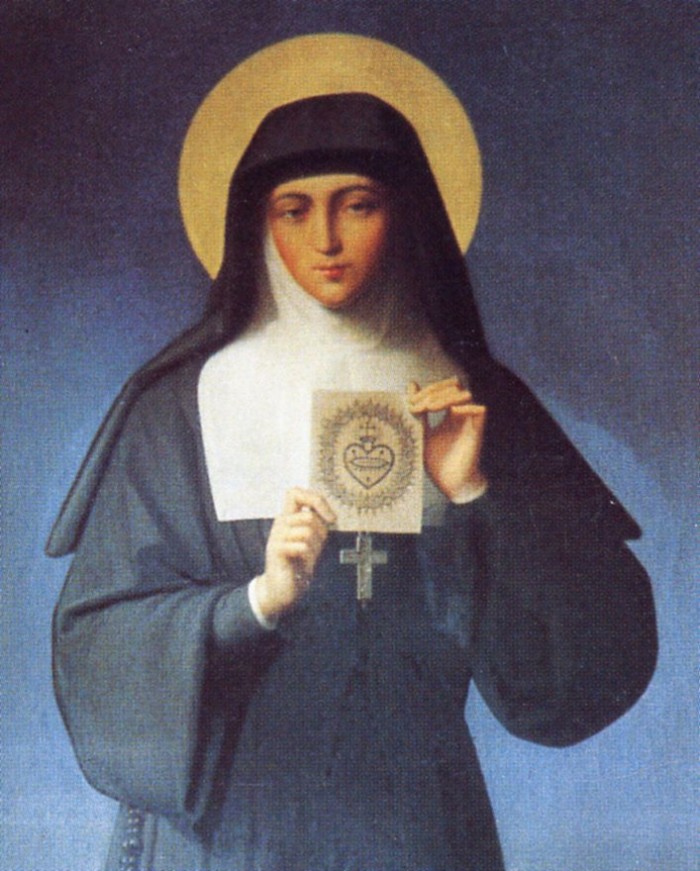
    The standard image: Margaret Mary in the brown habit and white wimple of the Visitation, kneeling before a vision of the Sacred Heart of Jesus — the Heart crowned with thorns, surmounted by a cross, and surrounded by flames — usually with a monstrance of the Blessed Sacrament on the altar before her.

Prayers to This Saint
Patronages
Devotees of the Sacred Heart of JesusSufferers of polioThose who have lost their parents
Sources & Further Reading