
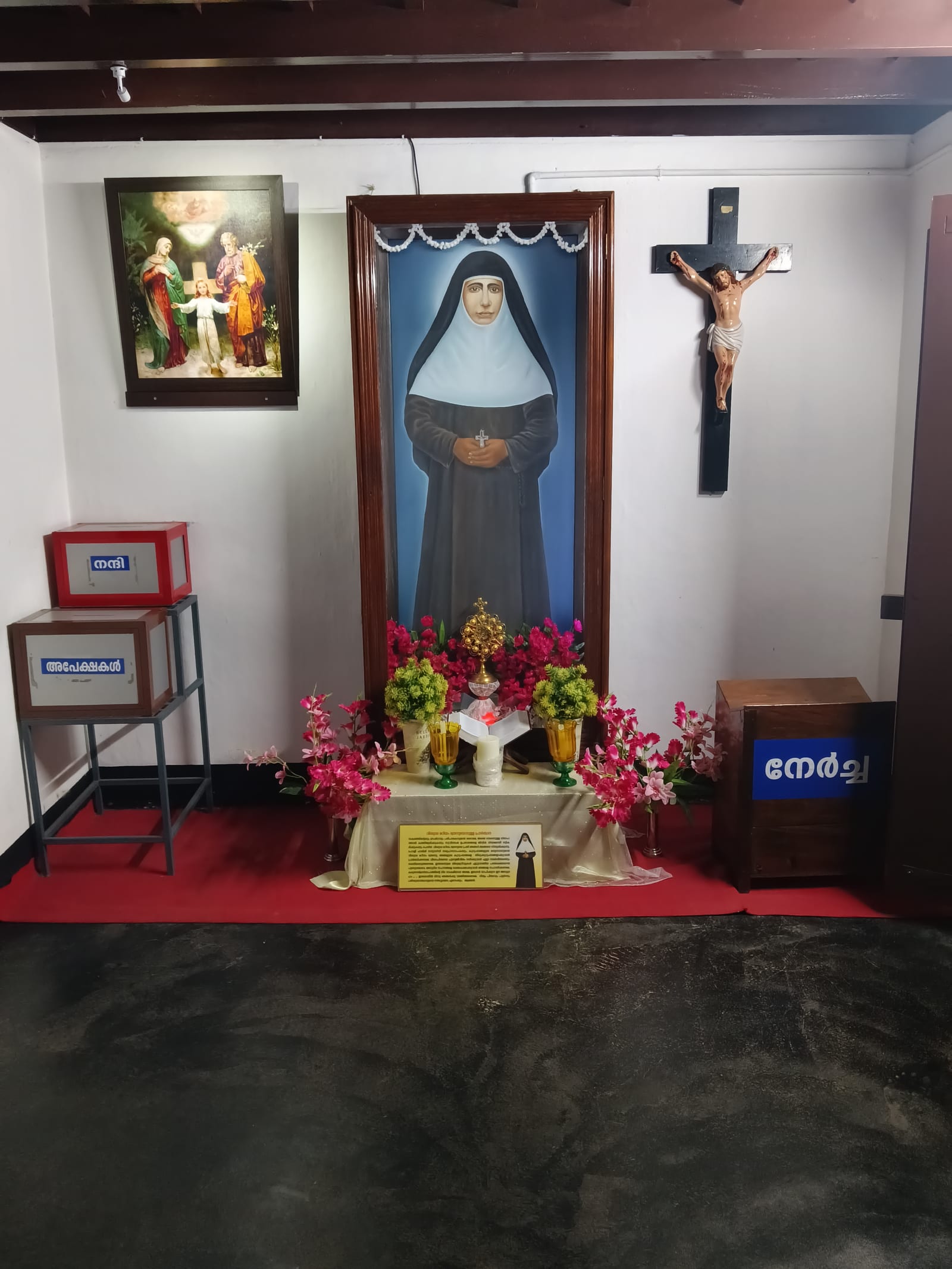
Thresia Mankidiyan was born to a Syro-Malabar Catholic family of small landed gentry at Puthenchira in central Kerala. From childhood she showed unusual mystical aptitude (recurring visions, levitations during prayer, sustained eucharistic fasts attested by family members) and an unusual focus on the ministry to families — she repeatedly added the Marian name 'Mariam' to her own at her First Communion in 1886 at ten.
From her twenties she organized — under the direction of her Carmelite spiritual director Father Joseph Vithayathil — a small lay-religious sisterhood of three companions dedicated to the visitation of distressed Kerala Catholic families (sick, abandoned, in marital crisis, dealing with mental illness in family members — the latter a Kerala Catholic ministry that was distinctively pioneering for the period). She received the visible stigmata of the Five Wounds in 1909 at thirty-three; the phenomena were attested by her spiritual director and by the Carmelite Discalced superiors of the Trichur Vicariate.
In 1914 — with the formal approval of Bishop John Menacherry of Trichur — she founded the Congregation of the Holy Family (CHF) at Kuzhikkattussery, the first Syro-Malabar women's religious congregation specifically dedicated to the integrated ministry to Catholic families. Under her direction the Holy Family Sisters grew across the Syro-Malabar Catholic regions of Kerala — by her death in 1926 there were over 50 sisters in seven houses. The Congregation today operates throughout India and in mission territories in Ghana, Germany, Italy, and the United States.
She died at Kuzhikkattussery on June 8, 1926 at fifty. Beatified by John Paul II in 2000, canonized by Pope Francis in 2019 — the second Indian woman canonized after Alphonsa of the Immaculate Conception (see her entry in the 20th-c. catalogue) and the third Syro-Malabar saint after Alphonsa and Kuriakose Elias Chavara.