
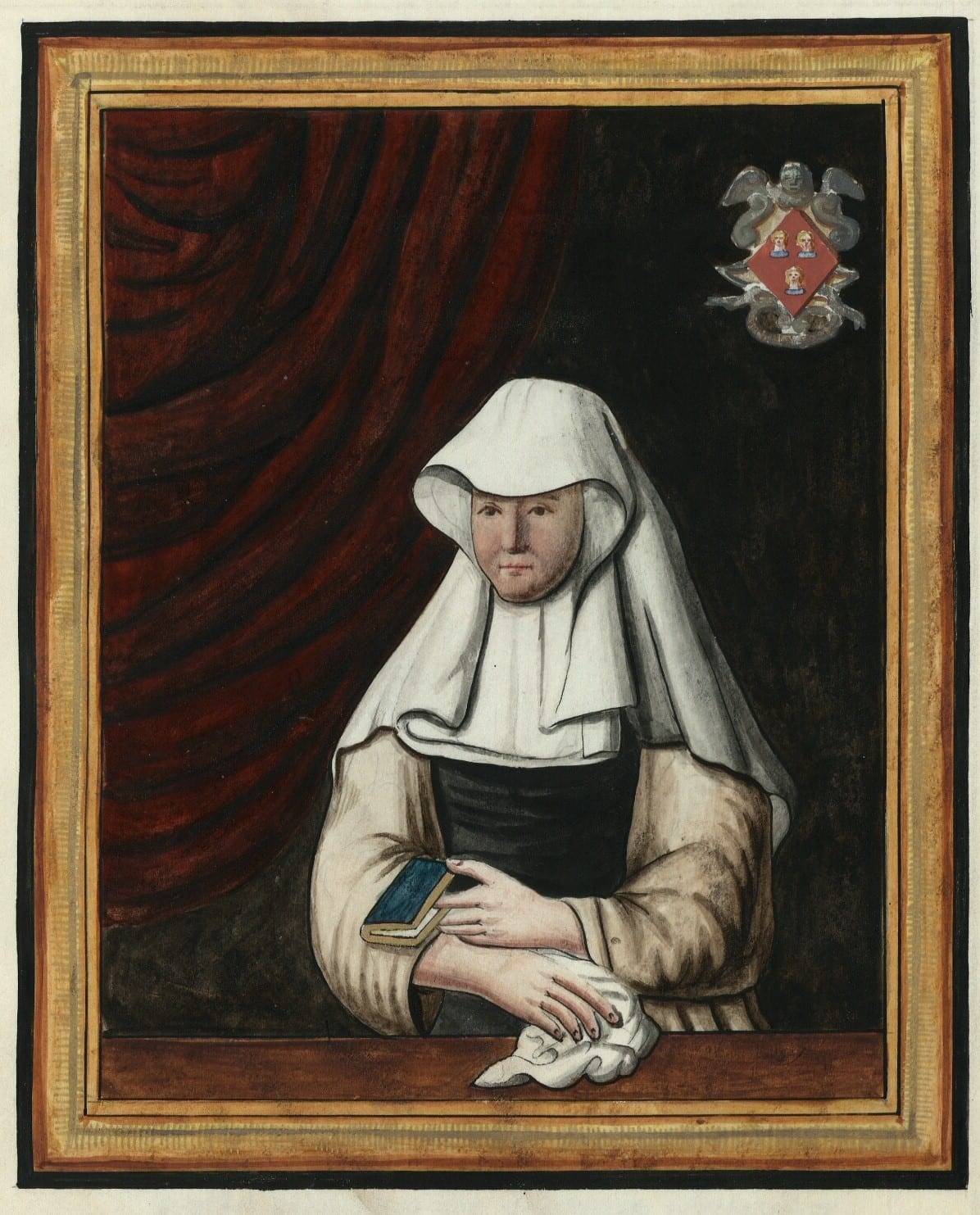
Marie was born to a wealthy Brabantine family at Nivelles and married at fourteen to John of Nivelles. After their conversion she and her husband took mutual vows of chastity (a 'Josephite marriage') and worked at the leprosarium of Willambroux — one of the first cases of the urban penitential lay movement that would soon become the Beguine phenomenon. She moved later to the Augustinian priory of Oignies-sur-Sambre, where she lived as an anchoress attached to the priory church.
She was the first major figure of the Beguine movement — the great wave of lay-religious women's piety that swept through the Low Countries in the early thirteenth century, characterized by lay vows of chastity, ordinary work, and intense mystical Eucharistic devotion. Her cult exploded throughout Europe after her death because Jacques de Vitry, her confessor and later cardinal-bishop of Tusculum, wrote her Vita as the seminal hagiographic document of the Beguine movement.
Through Jacques de Vitry's preaching of her life, the Beguine model spread from Liège and Brabant to Cologne, Strasbourg, Paris, and the Rhineland. The Beguinages of the Low Countries (a dozen survive in Belgium as UNESCO sites) are her institutional legacy. She is the mother of one of the most important currents of medieval women's spirituality.