
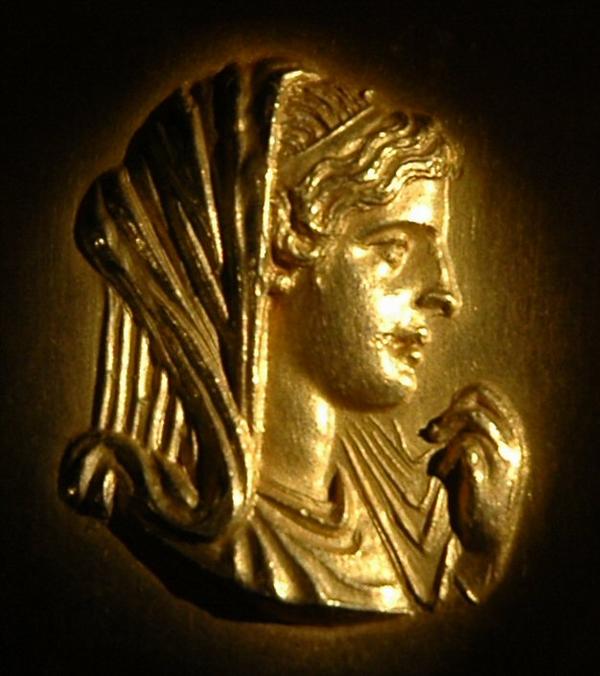
Olympias (Greek Olympias) was the daughter of a very wealthy Constantinopolitan patrician — Anysius Seleucus, count of the imperial treasury — and granddaughter of the famous late-Roman public official Ablabius (the Praetorian Prefect of the Emperor Constantine the Great). She was raised at Constantinople by her aunt Theodosia, who had been a personal friend of Gregory of Nazianzus (Patriarch of Constantinople 379–381 — see Gregory's entry already in the catalogue).
At seventeen Olympias was married to Nebridius, the prefect of Constantinople; he died less than two years later, leaving her one of the wealthiest women of the Eastern Roman Empire and a young childless widow. The Emperor Theodosius I — wishing to marry her to one of his own relatives — attempted to force her remarriage by impounding her estates; she refused steadfastly and remained an unmarried widow in religious vow.
She was ordained deaconess of the Church of Constantinople around 391 AD by the then-Patriarch Nectarius, becoming one of the most-documented examples of the early-Catholic deaconess ministry. She founded a large convent of deaconesses adjacent to the cathedral church of Hagia Sophia at Constantinople, devoting her vast inherited wealth to charitable works, support of refugee bishops (she sheltered Athanasius's disciples during their flights, gave personal support to Gregory of Nyssa, Epiphanius of Salamis, and the long line of Eastern hierarchs who passed through Constantinople), and to ransom of war-captives.
Her foundational friendship was with John Chrysostom (Patriarch of Constantinople 397–404 — see Chrysostom's entry already in the catalogue). When Chrysostom was deposed by the Empress Eudoxia and exiled in 404, Olympias supported him through her continued charitable work for his clergy and through her personal correspondence (sixteen of his letters to her from exile have survived). She was herself eventually arrested by the imperial authorities, imprisoned briefly, and exiled to Nicomedia, where she died on July 25, 408. Her cult became substantial in the Byzantine Catholic tradition and she is venerated as the foundational example of the early Constantinopolitan deaconess.