
MIRACULOUS MIRACLES™

Saint — Pafnuty of Borovsk

St. Pafnuty of Borovsk
1394 AD, Kudinovo, near Borovsk, Grand Duchy of Moscow (Tatar noble family — the Baskakov clan) — May 1, 1477 AD, Borovsk Monastery, Grand Duchy of Moscow
Russian abbot; Sergian second-generation disciple; spiritual master of Bl. Joseph of Volokolamsk
Nativity of the Theotokos Monastery of Pafnuty at Borovsk, Kaluga Oblast, Russia — his monastic foundation of 1444; Russian principal monastic pilgrim destination, Russia
Feast
May 1
Canonized
Canonized 1547 by the Council of Moscow under Metropolitan Macarius
Life

Pafnuty (baptismal name Parfeny) was born in 1394 at Kudinovo near Borovsk to a Tatar noble family (descendant of the Baskakov clan, the Tatar tribute-collecting family that had been Russified and Christianized in the late-14th-century Muscovite conversion of the Tatar aristocracy).

At the age of 20 (1414), Pafnuty entered the Vysoky Monastery at Borovsk under the personal spiritual direction of the Bl. Nikita of Serpukhov (disciple of St. Sergius of Radonezh) — producing the Sergian second-generation discipleship tradition.

Pafnuty served as abbot of the Vysoky Monastery from 1434 to 1444. In 1444, Pafnuty undertook the vocation of founding a new monastery — the Sergian pattern of second-generation disciples establishing new monastic foundations across the Muscovite territory.

Pafnuty founded the Nativity of the Theotokos Monastery of Pafnuty at Borovsk in 1444 — the principal Muscovite monastic foundation that would produce the famous spiritual master of the generation, Bl. Joseph of Volokolamsk (1439/1440–1515, father of the Josephite tradition of Russian monasticism).

Pafnuty's spiritual-institutional legacy is produced through his most famous disciple Bl. Joseph of Volokolamsk — who received his monastic formation at the Borovsk Monastery under Pafnuty's personal direction. The Joseph-of-Volokolamsk tradition became one of the two principal competing traditions of the Russian Orthodox monasticism of the late 15th and 16th centuries (the Josephite tradition of institutional monasticism in institutional-theological dispute with the Non-Possessor tradition of St. Nil Sorsky).

Pafnuty served as abbot of the Borovsk Monastery until his death on May 1, 1477.

Miracles & Phenomena
  • The Pafnuty-Joseph of Volokolamsk lineage

    St. Pafnuty of Borovsk's spiritual-institutional legacy is produced through his most famous disciple Bl. Joseph of Volokolamsk (1439/1440–1515), who received his monastic formation at the Borovsk Monastery under Pafnuty's personal direction. The Joseph-of-Volokolamsk 'Josephite' tradition became one of the two principal competing traditions of the Russian Orthodox monasticism of the late 15th and 16th centuries — in institutional-theological dispute with the Non-Possessor tradition of St. Nil Sorsky.

Relics
  • Body
    Relics of St. Pafnuty of Borovsk
    Nativity of the Theotokos Monastery of Pafnuty at Borovsk, Kaluga Oblast, Russia — his personal foundation; Russian principal monastic pilgrim destination

    His relics rest at the Nativity of the Theotokos Monastery of Pafnuty at Borovsk in the Kaluga Oblast — in continuous monastic use since 1444.

Iconography
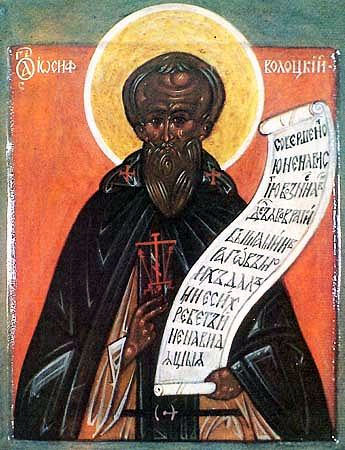
  • Pafnuty founding the Borovsk Monastery

    The mid-15th-century Russian abbot in Russian monastic schema-habit at the Borovsk site in 1444 directing the construction of the Nativity of the Theotokos Monastery, Bl. Joseph of Volokolamsk as a young disciple beside him — the iconography of Catholic-Orthodox Russian second-generation Sergian monastic-foundation tradition.

Patronages
The Russian, Ukrainian, and Belarusian Catholic-Orthodox traditionCatholic Sergian tradition (second-generation Sergius of Radonezh disciple)Kaluga Oblast (central Russia) and the Muscovite Catholic-Orthodox monastic tradition