
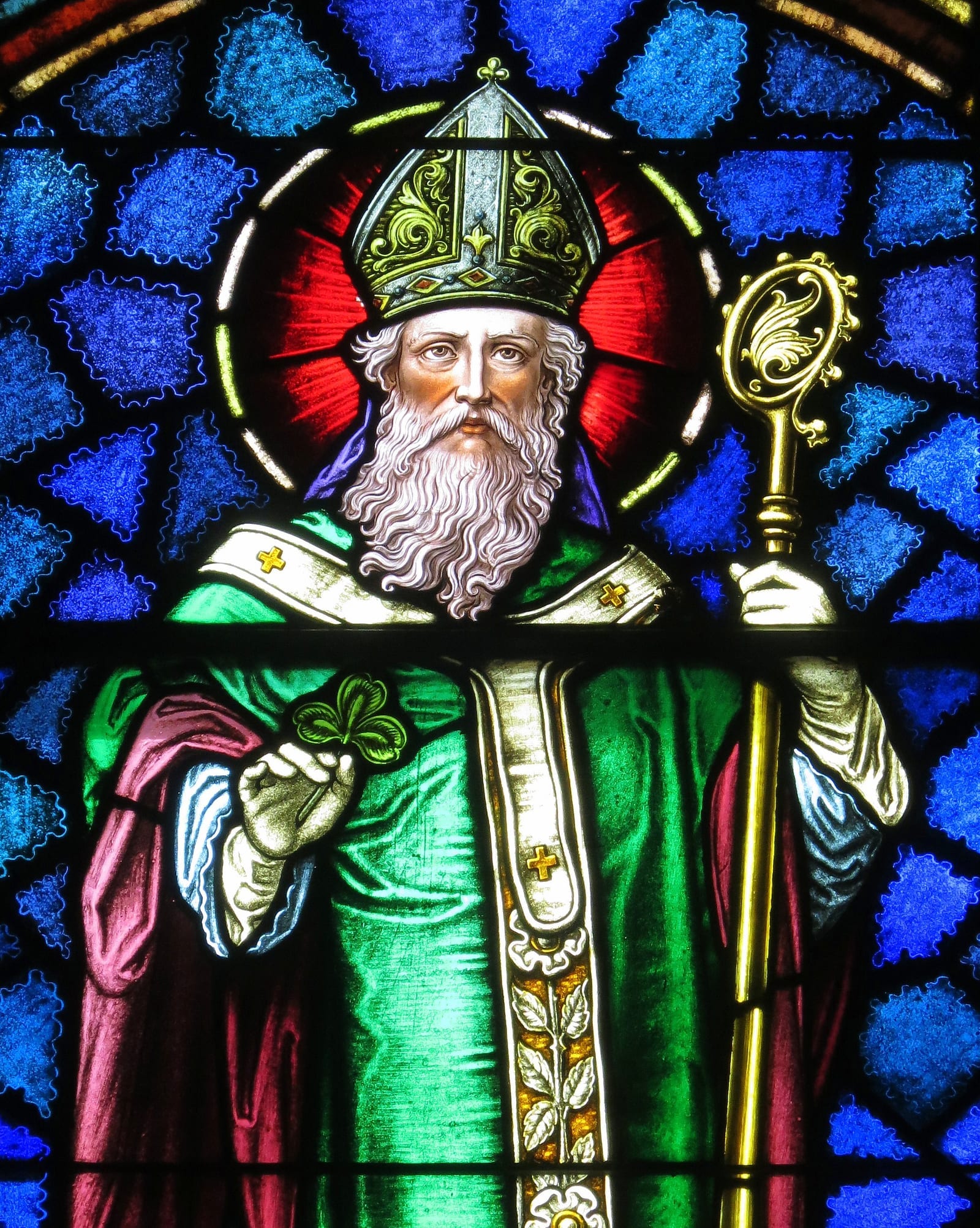
Patrick wrote two short Latin works himself — the Confessio (his spiritual autobiography) and the Letter to Coroticus — both authentic and surviving. He was a Romano-British boy, son of a Christian decurion-deacon Calpurnius and grandson of a priest, taken captive by Irish raiders at sixteen and sold into slavery as a shepherd in Ireland. After six years he heard in a dream the voice of God: 'Behold, your ship is ready.' He escaped, walked two hundred miles to a ship, returned home — and there, in another series of dreams, heard 'the voice of the Irish' calling him back.
He was ordained, perhaps in Gaul, and consecrated bishop. Around 432 he returned to Ireland as a missionary. For thirty years he traveled the island preaching, baptizing, ordaining priests, founding monasteries and dioceses (he established his see at Armagh, the ecclesiastical capital of Ireland to this day), confronting the pagan high kings at Tara, and converting a substantial portion of the population.
His apocryphal but charming traditions — the shamrock illustrating the Trinity, the banishing of snakes from Ireland, the Paschal fire at the Hill of Slane against the king's edict — are part of the universal heritage of Ireland and the Irish diaspora. The Cathedral of Armagh and the cathedrals of every Irish town bear his name; his feast on March 17 is the most-celebrated saint's day in the Anglo-Saxon world.