
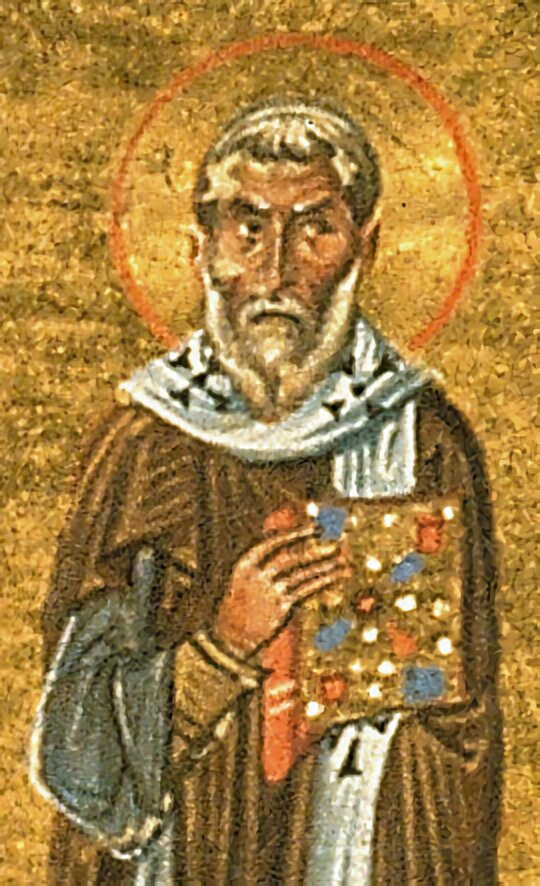
Agatho (Latin Agatho; Greek Agathōn, 'good') was a Greek-Sicilian Catholic monk of Palermo who succeeded Pope Donus as Bishop of Rome on June 27, 678 AD — substantially elderly at the time of his election (the substantial early-medieval sources record his age as substantially 100 years at his death three years later, which would make him the longest-living pope in the entire canonical succession — though the substantial age is probably hagiographic exaggeration).
His brief two-and-a-half-year pontificate was substantially devoted to the substantial Catholic resolution of the long Monothelite-Dyothelite Christological controversy that had divided the substantial post-Chalcedonian Eastern and Western Catholic worlds for some seventy years (see Honorius I's entry above for the substantial Monothelite-controversy background, and Pope Martin I and Maximus the Confessor's entries already in the catalogue for the substantial Western-Catholic opposition to Monothelitism).
Agatho's substantial Roman-papal contribution to the resolution: in March 680, Agatho convened the substantial Roman Synod of 125 substantial Western-Catholic bishops, which produced the substantial Synodal Letter to the Emperor Constantine IV that became the doctrinal basis for the Third Council of Constantinople. The substantial Agatho synodal letter — drafted substantially by Agatho personally — argued substantially for the substantial Catholic Dyothelite Christological doctrine (the substantial doctrine that Christ has two wills, one divine and one human, perfectly united) against the substantial Monothelite Christological doctrine.
The substantial Third Council of Constantinople (Constantinople III) was convened by the Emperor Constantine IV in November 680 and continued through September 681 — substantially based on the substantial Agatho synodal letter. The substantial Council formally defined the substantial Catholic Dyothelite Christological doctrine, formally condemned the substantial Monothelite Christological doctrine, and substantially confirmed the substantial Western-Catholic doctrinal position. The substantial Council also formally condemned posthumously the substantial earlier Pope Honorius I (see Honorius I's entry above for the substantial Honorius-condemnation context).
Agatho died at Rome on January 10, 681 — eight months before the substantial formal closure of the substantial Constantinople III Council that his substantial synodal letter had shaped.