
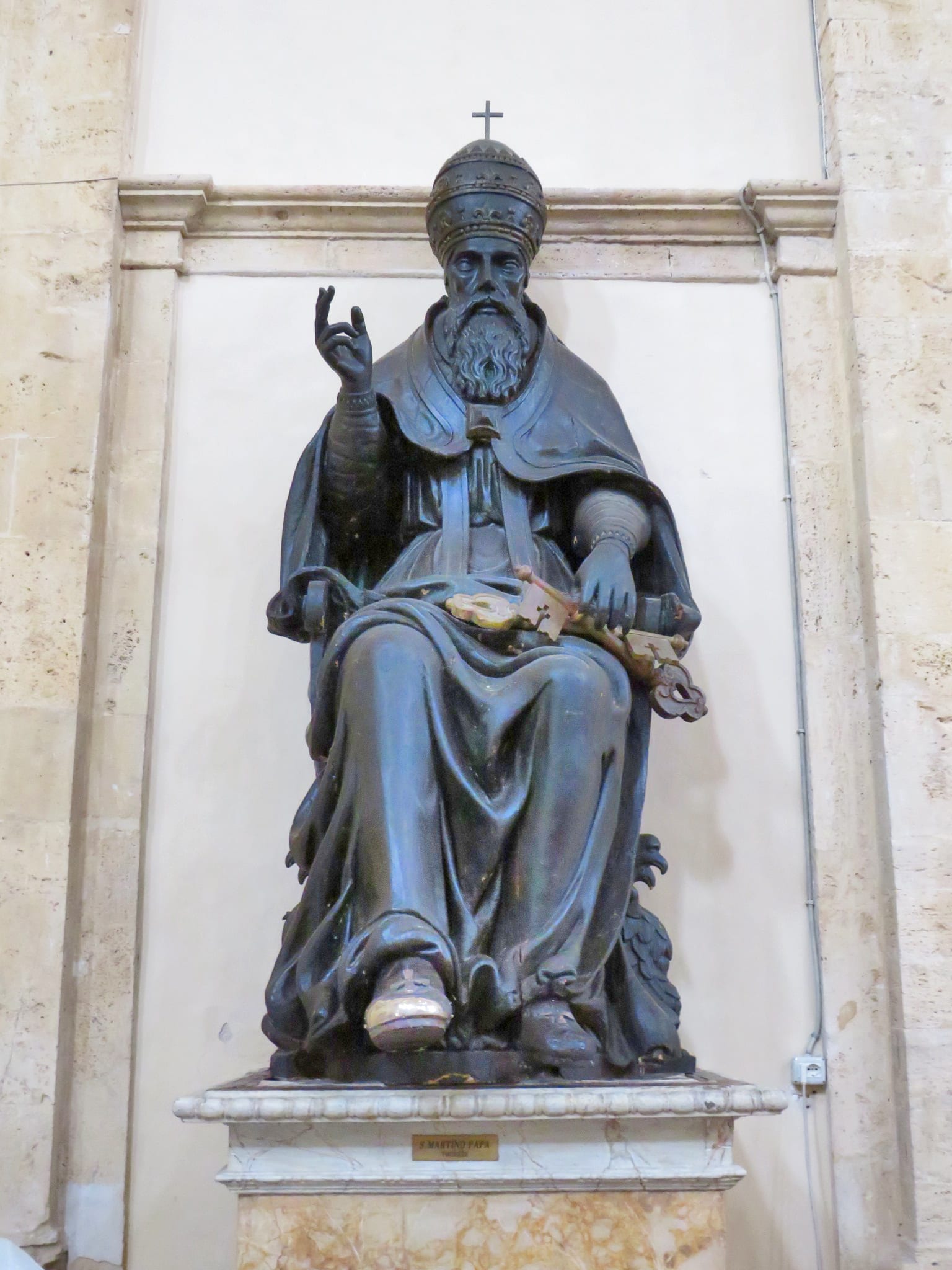
Martin was born at Todi on the Tiber, in Umbria, the son of Fabricius, and was sent by Pope Theodore I as apocrisiarius — papal legate — to Constantinople. On 21 July 649 he was elected to succeed Theodore I, and he was consecrated without waiting for the emperor's confirmation, against a custom a century old: a first sign of the independence that would cost him everything.
His pontificate met the Monothelite controversy head-on. The imperial theology held that Christ had only one will — a compromise meant to reconcile the Monophysites of Egypt and Syria — and the emperors had tried first to impose it, in the Ekthesis of Heraclius, and then to silence the argument altogether, in the Typos of Constans II. Less than three months after his election Martin convened 105 bishops at the Lateran, from 5 to 31 October 649, and the synod condemned Monothelitism, the Ekthesis and the Typos together.
Constans II wanted him brought to Constantinople. The first exarch sent against him, Olympius, failed to turn the bishops and, the Catholic Encyclopedia relates from the old sources, planned to kill him while receiving Communion from his hands; the attempt came to nothing, and Olympius left to fight the Saracens in Sicily and died there. His successor as exarch, Theodore Calliopas, arrived in Rome on 15 June 653 and two days later, in the Lateran Basilica, declared Martin deposed. The pope, wishing to avoid the shedding of blood, forbade the Romans to resist and declared himself willing to be brought before the emperor; he was taken away by sea.
The journey was long and cruel. Suffering much from bodily ailments and privations, he was held — his letters suggest — for a year on the island of Naxos before he reached Constantinople, where he was kept ninety-three days in close confinement, in hunger, cold and thirst. He was tried for treason, stripped of nearly all his clothing, loaded with chains and dragged through the streets, and condemned. He was not executed — the accounts differ on whether a death sentence was passed and remitted — but exiled to Cherson in the Crimea, which he reached on 15 May 655 in a time of great famine.
There he died on 16 September 655, having written letters that survive, asking his friends for bread and clothing. The Roman clergy had meanwhile elected Eugene I in his place in 654, while he still lived. He was buried in the church of Our Lady called Blachernae, near Cherson; the greater part of his relics are said to have been carried to Rome, to the church of Santi Silvestro e Martino ai Monti on the Esquiline. He is the last pope venerated by the universal Church as a martyr. His feast, on 12 November before the calendar reform of 1969, is now kept on 13 April; the Byzantine churches keep it on 14 April.