
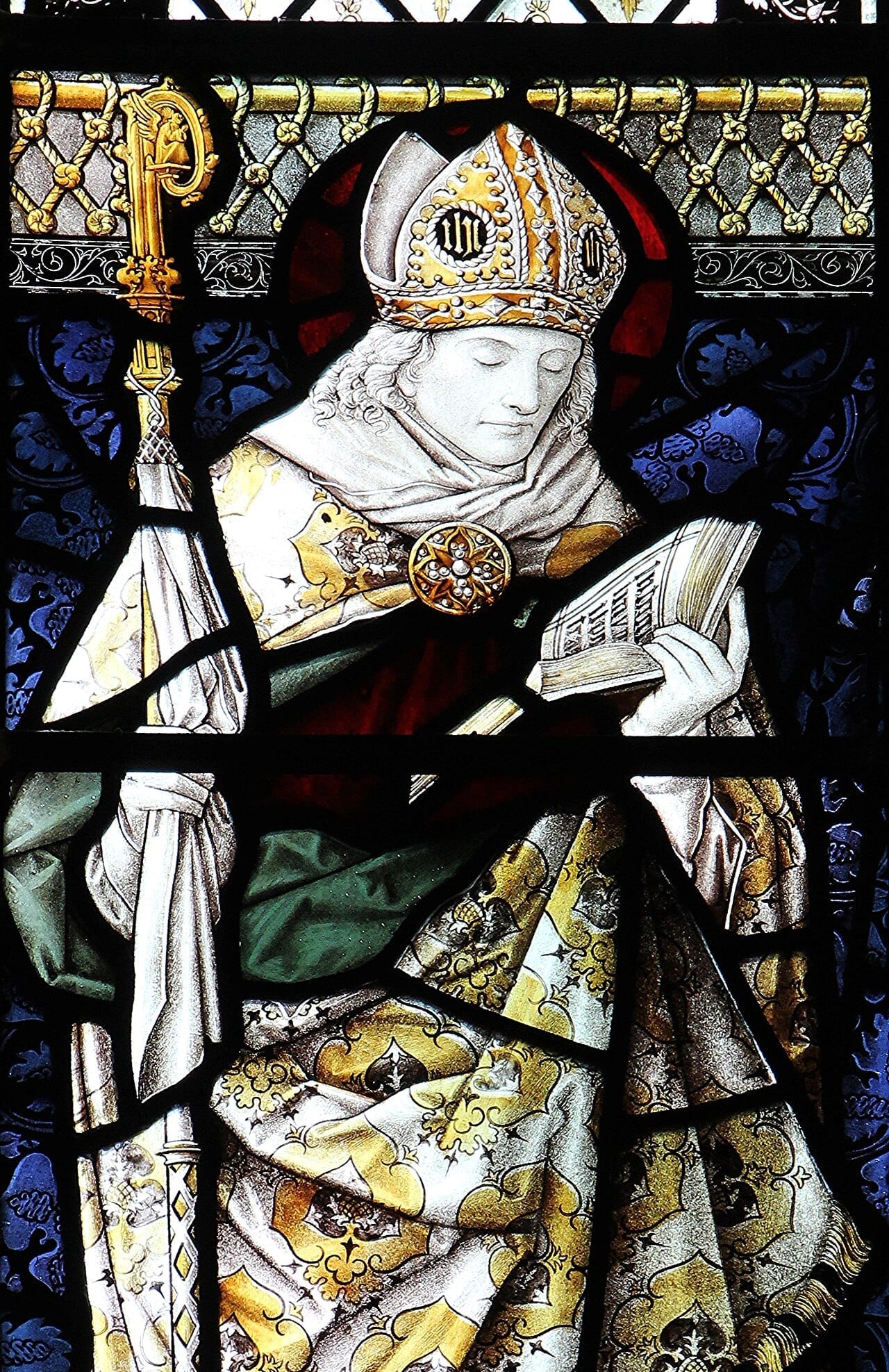
Richard (baptismal name Richard de Wych) was born in 1197 at Droitwich in Worcestershire to an Anglo-Saxon farming family. Orphaned in his youth, Richard undertook the restoration of the family farm — engaging in the manual agricultural labour (the later origin of his patronage of agricultural workers and coachmen).
Educated at the cathedral school of Worcester, then at the Universities of Oxford, Paris, and Bologna, Richard received the Doctor of Civil Law from Bologna and was appointed Chancellor of the University of Oxford around 1236.
He became chancellor of St. Edmund Rich of Abingdon (1170–1240, Archbishop of Canterbury 1233–1240, saint) and followed Edmund into exile at the Cistercian Abbey of Pontigny in Burgundy (1240) after the Archbishop's conflict with King Henry III of England.
After Edmund's death at Pontigny in 1240, Richard became chancellor of Edmund's successor Boniface of Savoy at Canterbury. In 1245, Boniface nominated Richard as Bishop of Chichester — the nomination that would provoke the famous royal-papal dispute of the late 1240s.
King Henry III refused to confirm Richard's nomination (advancing the royal candidate Ralph Neville), and seized the Chichester episcopal revenues. The dispute was referred to Pope Innocent IV, who personally consecrated Richard as Bishop of Chichester at Lyon on March 5, 1245 — the papal decision confirming Richard's appointment.
For the first two years of his episcopate (1245–1247), Richard was denied the Chichester episcopal palace and revenues by King Henry III; he lived on the charitable hospitality of the Chichester diocesan clergy, travelling on foot across the diocese, preaching and pastoring in personal poverty. Henry III finally yielded in 1247 under papal excommunication threat.
Richard's eight-year episcopate at Chichester (1245–1253) was devoted to the systematic Catholic pastoral reform of the Sussex diocese: strict enforcement of the clerical discipline (against concubinage, absenteeism, and simony), personal pastoral visitation of every parish, particular attention to the Catholic poor, institution of the schools for the catechesis of the rural Sussex peasantry.
In 1253, Pope Innocent IV commissioned Richard to preach the Crusade in support of the impending departure of St. Louis IX of France (the Seventh Crusade of 1248–1254). Richard undertook the Crusade-preaching tour of southeastern England — including the visit to Dover — and died at the Maison Dieu hospital in Dover on April 3, 1253 in the course of the preaching tour.
His shrine at Chichester Cathedral (established after his 1262 canonization by Pope Urban IV, the famous 1276 translation to the cathedral choir under Bishop Stephen of Bersted) became one of the principal pilgrim destinations of medieval southeastern England — until the shrine's destruction in the 1538 Reformation dissolution under King Henry VIII.