
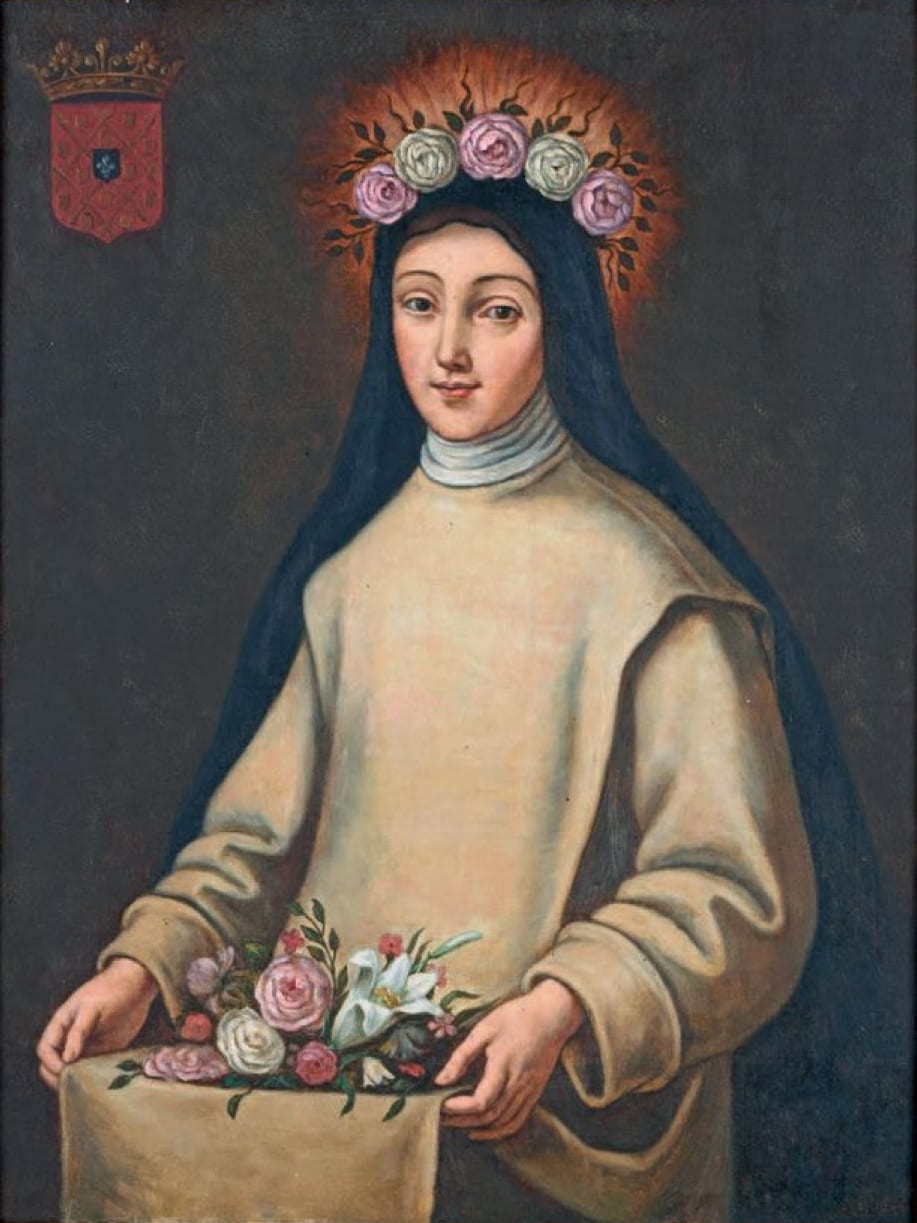
Roseline was born in 1263 at the Château des Arcs in Provence to the noble Provençal Villeneuve family. She undertook the Carthusian vocation at the Charterhouse of Bertaud in the French Alps around 1280, then transferred to the Charterhouse of Celle-Roubaud in her native Provence.
Roseline served as prioress of Celle-Roubaud from 1300 until her death in 1329 — producing the Provençal Carthusian women's mystical tradition. Her mystical-ecstatic experiences included: visions of Christ, bilocations, and Eucharistic-mystical devotions.
One famous episode: as Roseline was distributing bread to the poor at the Charterhouse gate — against the prohibition of her brother Elzear of Villeneuve (Baron of Les Arcs) — Elzear approached and demanded to see what she was carrying in her apron. Roseline opened her apron and the loaves of bread appeared as roses (the classic medieval Catholic 'rose miracle' in institutional parallel with the analogous miracles of Sts. Elizabeth of Hungary and Elizabeth of Portugal).
Roseline died at Celle-Roubaud on January 17, 1329.
Her body was exhumed in 1334 for veneration and discovered to be incorrupt — the classic Catholic incorrupt-body relic. Her eyes were removed at the exhumation for separate reliquary preservation — producing the unique 'Eyes of Sainte-Roseline' reliquary that survives to the present day, one of the most distinctive Catholic reliquary traditions in the world.
In 1660, King Louis XIV personally visited the Chapel of Sainte-Roseline to view the incorrupt body and the preserved eyes — institutionally underscoring the royal-Catholic devotion to the Roseline tradition.
The preserved eyes remained intact (still preserving the blue-gray colour of the irises) until the deterioration in the late 20th century — now preserved in the reliquary at the Chapel of Sainte-Roseline at Les Arcs.