
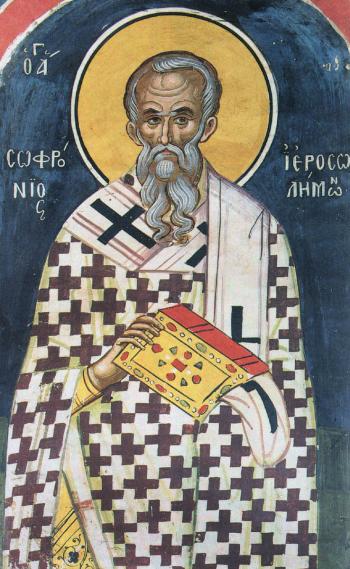
Sophronius was a Damascene rhetorician who became a monk in the Holy Land, traveled the great monastic centers of Egypt and Sinai with his companion John Moschus (whose Pratum Spirituale is one of the principal sources for early monastic biography), and finally became Patriarch of Jerusalem in 634.
He was the theological leader of the resistance to Monothelitism — the imperial Christological heresy promoted by Emperor Heraclius that taught Christ had only one will. Sophronius's Synodical Letter of 634 to Pope Honorius I and to the other patriarchs is the great Christological document of the seventh century, formulating the dyothelite doctrine (two wills in Christ) that the Sixth Ecumenical Council would confirm fifty years later.
His patriarchate coincided with the catastrophic conquests of the new Muslim caliphate. After the Battle of Yarmouk in August 636, the Byzantine armies were destroyed and the Holy Land lay open. Sophronius held Jerusalem under siege for two years; in February 638, recognizing the inevitable, he negotiated personally with the Caliph Umar at the gates and surrendered the city. According to tradition, he refused to pray with Umar inside the Church of the Holy Sepulchre lest the building be confiscated as a mosque; Umar, in respect, prayed outside, and that ground became the site of the Mosque of Umar that still stands beside the Holy Sepulchre.
Sophronius died on March 11, 638, only days after surrendering his city. He is buried at the Church of the Holy Sepulchre.