
MIRACULOUS MIRACLES™

Saint — Teresa of Ávila

St. Teresa of Ávila
March 28, 1515 — October 4 / 15, 1582
Doctor of the Church — first woman so named
Convent of the Annunciation, Alba de Tormes, Spain
Feast
October 15
Canonized
March 12, 1622 (by Pope Gregory XV)
Doctor of the Church
Yes
Life

Teresa de Cepeda y Ahumada was born into the gentry of Ávila, the daughter of a converso (Jewish-Christian) merchant. She lost her mother at thirteen, ran away as a child with her brother to seek martyrdom among the Moors, and entered the Carmel of the Incarnation in Ávila at twenty against her father's wishes.

Her first twenty years in religion were ordinary, even slack — she would later call them 'twenty years on a stormy sea, neither in mortal sin nor in true devotion.' At about forty, gazing at a wounded Christ statue brought for Holy Week, she felt herself broken open. From that moment her prayer deepened rapidly, and the great mystical phenomena began.

Despite illness, the Spanish Inquisition's suspicion, and the bitter opposition of the unreformed Carmelites, she founded seventeen new monasteries of the stricter 'Discalced' (barefoot) reform — and the male branch with the help of St. John of the Cross. She wrote four spiritual classics under obedience: her Autobiography, The Way of Perfection, The Foundations, and the supreme work, The Interior Castle (1577).

She died on the night of October 4–5, 1582 — on the very day the Gregorian calendar reform skipped to October 15, so the Church marks her death on that date. She was canonised in 1622 and, in 1970, became the first woman declared a Doctor of the Church.

Miracles & Phenomena
  • The Transverberation

    c. 1559

    She wrote of a vision in which an angel pierced her heart repeatedly with a long fiery dart tipped with gold: 'so great was the sweetness caused by this intense pain that one can never wish to lose it.' After her death, examinations of her preserved heart reportedly found a perforation through the muscle tissue.

  • Levitations during prayer

    She herself reports, with embarrassment, being lifted off the ground during prayer in the choir. She would beg the sisters to hold her down so the phenomenon would not be observed.

  • Resurrection of her nephew Gonzalo

    Witnesses testified at her canonisation process that during the construction of a new convent her young nephew Gonzalo was crushed by a falling wall. Teresa took the dead child in her arms, prayed, and after some time the child opened his eyes and was returned alive to his mother.

  • Visions of Christ and the Saints

    Throughout her later years she received recurring visions of Christ in glory, of His wounds, and of the souls of purgatory. Her director, the future St. Francis Borgia, helped her discern these as authentic rather than demonic.

Relics
  • Body
    Incorrupt body of St. Teresa
    Convent of the Annunciation, Alba de Tormes

    Examined most recently in August 2024, after 110 years. Anatomy professor Luigi Capasso reported skin, subcutaneous tissue, and muscle 'perfectly preserved.' Open for veneration in a silver coffin.

  • Bodily relic
    The Transverberated Heart
    Reliquary, Convent of the Annunciation, Alba de Tormes

    Removed for examination in the 1500s. The perforation through the heart muscle has been documented multiple times.

  • Bodily relic
    Right arm and hand
    Alba de Tormes
  • Bodily relic
    Left arm
    Discalced Carmelite convent, various sites in Spain

    Other relics dispersed across Spain in the 17th century by ecclesiastical or royal request.

Iconography
  • Ecstasy of St. Teresa
    Gian Lorenzo Bernini · 1647–1652 · Santa Maria della Vittoria, Rome

    Bernini's marble masterpiece in the Cornaro Chapel of Santa Maria della Vittoria, Rome — the angel about to plunge his arrow into Teresa's heart, her mouth half open in the moment of transverberation. The defining baroque image of mystical experience.

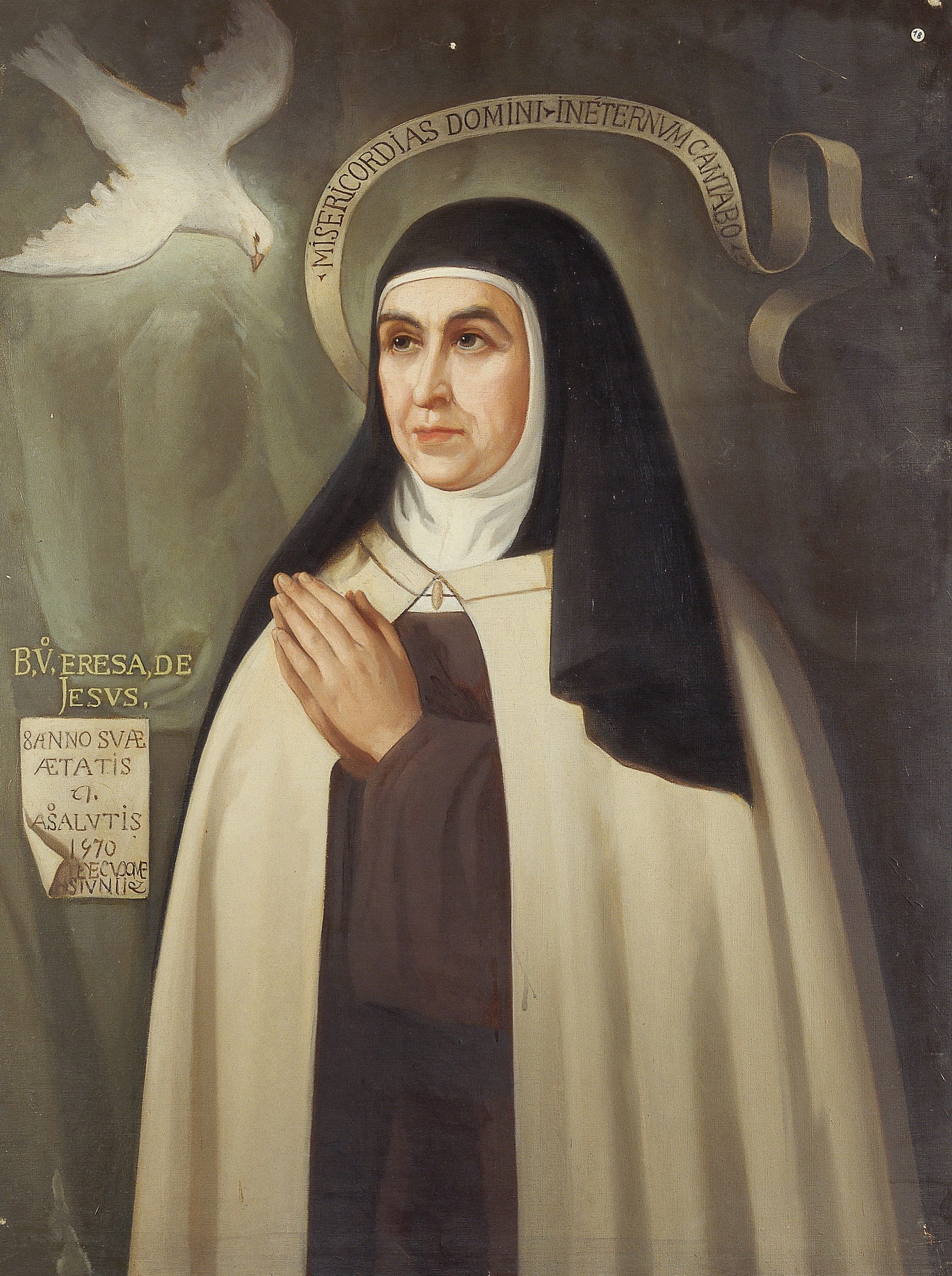
  • St. Teresa with the Dove of the Holy Spirit

    A common depiction — Teresa writing at her desk with the Holy Spirit dove at her shoulder.

Prayers Composed by This Saint
Prayers to This Saint
Patronages
Spanish writers and SpainThose in need of graceHeadache sufferersLacemakersHeart disease
Sources & Further Reading