
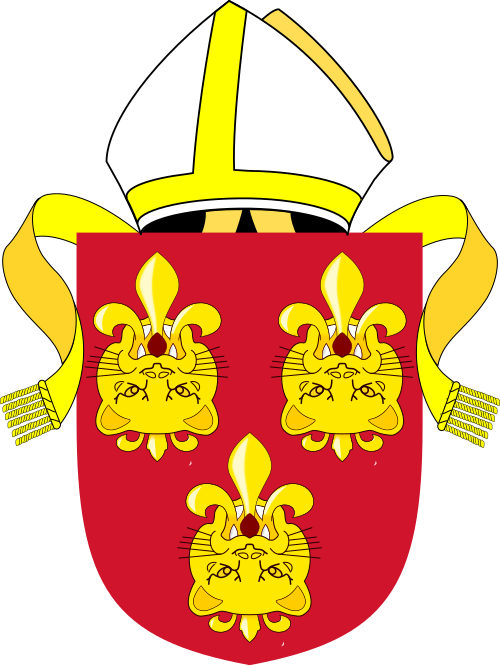
Thomas de Cantilupe was born around 1218 to William Cantilupe, feudal baron of Abergavenny — the Anglo-Norman noble family that produced Bishop Walter Cantilupe of Worcester (1237–1266, Thomas's uncle) and Nicholas Cantilupe (Thomas's cousin, cofounder of Beauchief Abbey).
Educated at the Universities of Paris, Orléans, and Oxford, Thomas received the Doctor of Canon Law from Orléans and the Doctor of Theology from Paris. He became Chancellor of the University of Oxford (1261–1263, 1273–1274) — the leading English canonist of the mid-13th century.
He served as Chancellor of England under King Henry III during the Second Barons' War (1264–1267) — chancellor 1265–1266 in the aftermath of the Battle of Lewes (May 14, 1264), aligned with the baronial party of Simon de Montfort. After Simon de Montfort's defeat at the Battle of Evesham (August 4, 1265) and the restoration of royal authority, Thomas withdrew to the academic life at Oxford and Paris.
He returned to serve as Chancellor of England briefly under King Edward I in 1272, then elected Bishop of Hereford in 1275 (consecrated December 8, 1275). His seven-year episcopate at Hereford (1275–1282) was devoted to the recovery of the alienated episcopal lands, the systematic pastoral visitation of the diocese, and the Catholic pastoral reform of the Herefordshire clergy.
Thomas entered into bitter conflict with Archbishop John Pecham of Canterbury (Franciscan, Archbishop 1279–1292) over the Canterbury visitation-rights and the canonical questions of episcopal jurisdiction. In February 1282, Archbishop Pecham excommunicated Thomas at the Council of Reading.
Thomas undertook the canonical appeal to Pope Martin IV against the excommunication — travelling to Italy in summer 1282. He died at Ferento near Orvieto (the papal court residence) on August 25, 1282, before the papal decision could be rendered.
His bones were boiled at Ferento to return the relics to Hereford (the medieval practice of relic-preparation for return-transportation). The relics were received at Hereford Cathedral on October 27, 1282, and interred in the Lady Chapel. On Easter Monday, April 3, 1287, Bishop Richard Swinefield translated the relics to a new shrine in the north transept of the cathedral.
The Hereford Cathedral shrine of St. Thomas became one of the principal pilgrim destinations of medieval England — rivalling the Canterbury Cathedral shrine of St. Thomas Becket in the late 13th and 14th centuries, with recorded miracles at the shrine numbering over 500 by the time of the canonization inquest.
Pope John XXII canonized Thomas on April 17, 1320 — the last pre-Reformation formal papal canonization of an English bishop.