
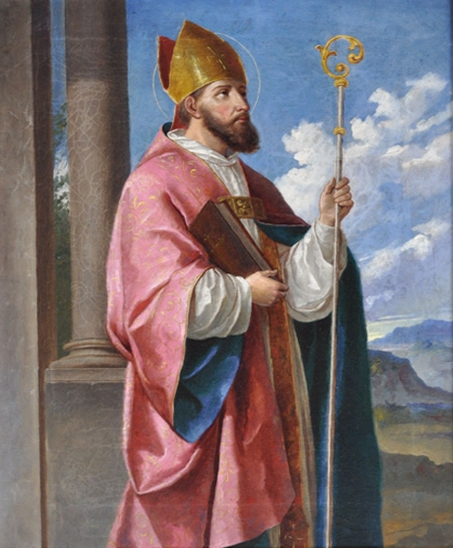
Valentine was a priest — some traditions say the bishop of Interamna, modern Terni — martyred at Rome on the Via Flaminia around the year 269, during the persecution under Emperor Claudius II Gothicus. His name appears in the earliest Roman lists of the martyrs, and Pope Julius I is said to have built a basilica over his tomb on the Via Flaminia in the fourth century — evidence of a cult already old and strong. Beyond this, almost everything told of him comes from later legend, which is why the Church, while keeping his cult, removed his feast from the universal calendar in 1969.
The traditional account: during the persecution Valentine was arrested for aiding Christians — the later legend adds, for secretly witnessing the marriages of Christian couples, since Claudius had allegedly forbidden young men to marry in order to fill his legions. Brought before the judge Asterius, Valentine spoke of Christ; Asterius put him to the test by presenting his blind adopted daughter. Valentine laid his hands on the girl's eyes and she received her sight, and Asterius's whole household was baptized. When word reached the emperor, Valentine was beaten with clubs and beheaded on the Via Flaminia.
The most famous flourish of the legend — that before his death he sent the healed girl a farewell note signed 'from your Valentine' — is medieval, and the association of his feast with romantic love was fixed by the poets: Chaucer's Parliament of Fowls (c. 1382) is the first text to connect February 14 with the pairing of lovers, on the belief that birds chose their mates that day. From Chaucer's conceit grew the whole tradition of valentines.
Two Valentines appear in the ancient martyrologies for February 14 — the priest of Rome and the bishop of Terni — and most scholars now think they are one man remembered in two places. Terni holds his principal shrine; his flower-crowned skull is venerated at Santa Maria in Cosmedin in Rome; and a reliquary given by Gregory XVI rests in the Carmelite church on Whitefriar Street, Dublin, where couples still come to have their engagement rings blessed.