
Three times a day, the bell that stops the work — and the Regina Caeli in Eastertide
The oldest daily habit in Western Catholic life: three versicles on the Incarnation with a Hail Mary after each, prayed at dawn, at noon, and at dusk when the bell rings — replaced through Eastertide by the Regina Caeli, sung standing.
How it grew
The Angelus has no founder and no single decree, and its history is a good corrective to the assumption that devotions must be instituted to be genuine. It assembled itself out of monastic habit over three hundred years.
The evening piece came first: by the thirteenth century, Franciscan houses and then whole towns rang a bell at nightfall for three Hail Marys — a custom Pope John XXII is generally credited with indulgencing in 1318. The morning bell, tied to the monastic office of Prime, followed in the fourteenth century. The noon bell came last, in the fifteenth, in several places attached to prayer for peace or against the Turkish advance. Only by about the sixteenth century did the three settle into one prayer with one name, taken from its opening words: <em>Angelus Domini nuntiavit Mariae</em> — the Angel of the Lord declared unto Mary.
What it actually prays
Its three versicles walk through the Annunciation: the angel's message, Mary's <em>fiat</em>, and 'the Word was made flesh and dwelt among us' — the last of which was, for centuries, said kneeling. The concluding collect asks that, having known the Incarnation by the message of an angel, we may be brought by the Passion and Cross to the glory of the Resurrection: the whole arc of salvation in one sentence, three times a day.
In Eastertide the Angelus gives way to the <em>Regina Caeli</em> — Queen of Heaven, rejoice — sung standing rather than knelt, because in the season of the Resurrection the Church does not kneel. Benedict XIV regularized this in the eighteenth century, and it holds from Easter Sunday through Pentecost.
The bell, the field, and the window
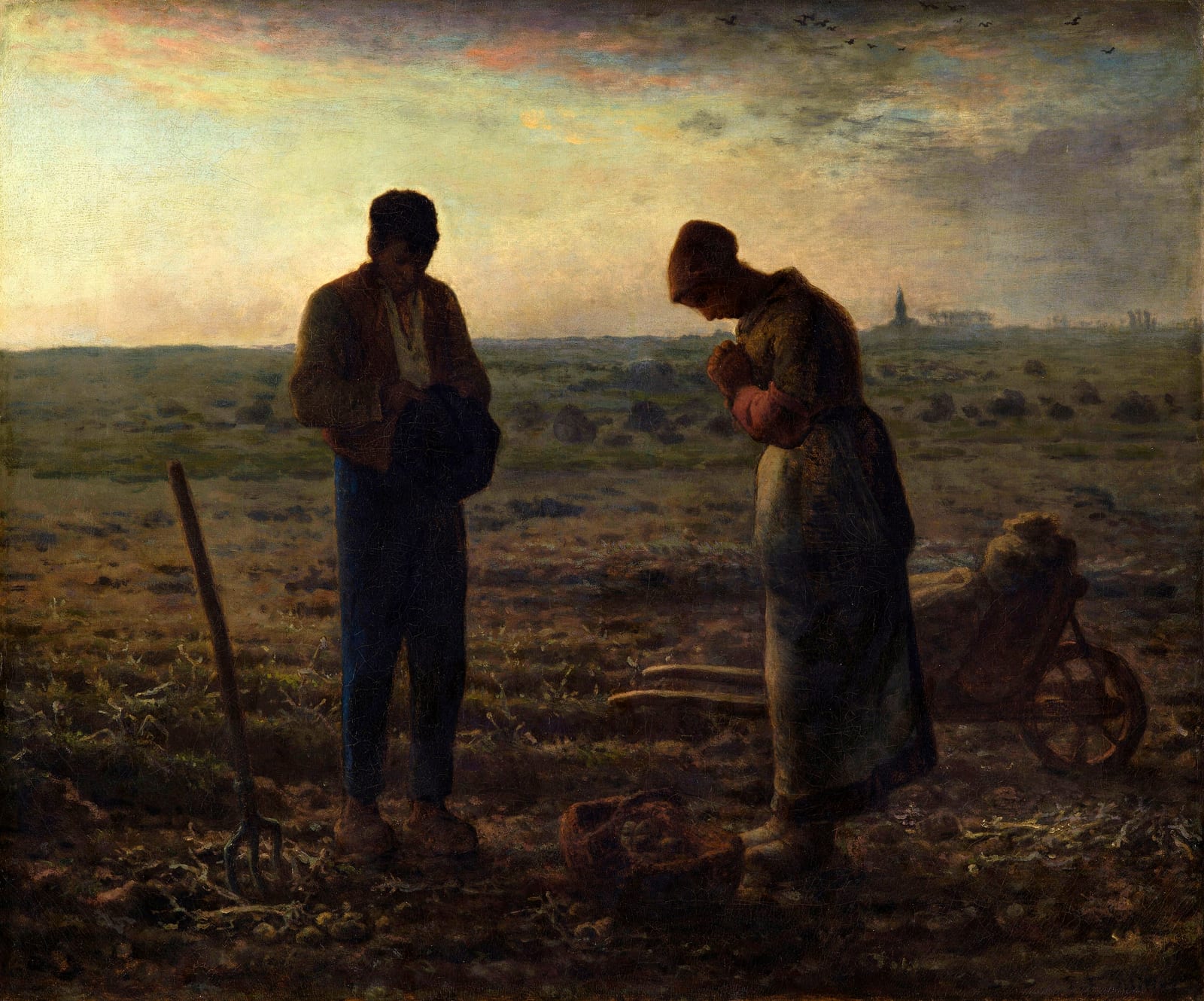
For most of European history the Angelus was not a private prayer but a public interruption: a bell that stopped ploughing, trading and argument three times a day, and put a village on the same words at the same moment. Millet's <em>L'Angélus</em>, painted between 1857 and 1859, catches the moment exactly — two peasants standing in a potato field at dusk with their heads down and the distant church spire behind them.
The custom survives most visibly at noon on Sundays in St. Peter's Square, where the pope prays the Angelus from the window of the Apostolic Palace and gives a short address before it. It is the same three versicles the fourteenth-century bell was rung for.
Living the Devotion
- 1.Pray it at six in the morning, at noon, and at six in the evening — or at whatever three hinges your own day actually has.
- 2.In Eastertide, from Easter Sunday through Pentecost, pray the Regina Caeli instead, and stand.
- 3.The traditional posture is to kneel at 'And the Word was made flesh', except on Sundays and through Eastertide.
- 4.A partial indulgence is attached to the Angelus, and to the Regina Caeli in its season.
- 5.If three times is not yet possible, keep the noon bell: it is the one that interrupts something.
In the Words of the Popes
"The Angelus, through its simple structure, its biblical character, its quasi-liturgical rhythm by which various times of the day are sanctified, and its openness to the Paschal mystery, retains its value unimpaired."
"The Angelus is a lovely way to recall in daily life the mystery of the Incarnation, in which the eternal Word entered our time."