
The more you honour me, the more I will bless you
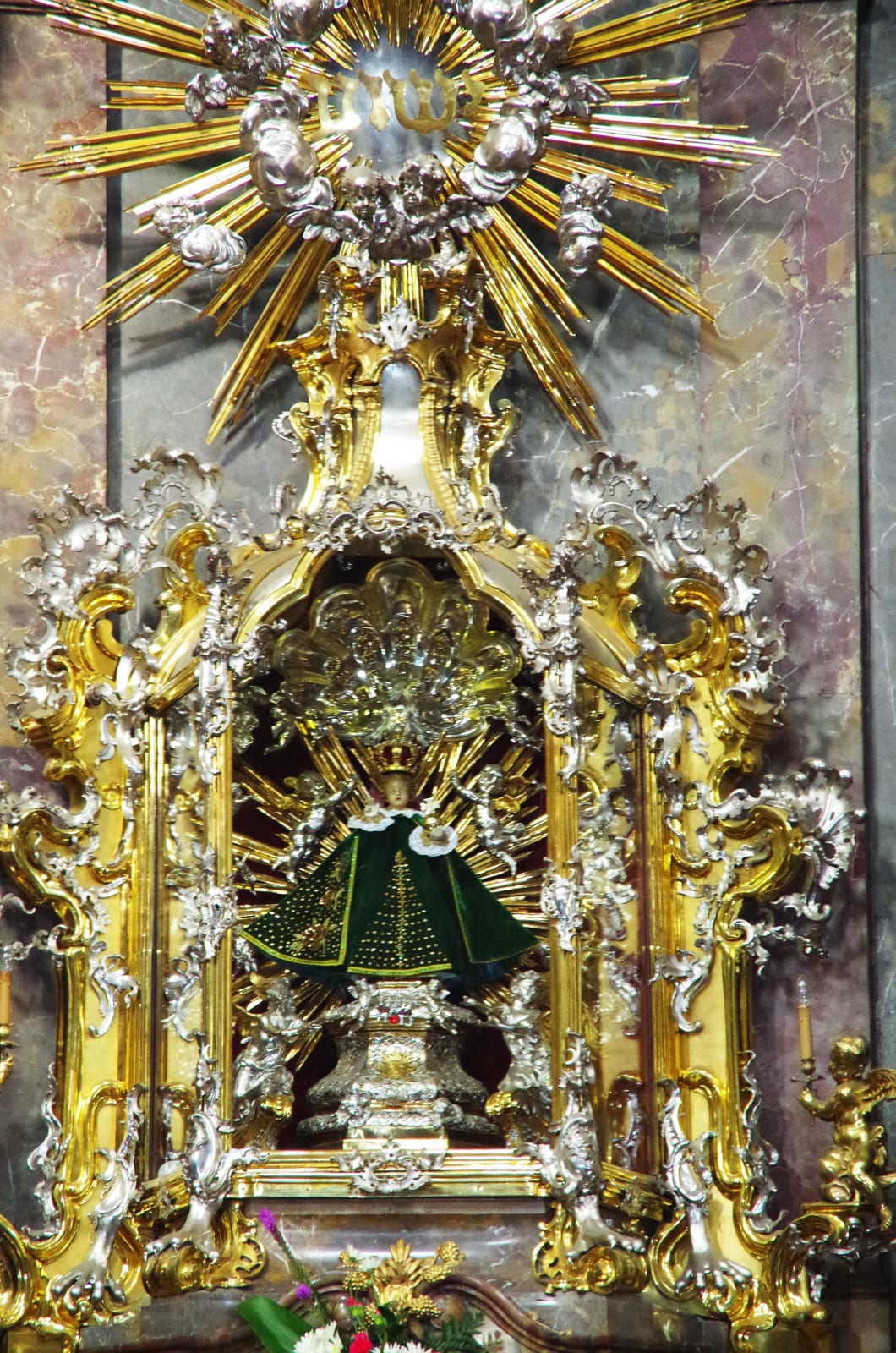
Devotion to the Christ Child under the form of a small Spanish wax statue kept by the Discalced Carmelites of Prague since 1628 — robed, crowned, and dressed in the colours of the liturgical year. It asks for nothing but the virtues of a child, and it has been carried in copies to every continent.
A Spanish statue in a Bohemian house
The Child is forty-seven centimetres tall, wood under linen under coloured wax, made in Spain in the second half of the sixteenth century by a hand nobody has named. María Manrique de Lara brought it to Bohemia when she married Vratislav of Pernštejn in 1556; her daughter Polyxena received it on her own marriage; and in 1628, a widow, Polyxena gave it to the Discalced Carmelites at Our Lady Victorious in the Lesser Town, with the words the order still repeats: 'I am giving you what I hold most dear. Honour this image and you shall never want.' The friars put it in the novitiate, and the novices prayed before it morning and evening.
In 1631 the Saxons took Prague, the friars fled, and the statue was thrown behind an altar with both hands snapped off. Six years later Father Cyril of the Mother of God, who had been one of those novices, came back, found it, and heard at prayer the words that give the devotion its shape: 'Have pity on me and I will have pity on you. Give me my hands and I will give you peace. The more you honour me, the more I will bless you.' The hands were remade; the house, which had been destitute, recovered; and from 1639 the friars kept a record of favours.
Crowned, dressed, and nearly forgotten
The statue went into the church in 1641 and in procession through the city in 1651. The Supreme Burgrave of Bohemia, Bernard Ignác of Martinic, paid for a gold crown, and on the first Sunday after Easter 1655 — 4 April — the auxiliary bishop Josef de Corte, standing in for the sick Cardinal Harrach, crowned the Child at Mass. From that year it has been a crowned king: the crown is why the statue is robed, and the robes are why the statue has a wardrobe. Maria Theresa embroidered one herself in 1754. The devotion spread with the empire.
It very nearly ended with the empire's reforms. Joseph II suppressed the Prague Carmel in 1784; the church became a parish church, the altar crumbled, and for ninety years the statue stood in a building nobody kept. The 1879 restoration of the altar was paid for, in the Carmelites' telling, by the Child himself, carried round the women's convents of Prague with a begging bag. The three-hundredth anniversary in 1928 was kept with splendour, and then the Nazi and Communist years closed the shrine for half a century. Pilgrims came anyway, most of them Spanish-speaking. The Carmelites returned in 1993.
How it went round the world
The Carmelites date the devotion's first spread to the mid-eighteenth century, through the Austrian lands, and its second, far larger one to the turn of the twentieth, when copies travelled across the Atlantic with Spanish and Portuguese priests and with emigrants. It took deepest root in Spain, the statue's own country, and in South America; missionaries carried it to India, China, Korea and the Philippines; emigrants took it to North America, where the Discalced Carmelites of the United States printed the novena leaflets that put Father Cyril's prayer into millions of homes. In Ireland the Child became a household figure, given at weddings and set outside the door the night before to secure fine weather — a custom the Prague Carmelites do not mention and which the Church has never blessed, but which shows how far a wax figure from Bohemia could go.
What travelled was never the statue's power but the Child's humility. The Carmelites of Prague say it plainly: the feast 'seeks to recall that Jesus was a fragile and defenceless child and, at the same time, as God, holds the whole world in His hands.'
A pope at the altar, 2009
On the afternoon of 26 September 2009, Benedict XVI made Our Lady Victorious his first stop in Prague. He greeted the cardinals and the families, said that the Child Jesus 'calls to mind the mystery of the Incarnation', entrusted every struggling family in the world to the Holy Infant, spoke of children who are neither loved nor welcomed, and then turned to the children in the church and told them to be 'obedient, good and kind'. He left a gold crown — now in the shrine museum with the crown of 1820 — and a prayer of his own composition that the Carmelites give to every pilgrim.
The Promises
The Carmelites of Prague publish no list of promises, and the Church has attached none. One sentence stands behind the whole devotion, and it is a tradition, not a record.
"The more you honour me, the more I will bless you."
No contemporary document records the words; they come down through the order and were in print by the eighteenth century, when the Prague Carmelite Emericus a S. Stephano published the first history of the statue. The English page of the Prague shrine's own history does not quote them; the Carmelite nuns of Boston and the Carmelite Fathers' leaflets do. They are a promise of blessing in return for honour, which is to say the ordinary logic of every devotion, and they promise nothing about weather, money or marriages.
Living the Devotion
- 1.The novena: nine days of the same prayer, most often Father Cyril's 'O Child Jesus, I have recourse to Thee', before the coronation feast or before Christmas; the Prague Carmelites publish a nine-day novena of their own on the characteristics of childhood, and will send it by e-mail.
- 2.The twenty-fifth of the month: the Child's day, kept since Pius VII granted a plenary indulgence (23 November 1819) for the public recitation of the twelve mysteries of the Holy Childhood on the twenty-fifth of every month; Pius IX indulgenced a novena of five offerings for the nine days before it (23 September 1846).
- 3.The chaplet: three Our Fathers for the Holy Family and twelve Hail Marys for the twelve years of the Child's hidden life, each preceded by 'And the Word was made flesh' — the chaplet of the Carmelite Marguerite of the Blessed Sacrament of Beaune (1636), prayed before the Prague statue and on this site.
- 4.The robes: the statue is dressed by the Carmelite Sisters of the Child Jesus from a wardrobe of some three hundred garments — a white alb, then a tunic and cloak in the colour of the season, lace ruffs at neck and wrist, the orb and the crown — in white for Christmas, Easter and feasts, red for Holy Week and Pentecost, violet for Advent and Lent, green through Ordinary Time, and gold on the greatest days.
- 5.The coronation feast: the first Sunday of May, the anniversary of 1655, when the Child wears the ermine robes and the crown of 1767 and stands in the sanctuary all weekend; roses are presented at the noon Mass in English.
- 6.At home: a copy of the statue, robed, in the house; the family's prayer before it; and the practice that Benedict XVI set before the children of Prague — to be 'obedient, good and kind', and 'always turn to him in trust'.
In the Words of the Popes
"The image of the Child Jesus calls to mind the mystery of the Incarnation, of the all-powerful God who became man and who lived for thirty years in the lowly family of Nazareth, entrusted by Providence to the watchful care of Mary and Joseph."
"The figure of the Child Jesus, the tender infant, brings home to us God's closeness and his love. We come to understand how precious we are in his eyes, because it is through him that we in our turn have become children of God. Every human being is a child of God and therefore our brother or sister, to be welcomed and respected."
"You are greatly loved by the Child Jesus, and you should return his love by following his example: be obedient, good and kind. Learn to be, like him, a source of joy to your parents. Be true friends of Jesus, and always turn to him in trust."