
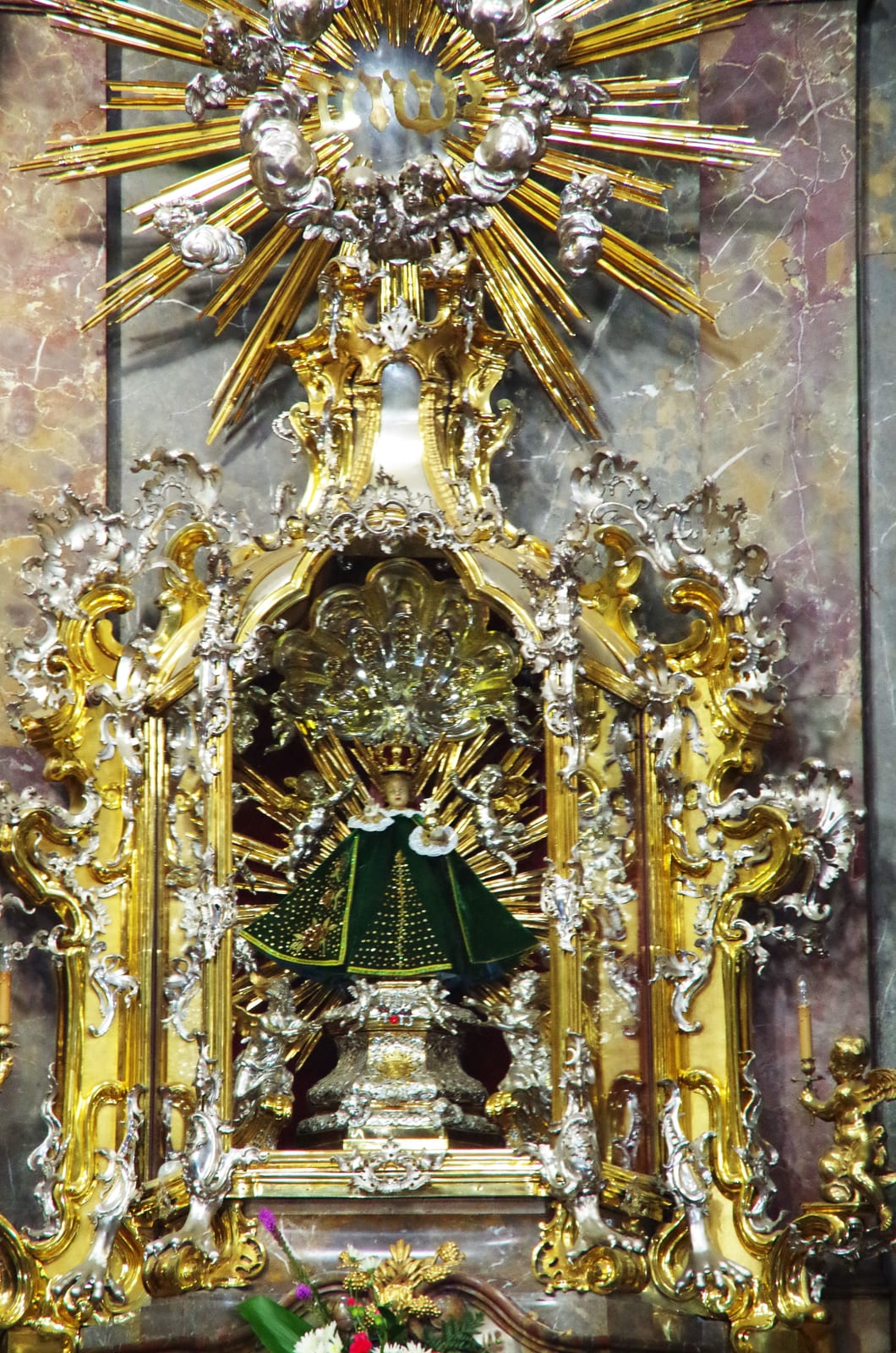
The statue is small: forty-seven centimetres, a wooden core under linen, modelled over in coloured wax, the right hand raised in blessing and the left holding an orb topped with a cross. Its maker is unknown; the Carmelites say only that it was made in Spain in the second half of the sixteenth century, and the legend that it belonged to St Teresa of Ávila is told in Prague as a legend. Its route is documented: it came to Bohemia with María Manrique de Lara, who married Vratislav of Pernštejn in 1556, and passed to her daughter Polyxena as a wedding present. In 1628 Polyxena, widow of the Chancellor Lobkowicz, gave it to the Discalced Carmelites at Our Lady Victorious, with the words the order still repeats: 'Reverend Father, I am giving you what I hold most dear. Honour this image and you shall never want.'
The friars put it in the novitiate chapel, so that the novices would learn the virtues of the Child. Then the war reached Prague. In November 1631 the Saxon army took the city, the Carmelites fled, the friary was plundered, and the statue was thrown behind an altar among the rubbish with both hands broken off. It lay there six years.
In 1637 the friars came back. Among them was Father Cyril of the Mother of God, a Luxembourger (1590–1675) who had made his novitiate before the statue; he found it handless and set it up in the oratory anyway. The words he reported hearing at prayer come down through the Carmelite tradition of the house, not through any process: 'Have pity on me and I will have pity on you. Give me my hands and I will give you peace. The more you honour me, the more I will bless you.' The prior would not pay for the repair; the money came as a gift, and new wax hands were made. From 1639 the friars credited the Child with cures, with the city's protection in the Swedish siege of that year, and with their own recovery from want; the walls of its alcove are covered with marble plaques of thanks.
In 1641 the statue went into a chapel of the church; the chapel was blessed in 1648; in 1651 it was carried in procession through the churches of Prague. Bernard Ignác of Martinic, Supreme Burgrave of the kingdom, commissioned a gold crown, and on 4 April 1655, the first Sunday after Easter, the statue was solemnly crowned at Mass. The Carmelites' pages say 'the Bishop of Prague'; the Czech literature is more precise: Cardinal Harrach, the archbishop, was ill, and the crown was placed by his auxiliary, Josef de Corte (Giuseppe Corti, titular bishop of Sebaste). That crown is lost; the one worn today on the feast dates from 1767, and the anniversary is kept on the first Sunday of May.
In 1741 the crowds forced a move to the present altar on the right of the nave. Maria Theresa embroidered a robe for the statue herself in 1754, and the devotion spread through the Habsburg lands — until Joseph II dissolved the Carmelite house in 1784. The church became a parish church, the altar decayed, and the devotion dwindled for nearly a century, though the statue never left the building. The altar was restored in 1879, and by 1900 copies of the Prague Child had gone wherever Spanish and Portuguese priests and Central European emigrants went: to Spain, to South America, to India, China, Korea, the Philippines and North America. Nazis and Communists silenced the shrine for fifty years without stopping the pilgrims; the Carmelites returned in 1993.
On 26 September 2009, on the first afternoon of his visit to the Czech Republic, Benedict XVI came to the church, prayed before the statue, spoke to the children and families gathered there, and left a gold crown; it is kept in the shrine museum beside the crown of 1820, and the prayer he composed is given to pilgrims. The Church has never pronounced on any cure attributed to the Child. What it has done is crown the image, bless its chapel, indulgence the twelve mysteries of the Holy Childhood on the twenty-fifth of every month, and send a pope to kneel before it.