
O Mary, conceived without sin, pray for us who have recourse to thee
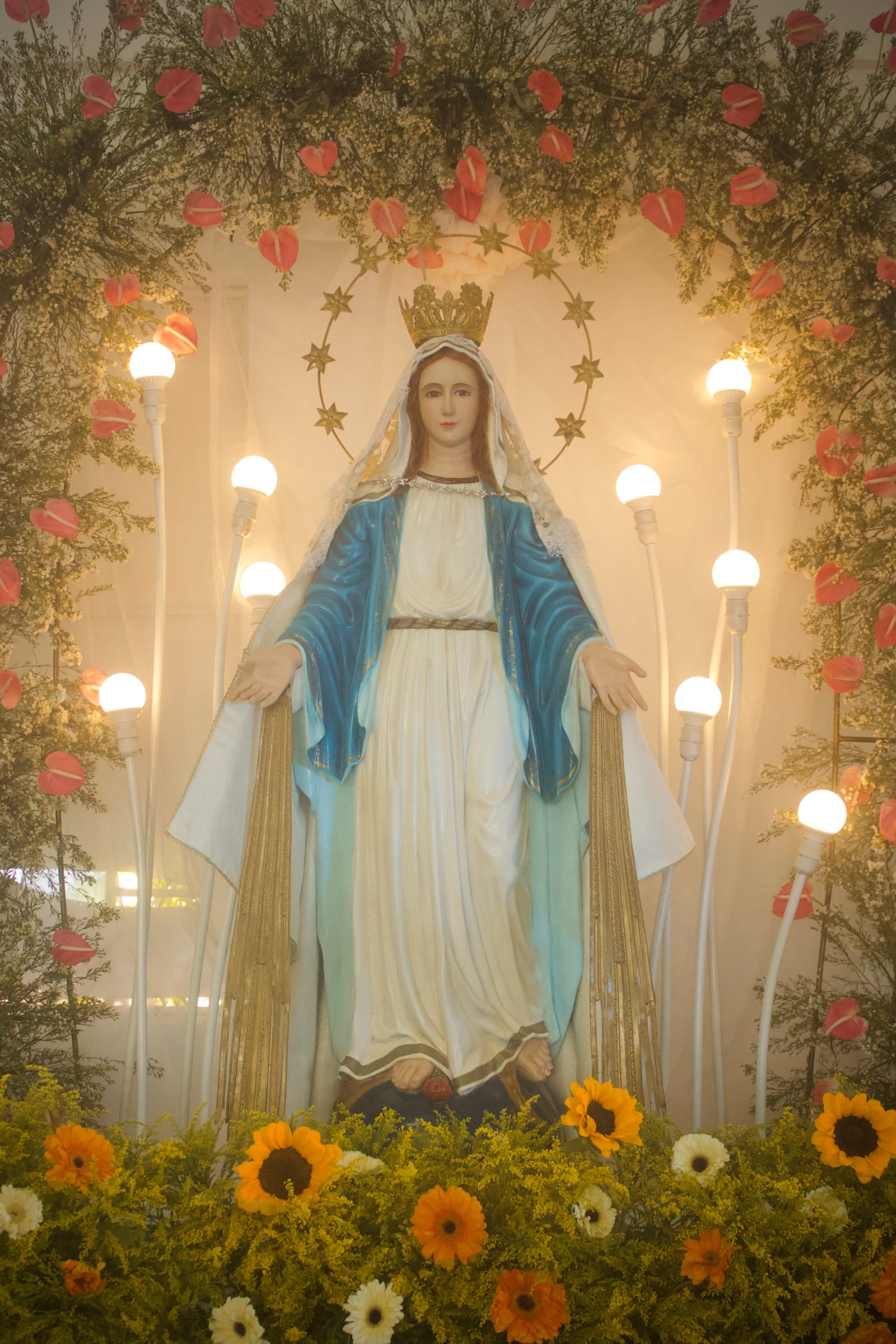
The medal shown to St. Catherine Labouré at the Rue du Bac in Paris in 1830 — Mary standing on the globe with rays streaming from her hands, and on the reverse her monogram, the cross, the two hearts, and twelve stars. The people named it miraculous; the Church never did, and never had to.
The nights of 1830
Catherine Labouré, a farmer's daughter from Burgundy, was a twenty-four-year-old novice with the Daughters of Charity at 140 Rue du Bac when, on the night of July 18, 1830, she was woken by a child and led to the chapel. There, she recorded, the Blessed Virgin came and sat in the director's chair, and Catherine knelt with her hands in the Virgin's lap and spoke with her for something over two hours — a scene she never described without weeping.
The medal came in a second apparition, on November 27, 1830. Catherine saw the Virgin standing on a globe, crushing a serpent beneath her foot, with rays of light streaming from rings on her fingers; around her, in an oval, the words <em>O Marie conçue sans péché, priez pour nous qui avons recours à vous</em>. Some of the gems, she noticed, cast no light, and was told that these were the graces people forget to ask for.
The oval then turned, and she saw the reverse: the letter M surmounted by a cross, and beneath it two hearts — one crowned with thorns, one pierced by a sword — with twelve stars around the rim. She was told to have a medal struck after this pattern.
How it spread, and the name it was given
Catherine told no one but her confessor, Fr. Jean-Marie Aladel, who did nothing for two years. Under pressure and after a third apparition, he brought the matter to the Archbishop of Paris, Hyacinthe-Louis de Quélen, who authorized the striking; the first 1,500 medals were made in June 1832, in the middle of a cholera epidemic that killed some twenty thousand Parisians.
The Daughters of Charity distributed them among the sick, and the accounts of cures and conversions that followed were numerous enough that within a few years the medal had acquired a nickname from the people who wore it. That is the important detail: the Church struck a Medal of the Immaculate Conception. Ordinary Catholics called it the Miraculous Medal, and the name stuck. By 1836 the canonical inquiry had declared the apparitions genuine; by 1839 over ten million medals had been distributed.
The most famous single case is Alphonse Ratisbonne, a Jewish banker from Strasbourg, hostile to Christianity, who accepted a medal in Rome on a wager in January 1842 and — on January 20, in the church of Sant'Andrea delle Fratte, waiting a few minutes while a friend arranged a funeral — came out converted, and was baptized eleven days later. He was baptized eleven days later, and spent the rest of his life as a priest working in the Holy Land. The conversion was examined by formal ecclesiastical process and declared miraculous by Church authority.
The invocation, and 1854
The medal's inscription is the point most easily missed. In 1830 the Immaculate Conception was the common belief of Catholics and the teaching of theologians, but it was not yet defined; it would be another twenty-four years before Pius IX defined it in <em>Ineffabilis Deus</em> on December 8, 1854. The medal put the doctrine into the hands and onto the necks of millions of ordinary people, in a single sentence they prayed daily, in the decades immediately before the definition.
Twenty-eight years after the medal, at Lourdes in 1858, a girl asked the lady in the grotto her name and was answered: <em>Que soy era Immaculada Councepciou</em> — I am the Immaculate Conception. Bernadette wore a Miraculous Medal.
The Promises
One promise, and one caution — and on this the Church has been careful, because a medal is the easiest of all devotions to misuse.
"All who wear it will receive great graces, especially if they wear it around the neck."
Given with a condition attached in the same apparition: the graces are abundant for those who ask for them. The rays that cast no light were shown precisely to make that point — the medal is not a battery of grace that works regardless of the wearer, but an invitation to ask. Worn with the invocation actually prayed, it is what the Church calls a sacramental: a sign that disposes the soul to receive what God is already willing to give.
"The medal is a sacramental, and not a charm."
This is the Church's own qualification, and she has never been shy about it. A sacramental does not work of itself the way a sacrament does; it works through the prayer of the Church and the disposition of the person using it. To wear the medal while refusing conversion is to wear a request one has no intention of making. Catherine herself, who spent the following forty-six years in the obscurity of a hospice laundry and stable yard caring for old men, and let no one know she was the seer until the last months of her life, is the best commentary on what the devotion is for.
Living the Devotion
- 1.Wear it around the neck, and pray the invocation on it: 'O Mary, conceived without sin, pray for us who have recourse to thee.'
- 2.Ask. The apparition's own image for grace unasked-for was a gem that cast no light.
- 3.The medal is traditionally blessed by a priest, though no special enrollment is required — unlike the scapular, it has no confraternity attached.
- 4.The Novena of the Miraculous Medal is kept on Mondays in many parishes, a devotion that began in Germantown, Philadelphia, in 1930.
- 5.November 27, the anniversary of the second apparition, is kept as the feast of the Manifestation of the Blessed Virgin of the Miraculous Medal.
In the Words of the Popes
"She was the saint of silence — she who saw, and spoke only to her confessor, and for forty-six years said nothing."
"The Miraculous Medal recalls the mystery of the Redemption, the love of the Heart of Christ and of the sorrowful Heart of Mary, and it invites us to trust in her intercession."