MIRACULOUS MIRACLES™

The Scapulars

Clothed in Mary's garment — the Brown Scapular of Mount Carmel and its family

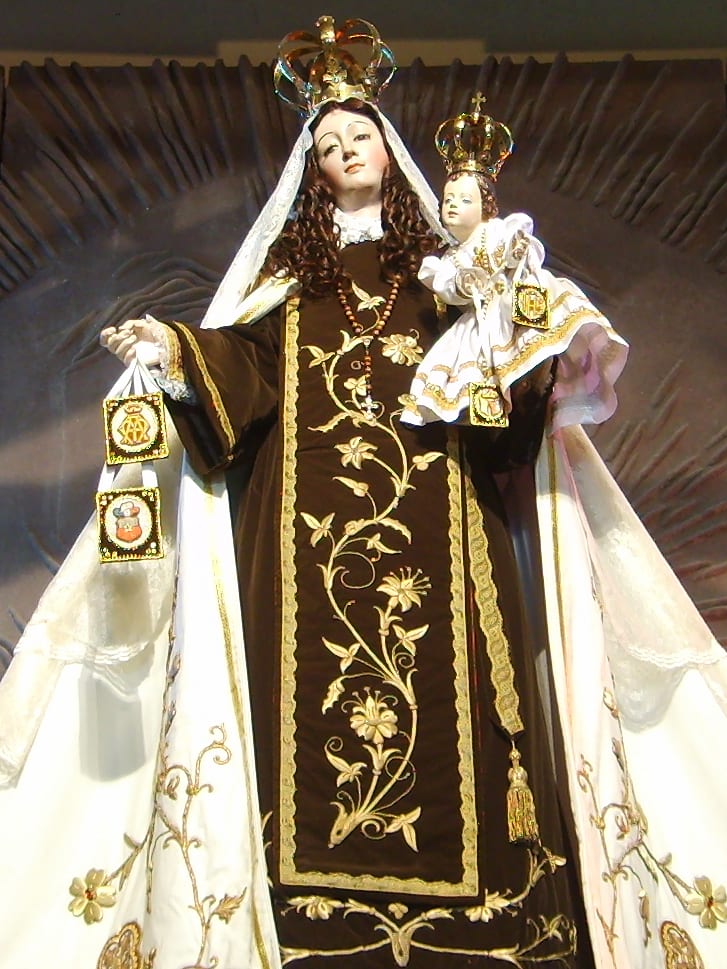
Two small squares of wool joined by cords and worn over the shoulders — a miniature religious habit that clothes the wearer in the spiritual family of an order. The Brown Scapular of Our Lady of Mount Carmel is the most beloved sacramental in the Church after the Rosary.

The Scapulars
Where the Church stands
The scapular is a sacramental formally blessed by the Church: the Congregation for Divine Worship confirmed the Rite of Blessing and Enrollment in the Scapular on November 29, 1996, and Pope St. John Paul II wrote in 2001 that he had worn the Scapular of Carmel over his heart since his youth. Whatever any single medieval document may or may not prove, the devotion itself rests on something far stronger: more than seven centuries of the Church's continuous blessing, preaching, and papal commendation.

What a scapular is

The word comes from the Latin scapulae — the shoulder blades. In the monastic orders the scapular was a full-length apron of the habit, hanging front and back, worn through the day's labor; the Rule of St. Benedict already mentions it. The small devotional scapular is that garment in miniature: two squares of wool joined by cords, one square resting on the chest and one on the back. To wear it is to be clothed, in a small and hidden way, in the habit of a religious family — to belong to it, share its spirituality, and stand under the patronage it enjoys.

The Church counts the scapular among the sacramentals — sacred signs that prepare the soul to receive grace and sanctify the ordinary hours of life (Catechism of the Catholic Church, 1667–1670). A sacramental is not a charm and does not work automatically; the Catechism is direct that sacramentals bear fruit through the Church's intercession and the disposition of the one who uses them. A scapular worn as jewelry does nothing; a scapular worn as a daily, silent act of consecration to Mary is a school of holiness.

The Brown Scapular and St. Simon Stock

The hermits of Mount Carmel in the Holy Land, gathered in the twelfth century around the memory of the prophet Elijah and devoted to the Mother of God, migrated to Europe in the thirteenth and became the Carmelite Order. The tradition cherished by Carmel tells that on July 16, 1251, the Blessed Virgin appeared to the English prior general St. Simon Stock at Aylesford, holding the brown scapular of the order and saying: 'This shall be a privilege for you and for all Carmelites: whosoever dies clothed in this habit shall not suffer eternal fire.'

What do the records show? The earliest surviving accounts of Simon's life do not mention the vision; the first written references appear in the late fourteenth century, and the earliest liturgical office in his honor was composed at Bordeaux in 1435. Historians, including the Carmelite Order's own, are frank that the documentary trail begins generations after 1251. But the conclusion the Church draws from this is worth stating carefully: the devotion does not rest on one parchment. It rests on what is beyond all historical doubt — that for over seven hundred years the Church has blessed this practice, extended its feast to the universal calendar, enriched it, preached it, and seen it bear fruit in countless lives. Tradition is not less than history; it is the Church's living memory, tested by time.

The scapular's meaning, as the Carmelites themselves teach it today, is threefold: it is Mary's garment, a sign of belonging to her; it is a commitment to imitate her life of prayer and obedience; and it is a pledge of her maternal protection, above all at the hour of death — which is exactly what the Church prays for every one of her children in the Hail Mary.

Carmel at Lourdes and Fátima

Two of the most scrutinized apparitions in the Church's history close with Carmel's sign. At Lourdes, the eighteenth and final apparition to St. Bernadette came on July 16, 1858 — the feast of Our Lady of Mount Carmel. And at Fátima on October 13, 1917, during the miracle of the sun, the three children saw a final tableau in which, in Sr. Lucia's account, Our Lady appeared as Our Lady of Mount Carmel, holding the scapular toward the world. Asked years later why, Lucia answered simply that Our Lady wants everyone to wear it — 'the scapular and the Rosary are inseparable.' Both events are told in full in this catalogue.

The medal, the enrollment, and the living practice

Because the scapular is an enrollment into the Carmelite family and not a private accessory, it is first received from a priest with the Church's blessing — a moment for which the Church published a formal rite, confirmed in 1996. Once enrolled, worn-out scapulars are simply replaced without a new ceremony. Since a decision of Pope St. Pius X in 1910, the faithful who have been enrolled may substitute a blessed scapular medal, bearing the Sacred Heart on one side and Our Lady on the other — a concession for practicality that the popes granted while still expressing their preference for the cloth.

The Promises

These are the promises the tradition attaches to the Brown Scapular, each shown with its standing. Read them the way the Church reads them: not as legal clauses that bind God, but as expressions of a mother's real patronage — fulfilled in those who wear the scapular as it is meant to be worn, as a life of devotion and not a substitute for one.

"Whosoever dies clothed in this habit shall not suffer eternal fire."

The words of Our Lady to St. Simon Stock, tradition of 1251 · Held by tradition

The vision's earliest written attestation comes from the late fourteenth century. The Church has never defined the promise, but she has done something arguably weightier: blessed and commended the devotion continuously for seven centuries. Rightly understood, the promise is Mary's pledge to obtain for her faithful child the grace of final perseverance — and no one who wears her garment while living in her Son's friendship needs to fear it will fail.

"The Sabbatine Privilege — that Our Lady will come to the aid of the souls of enrolled wearers in purgatory, especially on the Saturday after their death."

Attributed to a bull of Pope John XXII, dated March 3, 1322 · Tradition, with a note on the records

The bull does not appear in John XXII's registers, and scholars — including the Carmelite Order's own historians — hold it to be apocryphal. The Holy See addressed this with great care in 1613: without pronouncing on the document, it permitted the faithful to be taught that Mary aids the souls of departed scapular wearers by her intercession, especially on Saturday, the day the Church dedicates to her. That moderated form — Mary's real help for her own, not a scheduled release — is what the Church allows to be preached, and it asks nothing of the document at all.

"The scapular is a sign and pledge of Mary's maternal protection through life."

The continuous teaching of the popes, Pius XII to John Paul II · Confirmed by the Church's teaching

This is the promise the Church herself vouches for. Pius XII called the scapular 'a sign of consecration to the Immaculate Heart of Mary'; John Paul II called it 'an evocative synthesis of Marian spirituality.'

Living the Devotion

  1. 1.Be enrolled once by a priest, using the Church's rite of blessing and enrollment — any priest may do it, and it takes two minutes.
  2. 2.Wear the scapular (or, once enrolled, the scapular medal) day and night, as a silent habit of belonging to Mary.
  3. 3.Live the consecration it signifies: chastity according to your state of life, and some daily prayer to Our Lady — the Rosary is the natural companion; the traditional norm was the Little Office of the Blessed Virgin.
  4. 4.When a scapular wears out, replace it — no new enrollment is needed. Old blessed scapulars are burned or buried, not thrown away.

In the Words of the Popes

"Let it be your sign of consecration to the Immaculate Heart of Mary, which we are particularly urging in these perilous times."

— Pope Pius XII, 1950

"I too have worn the Scapular of Carmel over my heart for a long time! Out of my love for our common heavenly Mother, whose protection I constantly experience, I hope that this Marian year will help all the men and women religious of Carmel and the devout faithful who venerate her with filial affection to grow in her love."

— Pope St. John Paul II, 2001

The family of scapulars

The Brown Scapular is the eldest of a family. Each of these was born in its own century, approved by the Church, and carries its own accent of devotion.

The Green Scapular

1840 · Paris

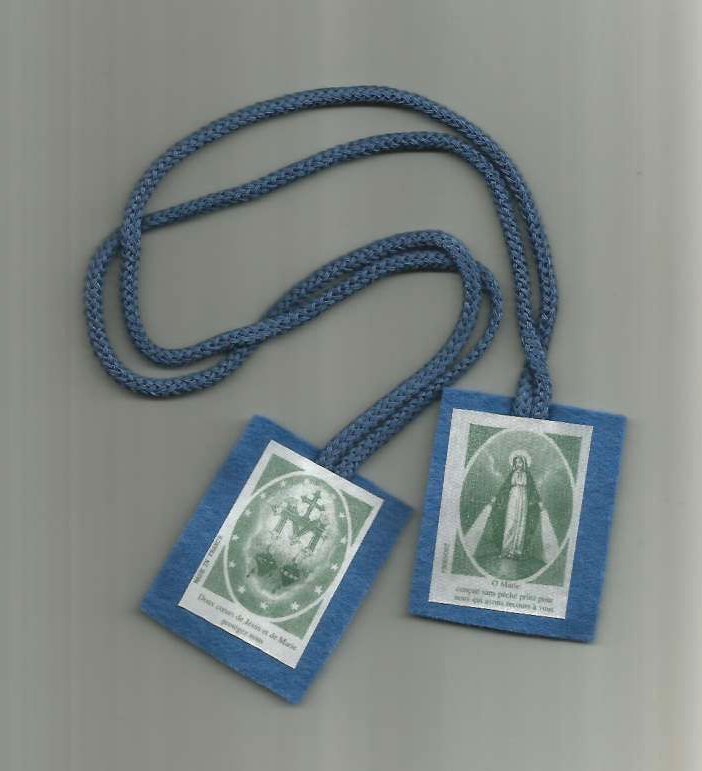
The devotion for conversions and the sick — a single green panel of Mary's Immaculate Heart, given through Sr. Justine Bisqueyburu, Daughter of Charity, in the same decade of grace that gave the Church the Miraculous Medal.
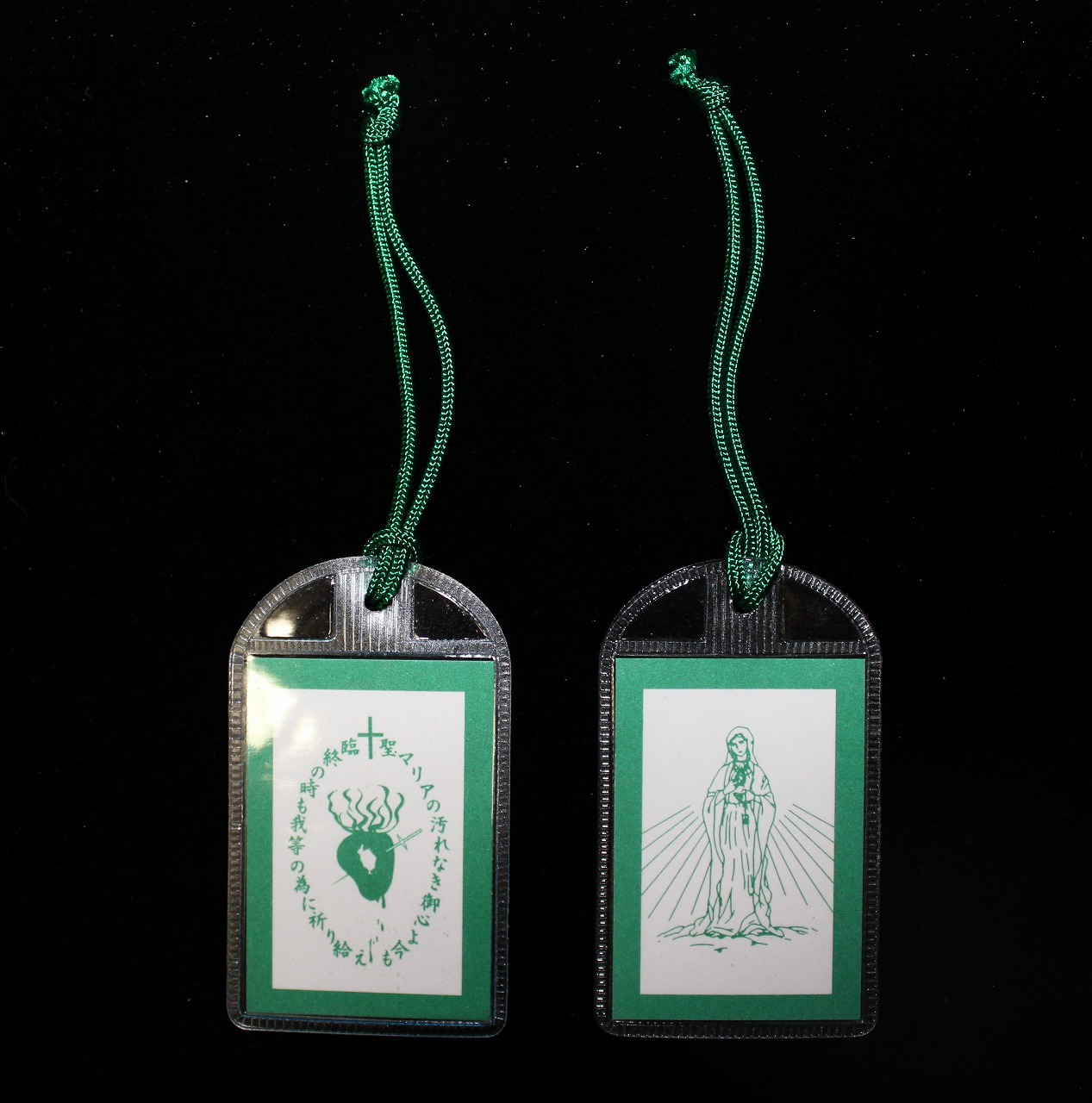
The Green Scapular

Beginning on September 8, 1840 — the feast of Our Lady's Nativity — the Blessed Virgin appeared to Justine Bisqueyburu, a young Daughter of Charity, holding in her hand a green cloth badge: on one side Mary herself, on the other her Immaculate Heart pierced by a sword, ringed by flames and surmounted by a cross, encircled with the words 'Immaculate Heart of Mary, pray for us now and at the hour of our death.' Strictly speaking it is a badge rather than a two-panel scapular, and it obeys gentler rules than the Brown: no enrollment is required — any priest's blessing suffices.

Its distinctive grace is missionary. The green scapular may be given to someone far from the faith, laid near the sick, or even carried secretly on behalf of a person who would refuse it — the one prayer being said daily by the wearer, or by the giver when the wearer cannot or will not pray it. Generations of stories of deathbed conversions surround it. Pius IX approved the devotion twice, in 1863 and again in 1870, with the words: 'Write to these good sisters that I authorize them to make and distribute it.'
The Red Scapular of the Passion

1846 · Paris

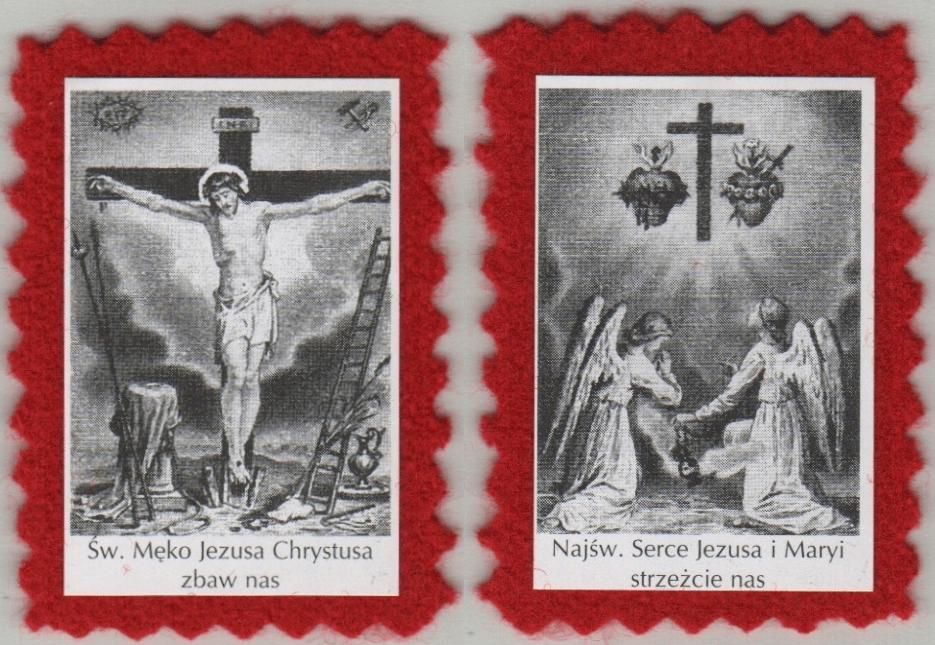
Christ crucified on red wool with the prayer 'Holy Passion of Our Lord Jesus Christ, save us' — shown in vision to Sr. Apolline Andriveau, and approved by Pius IX within a year.

The Red Scapular of the Passion

On July 26, 1846, in the chapel of the Daughters of Charity at Troyes, Sr. Apolline Andriveau saw Our Lord holding a scapular of red wool: on one side Christ on the Cross amid the instruments of the Passion, with the words 'Holy Passion of Our Lord Jesus Christ, save us'; on the other, the Hearts of Jesus and Mary beneath a cross, with 'Sacred Hearts of Jesus and Mary, protect us.'

Pius IX approved the scapular on June 25, 1847, entrusting its blessing to the Congregation of the Mission — St. Vincent de Paul's priests — and the tradition attaches to its devout wearing a great increase of faith, hope, and charity each Friday, the day of the Passion. It is the scapular of those who wish to keep the Cross literally close to the heart.

The Blue Scapular of the Immaculate Conception

1617 · Naples

Born from the visions of Venerable Ursula Benincasa two centuries before the dogma of 1854 — sky-blue wool in honor of the Immaculate Conception, offered for the conversion of sinners.

The Blue Scapular of the Immaculate Conception

On the feast of the Purification, February 2, 1617, the Neapolitan foundress Ursula Benincasa saw the Blessed Virgin robed in white with a mantle of sky blue, the Christ Child in her arms, promising abundant graces to those who would honor her Immaculate Conception and wear a small sky-blue scapular in its honor. Ursula's Theatine nuns took the blue habit; the little scapular spread from Naples through the whole Church.

The devotion carries a double intention: personal consecration to Mary conceived without sin, and intercession for the conversion of sinners. The popes enriched it repeatedly — Clement X extended its blessing beyond the Theatines in 1671 — and when Pius IX defined the Immaculate Conception as dogma in 1854, the wearers of the blue had been keeping the feast on their shoulders for over two hundred years.

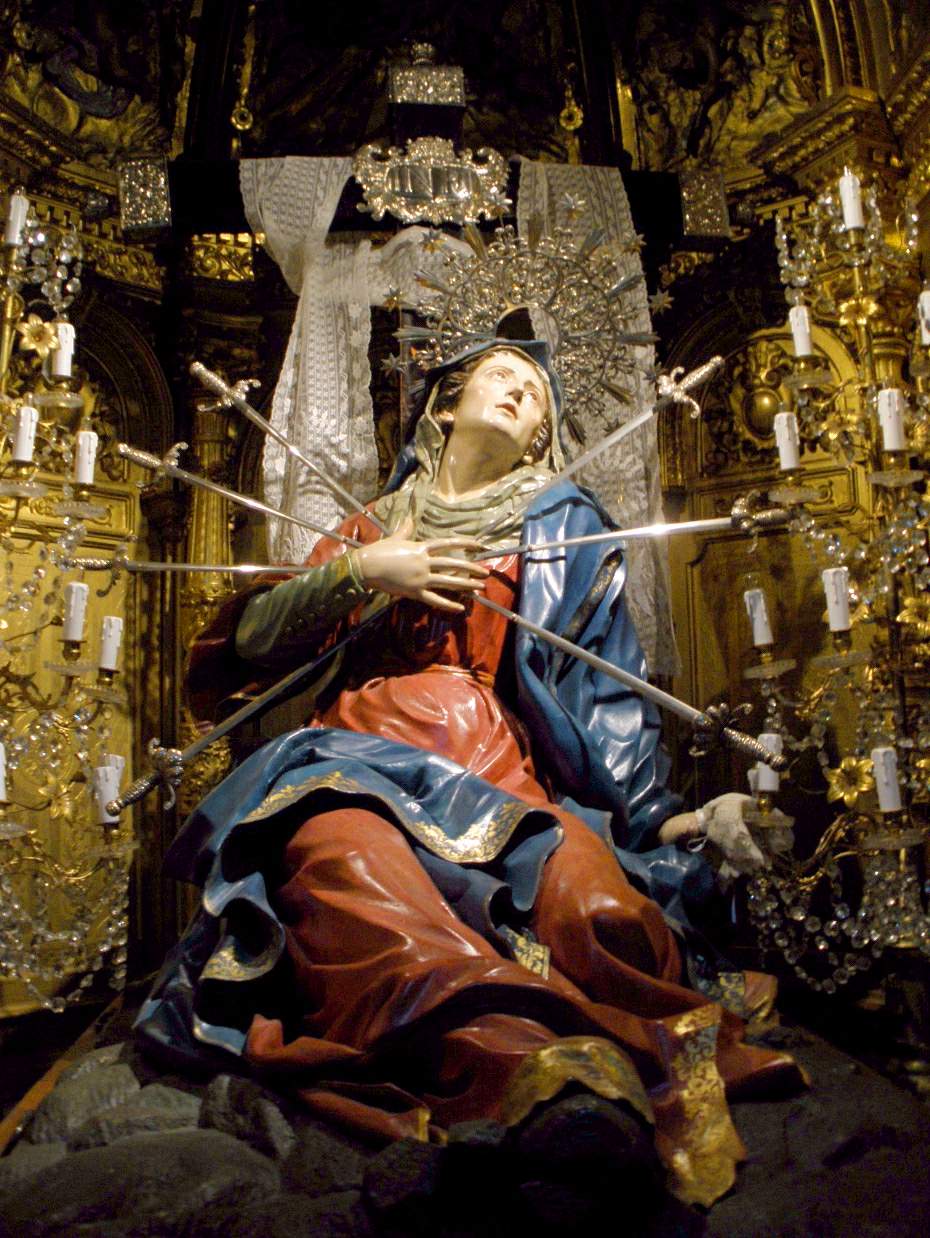
The Black Scapular of the Seven Sorrows

13th–17th century · Servite Order

The Servites' miniature habit, bearing the image of Our Lady of Sorrows — the oldest habit of compassion in the Church: to stand with the Mother beneath the Cross.

The Black Scapular of the Seven Sorrows

The Order of the Servants of Mary — the Servites, founded at Florence in 1233 by seven merchant-saints who left everything for Our Lady — received as its charism the compassion of Mary: to keep her company in the seven sorrows that run from Simeon's prophecy to the burial of her Son. The black scapular is their habit in miniature, bearing the image of the Mother of Sorrows, and admission to it joins the wearer to the Servite confraternity.

Its practice is meditative before it is anything else: the wearer takes up the Seven Sorrows as a school of com-passion in the literal sense — suffering-with. The devotion's classic prayer, the Seven Sorrows chaplet, walks each sorrow with a Hail Mary, and the Church has attached her blessing to the scapular since the seventeenth century.

The White Scapular of the Most Holy Trinity

1198 · Trinitarian Order

White wool with a cross of red and blue — the sign of the Trinitarians, founded to ransom Christian captives; in its full-habit form the eldest sign in the scapular family.

The White Scapular of the Most Holy Trinity

When St. John of Matha celebrated his first Mass in Paris in 1193, the tradition of his order tells that he saw an angel clothed in white, a cross of red and blue on his breast, his hands crossed over two chained captives. Out of that vision came the Order of the Most Holy Trinity for the Redemption of Captives — founded with the hermit St. Felix of Valois, whose emblem is the stag bearing the red-and-blue cross between its antlers — approved by Innocent III in 1198: its mission the ransom of Christians enslaved in the age of the raiding coasts, its habit the white tunic with the two-colored cross.

The small white scapular extends that habit to the faithful enrolled in the Trinitarian confraternity: a sign of devotion to the Blessed Trinity and of solidarity with captives of every kind — a devotion that has lost none of its point in a world that still holds prisoners for their faith.

The Fivefold Scapular

19th century · Modern practice

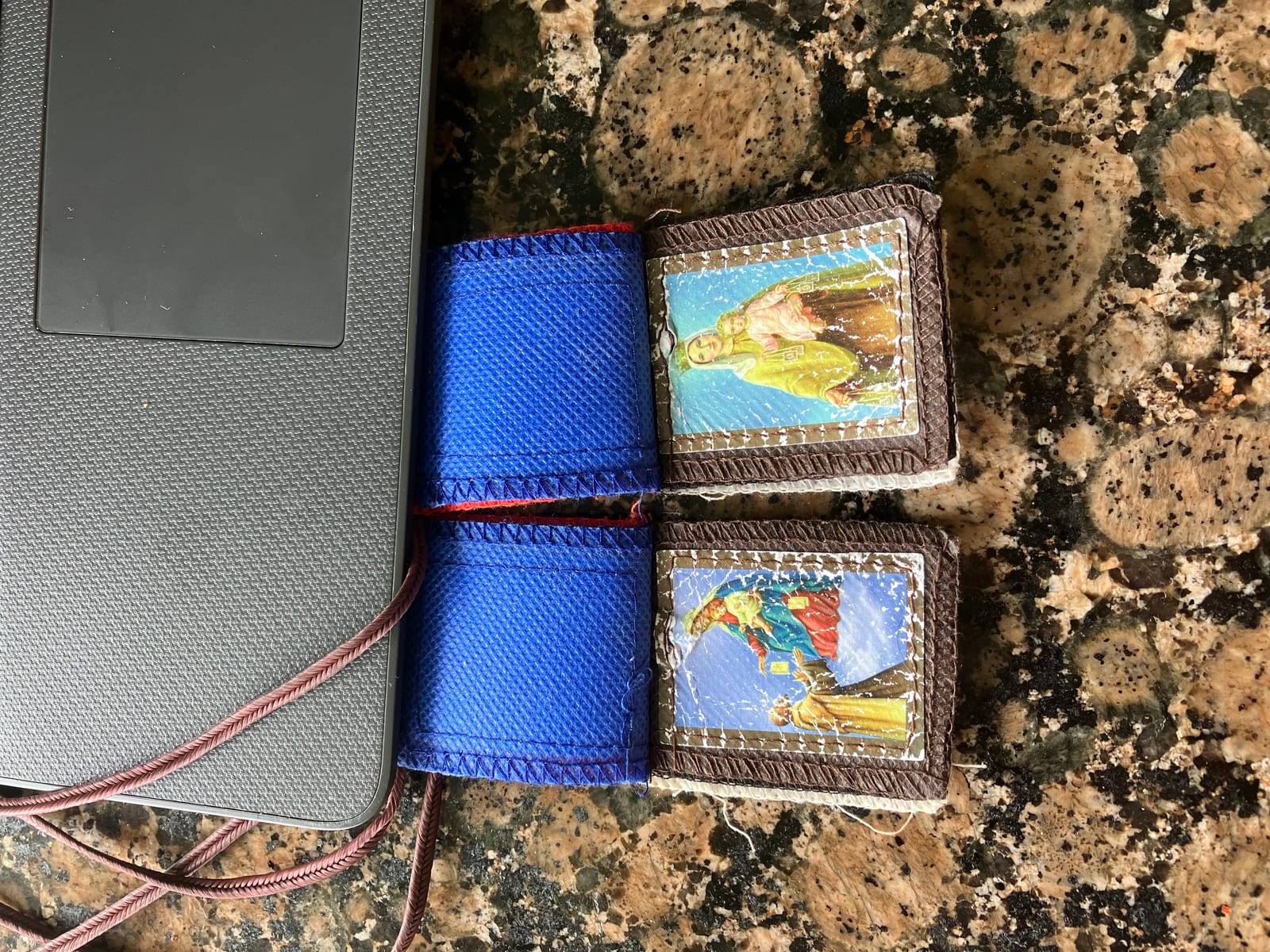
Five approved scapulars — Brown, Blue, Red, Black, and White — sewn on one pair of cords and worn together, a whole devotional wardrobe over the shoulders.

As the scapular devotions multiplied, the faithful began wearing several at once, and the fivefold scapular became the practical answer: the Brown of Carmel, the Blue of the Immaculate Conception, the Red of the Passion, the Black of the Seven Sorrows, and the White of the Trinity, stacked with the Red uppermost, joined on shared cords of red wool.

One properly faculted blessing now enrolls the wearer in all five at once. The fivefold is a reminder that the scapulars were never rivals: each is one accent — Mary's garment, her Immaculate Conception, her sorrows, the Passion, the Trinity — of a single consecrated life.

A fivefold scapular, panel by panel — the author's own
The Brown — Our Lady of Mount Carmel
1 of 5

The eldest panel: Our Lady of Mount Carmel with the Child, both holding the scapular she gave to Carmel.

In this catalogue