
God, one and true, created out of nothing both orders of creature — the spiritual and the corporeal — at the beginning of time, and by His own free will, not out of necessity and not out of pre-existing matter.
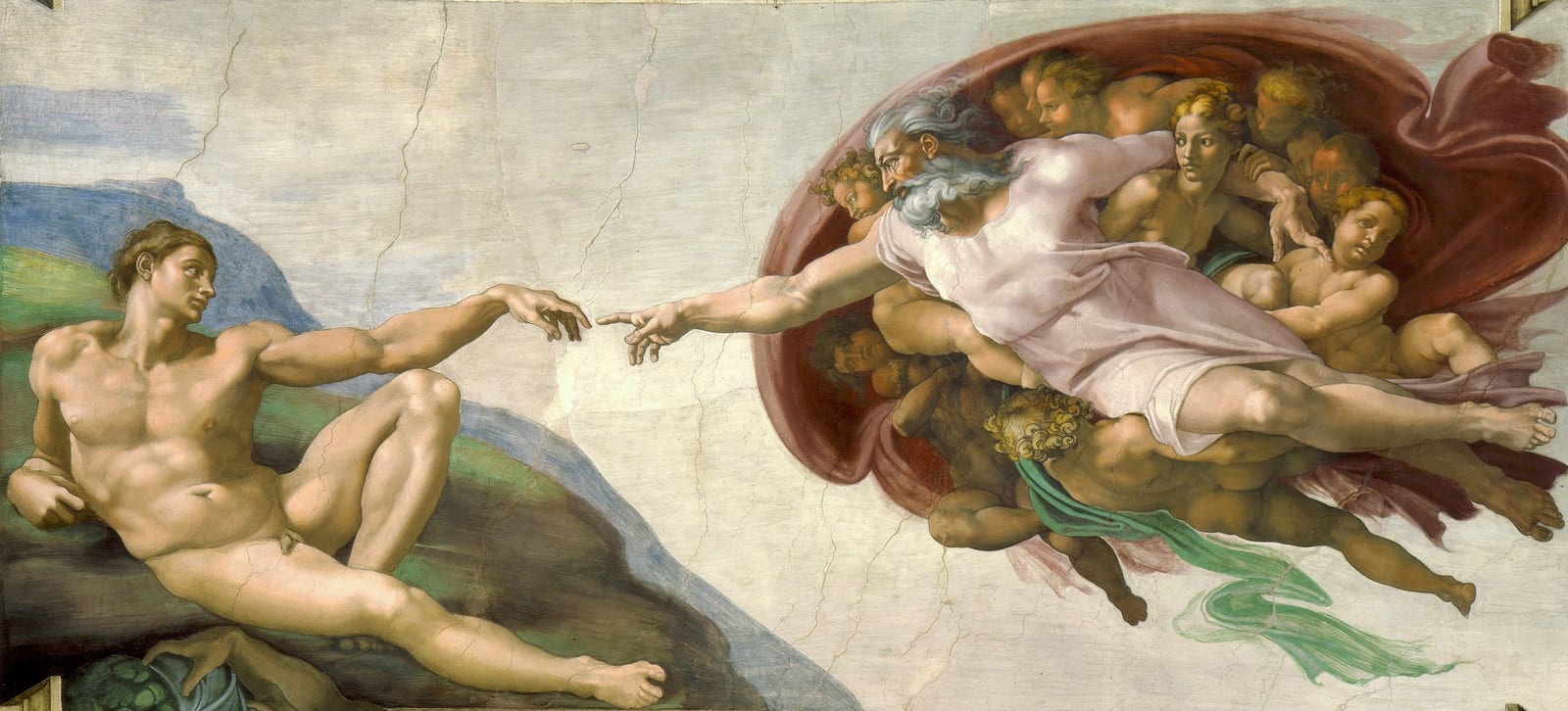
“There is one true God… the one principle of all things: creator of all things visible and invisible, spiritual and corporeal, who by His almighty power at the beginning of time made from nothing both orders of creature, the spiritual and the corporeal, that is, the angelic and the earthly, and then the human creature, who as it were shares in both orders, being composed of spirit and body.”
Solemnly defined by an ecumenical council or by a pope teaching ex cathedra. The wording of the definition itself is what binds, and it cannot be reversed.
The Scripture it rests on
“In the beginning God created heaven, and earth.”
Genesis 1:1 →“I beseech thee, my son, look upon heaven and earth, and all that is in them: and consider that God made them out of nothing, and mankind also.”
2 Maccabees 7:28 →“All things were made by him: and without him was made nothing that was made.”
John 1:3 →Defined against the Cathars
This dogma was defined because of a dualism that had swept southern France and northern Italy: the Cathars, or Albigensians, taught two principles — a good god who made spirit and an evil one who made matter. On that view the body is a prison, marriage is a sin, and the Incarnation is impossible, since God could not take on flesh that was evil by its origin.
The Fourth Lateran Council in 1215 answered with the sentence above, and note what it insists on: one principle, and matter made by Him, and man deliberately composed of both spirit and body. Catholicism has never been able to be a religion that despises the material world, and this is where that is nailed down.
What the Church has and has not said about how
The dogma is that God created, freely, from nothing, and that everything He made is good. It is not a statement about mechanism or timescale. The Church has never defined the age of the earth, and Pope Pius XII in Humani Generis (1950) explicitly permitted research into the evolution of the human body from pre-existing living matter, while holding that each soul is created immediately by God.
Two things remain firm and are worth stating: that the human soul is not a product of matter, and that the world exists because God willed it rather than because it had to. Creation is not an event God performed once and left; it is the reason anything is here at all this second.
What it does not mean
A great deal of what people believe the Church teaches, and reject, is something she has never taught.
The Church has defined that the world is six thousand years old, or that the six days were twenty-four hours.
She has defined neither. St. Augustine warned against reading Genesis as a physics textbook in the fifth century, and Catholic exegesis has never required a literal chronology.
Matter is second-rate, and holiness means escaping the body.
The exact heresy Lateran IV condemned. God made matter, called it good, took a body Himself, and has promised to raise ours.
Why it matters
- ✧It is the ground of every sacrament: water, oil, bread and wine can carry grace because matter is God's and not an enemy's.
- ✧It means your existence is not an accident of physics but something willed — and willed by name.
- ✧It is why the Church can bless a field, a fishing boat, or a house, and why she has never been able to be a religion of pure spirit.