
When the Roman Pontiff speaks ex cathedra — as universal pastor, defining a doctrine of faith or morals to be held by the whole Church — he possesses that infallibility with which Christ willed His Church to be endowed. It is the narrowest of the dogmas, and the most widely misunderstood.
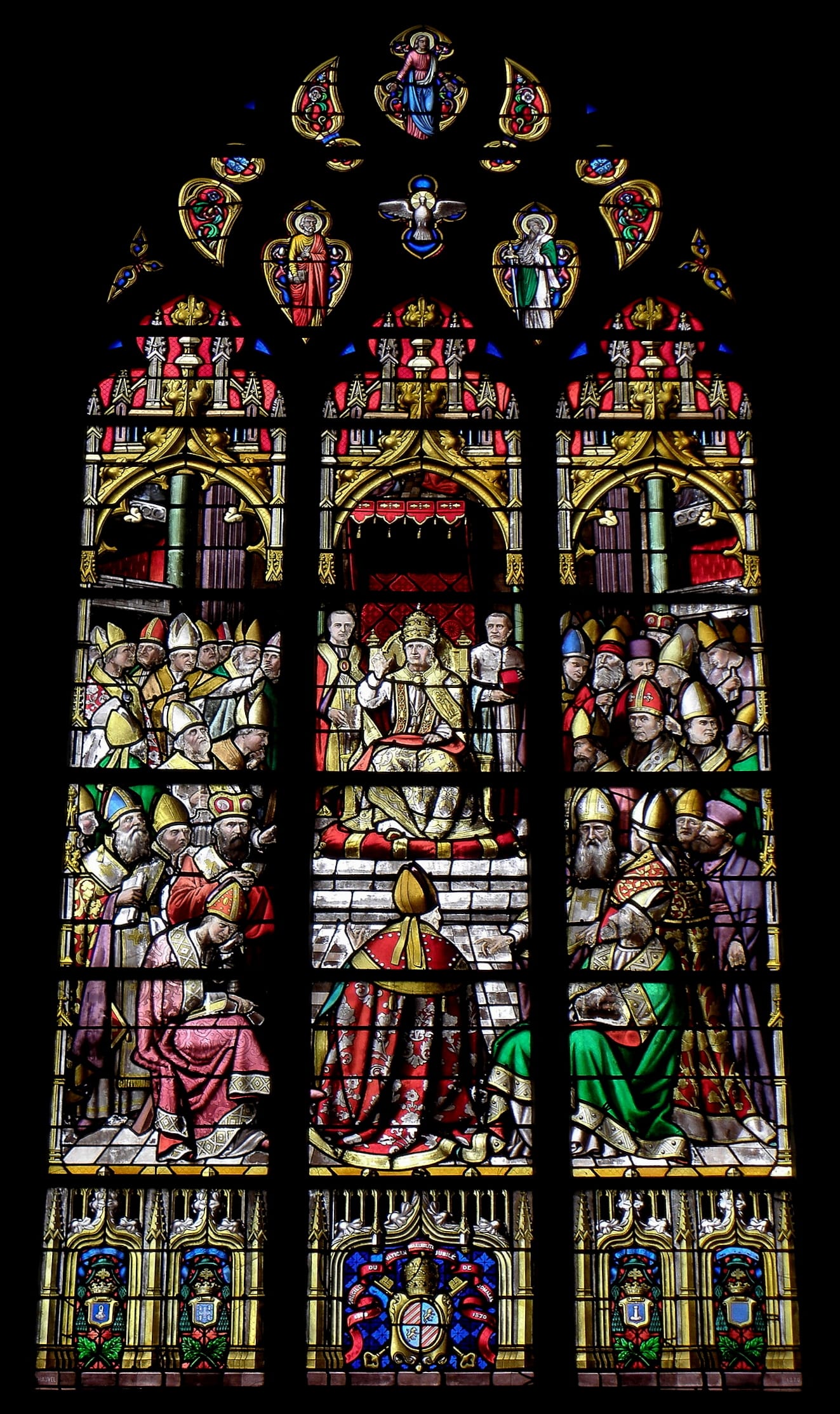
“When the Roman Pontiff speaks ex cathedra, that is, when in the exercise of his office as shepherd and teacher of all Christians, in virtue of his supreme apostolic authority, he defines a doctrine concerning faith or morals to be held by the whole Church, he possesses, by the divine assistance promised him in blessed Peter, that infallibility which the divine Redeemer willed His Church to enjoy in defining doctrine concerning faith or morals.”
Solemnly defined by an ecumenical council or by a pope teaching ex cathedra. The wording of the definition itself is what binds, and it cannot be reversed.
The Scripture it rests on
“And I say to thee: That thou art Peter; and upon this rock I will build my church, and the gates of hell shall not prevail against it.”
Matthew 16:18 →“But I have prayed for thee, that thy faith fail not: and thou, being once converted, confirm thy brethren.”
Luke 22:32 →Four conditions, and why they are so tight
Read the definition again and count the conditions. The pope must be speaking (1) as universal pastor, not as a private theologian or a local bishop; (2) in virtue of his supreme apostolic authority; (3) defining — settling definitively, not discussing; and (4) a doctrine of faith or morals, for the whole Church. All four must hold.
The result is a charism used with extreme rarity. There is universal agreement that it has been exercised in the Immaculate Conception (1854) and the Assumption (1950). Most theologians count no more than these two since the definition itself. It is not a licence to invent: Pastor Aeternus is explicit that the Holy Spirit was promised to Peter's successors 'not that they might make known some new doctrine, but that they might religiously guard and faithfully expound the revelation handed down through the apostles.' The charism is custodial, not creative.
Defined at the worst possible moment
The council defined it on 18 July 1870. The following day France declared war on Prussia; within two months Italian troops entered Rome, the Papal States ended, and the council was suspended and never formally resumed. The pope who had just been declared infallible in matters of doctrine had, within eight weeks, no temporal power at all.
The timing is worth noticing, because it cuts against the usual reading of the definition as a grab for power. What Vatican I actually did was define a narrow doctrinal charism at the exact moment the papacy lost everything else.
What it does not mean
A great deal of what people believe the Church teaches, and reject, is something she has never taught.
The pope is sinless.
Infallibility is not impeccability. Popes have sinned, gravely; the first one denied Christ three times. The charism protects the Church from being taught error in a definitive act, not the man from being a sinner.
Everything the pope says is infallible — interviews, homilies, opinions on politics or science.
None of that is ex cathedra. Ordinary papal teaching is owed religious submission of intellect and will, which is real but is a different thing, and a great deal of what a pope says carries no doctrinal weight at all.
The pope can define a new doctrine whenever he likes.
Pastor Aeternus says he may not: the charism exists to guard and expound what was handed down from the apostles, and revelation closed with the death of the last apostle.
Why it matters
- ⚷It means the Church's most solemn teaching is not finally a matter of your own private judgment, or of whichever scholar is currently in fashion.
- ⚷It is a limit as much as a power — it tells you exactly how far the Church's guarantee extends, and where it does not.
- ⚷It is why a Catholic can distinguish, calmly, between what must be believed and what is simply someone's opinion, including a pope's.