
Jesus Christ truly died, was buried, and on the third day rose again bodily from the dead by His own power — the same body, glorified, and not a vision, a memory, or a manner of speaking.
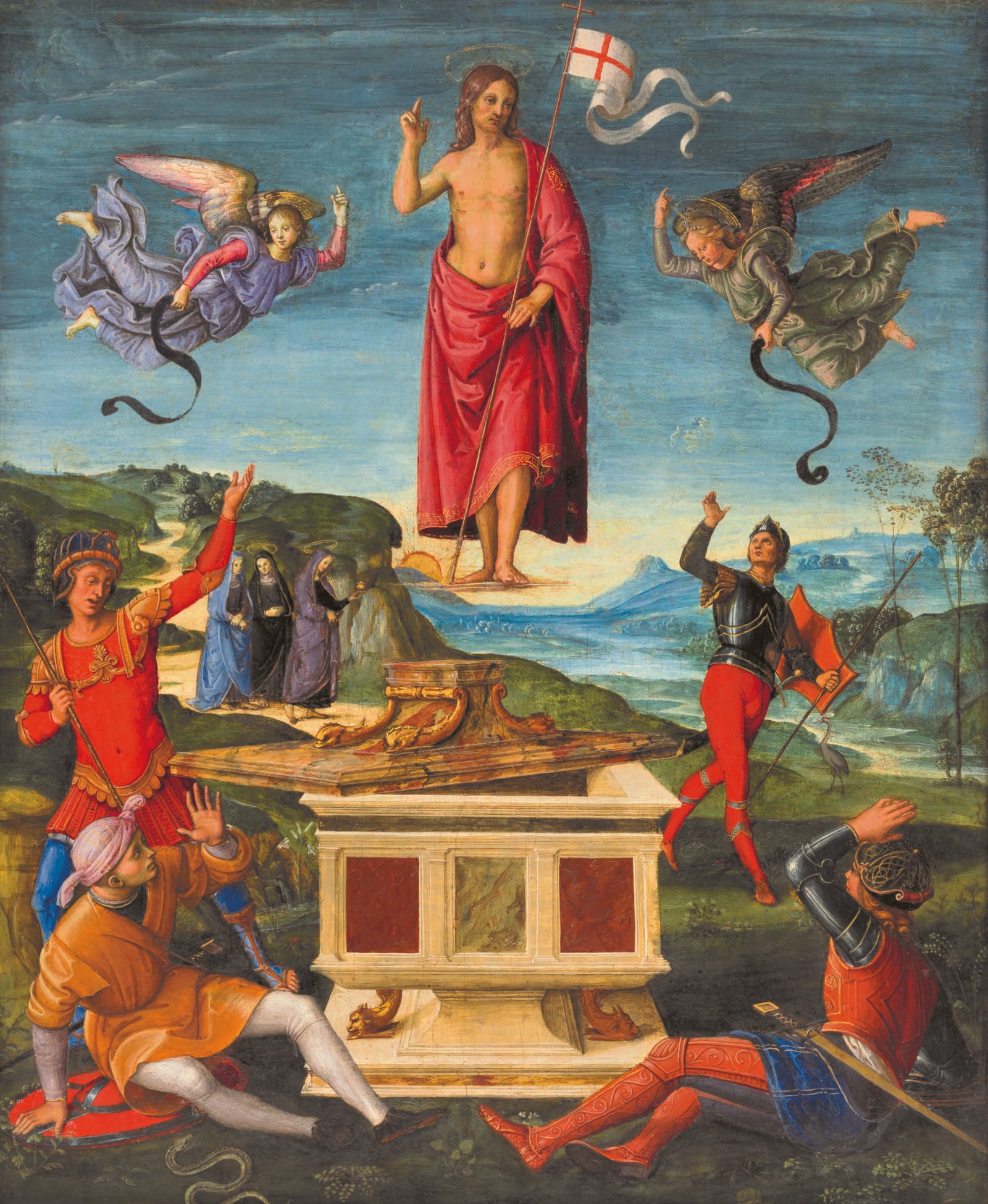
“He suffered and was buried, and rose again on the third day according to the Scriptures, and ascended into heaven, and sits at the right hand of the Father.”
Divinely revealed and taught constantly by the Church's ordinary and universal magisterium, without ever having required a formal definition — usually because nobody prominent enough ever denied it. It binds no less firmly than a defined dogma; it has simply never needed the canon.
The Scripture it rests on
“And if Christ be not risen again, then is our preaching vain, and your faith is also vain.”
1 Corinthians 15:14 →“See my hands and feet, that it is I myself; handle, and see: for a spirit hath not flesh and bones, as you see me to have.”
Luke 24:39 →“Put in thy finger hither, and see my hands; and bring hither thy hand, and put it into my side; and be not faithless, but believing.”
John 20:27 →The one dogma with a list of witnesses
The Resurrection is unusual among the dogmas: it was never seriously disputed inside the Church until modern times, so it needed no conciliar definition beyond the Creed. What it has instead is the oldest surviving Christian text on the subject — St. Paul's summary in 1 Corinthians 15, written around AD 55, which he says he 'received' and is handing on. It names Cephas, the Twelve, more than five hundred at once 'of whom many remain until this present', James, all the apostles, and last of all Paul himself.
That is a creed older than any Gospel, and it is framed as testimony: most of these people, Paul says, are still alive and can be asked.
Bodily, and therefore awkward
The Gospels are strikingly unhelpful if one wants a tidy miracle. The risen Christ eats broiled fish, tells Thomas to put his hand in the wound, and yet enters a room through locked doors and is twice not recognised by people who knew Him well. A body, then, but a body no longer bound as ours are.
The Church has never let this be softened into 'the disciples came to feel He was somehow still with them.' The empty tomb matters, the wounds matter, the fish matters. Christianity makes a claim about something that either happened in Jerusalem or did not, and St. Paul himself supplies the terms of surrender: if Christ is not risen, our preaching is vain and so is your faith.
What it does not mean
A great deal of what people believe the Church teaches, and reject, is something she has never taught.
The Resurrection means Jesus lives on in the hearts of His followers.
That would be a way of saying He is dead. The Church means a corpse became a living body on the third day.
He returned to ordinary life, like Lazarus.
Lazarus was resuscitated and died again. Christ rose glorified, no longer subject to death — the first of a new creation, not a repaired instance of the old one.
Why it matters
- ✹It is the guarantee of your own resurrection: He is called the firstborn from the dead, which implies others follow.
- ✹It means the wounds remain. The glorified body still bears them — suffering is not erased by glory, but taken up into it.
- ✹It is the reason Sunday, not Saturday, and the reason there is no Christian season of unrelieved mourning.