
The Holy House of Loreto is a small one-room structure — three walls without foundation — built of stones, mortar, and ceramic typical of 1st-century Galilee, not of Italian construction. By tradition, it is the house where the Virgin Mary was born, raised, and received the Annunciation. The walls are matched perfectly to the foundation that has been preserved in situ in the Basilica of the Annunciation at Nazareth — and where, between the foundation and the wall-stub that remains in Nazareth, the three walls now at Loreto fit precisely.
Pious tradition (recorded from c. 1450) holds that the walls were carried through the air by angels from Nazareth to Tersatto (in modern Croatia) in 1291 — as the Crusader Kingdom collapsed and Muslim conquerors threatened the Holy Land sites — and then in 1294 to Recanati, and on 10 December 1295 to Loreto. Modern historical research (notably by Giuseppe Santarelli, 2000s) has identified an 'Angeli' family — Crusader Despots of Epirus — who appear in 1294 documents arranging for the 'stones from the house of the Blessed Virgin' to be transported. (The pious tradition and the historical account share a verbal foundation: angeli / Angeli.)
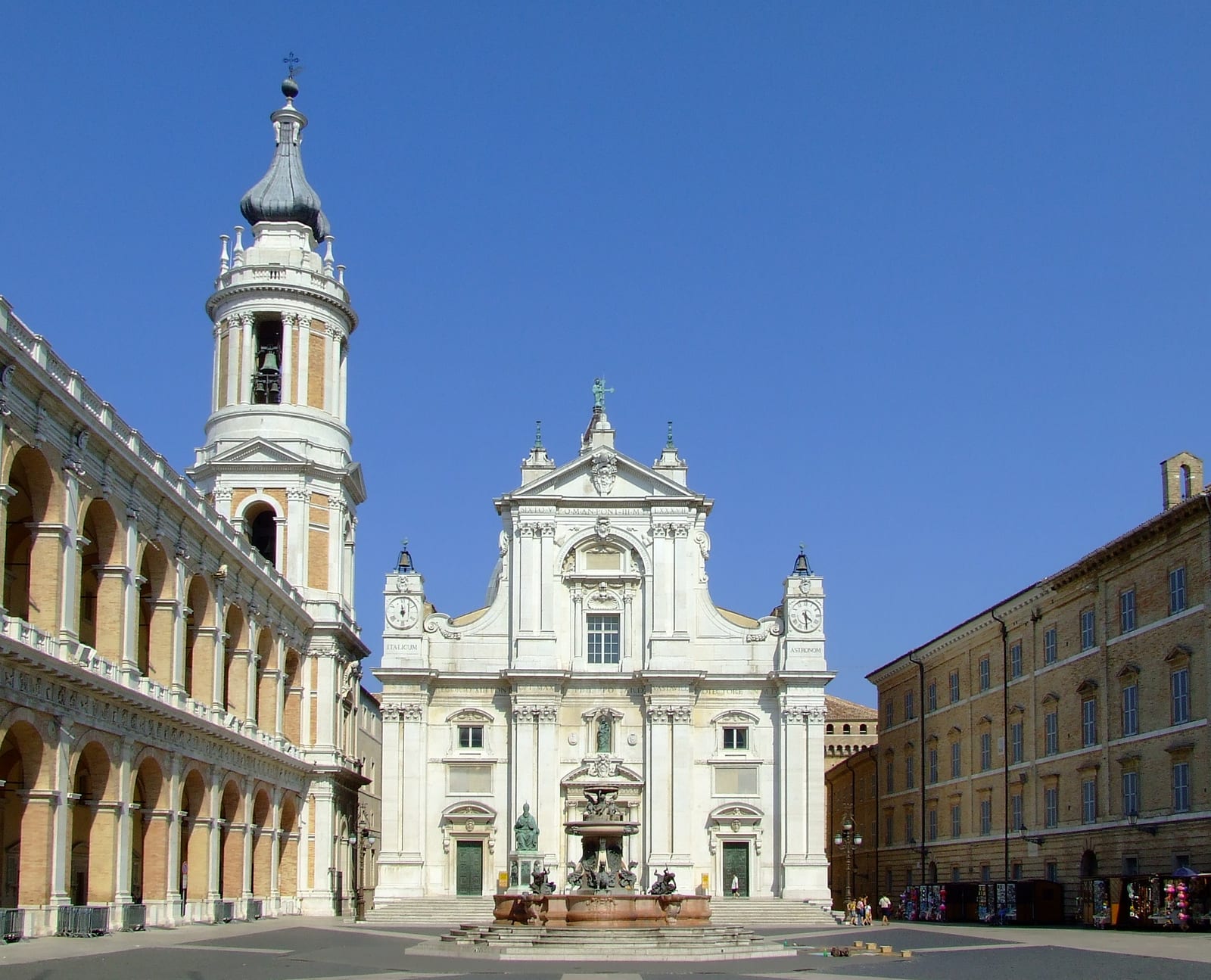
Pope Sixtus IV declared the Holy House the 'tabernacle of the Word made flesh' in 1471. The great Basilica della Santa Casa, built around the three walls between 1469 and 1587, is the principal pilgrimage site of central Italy and one of the most-visited Marian shrines in the world. The Holy House is the patron of aviators and air travellers — and the Virgin of Loreto is the patron of the Italian Air Force.