
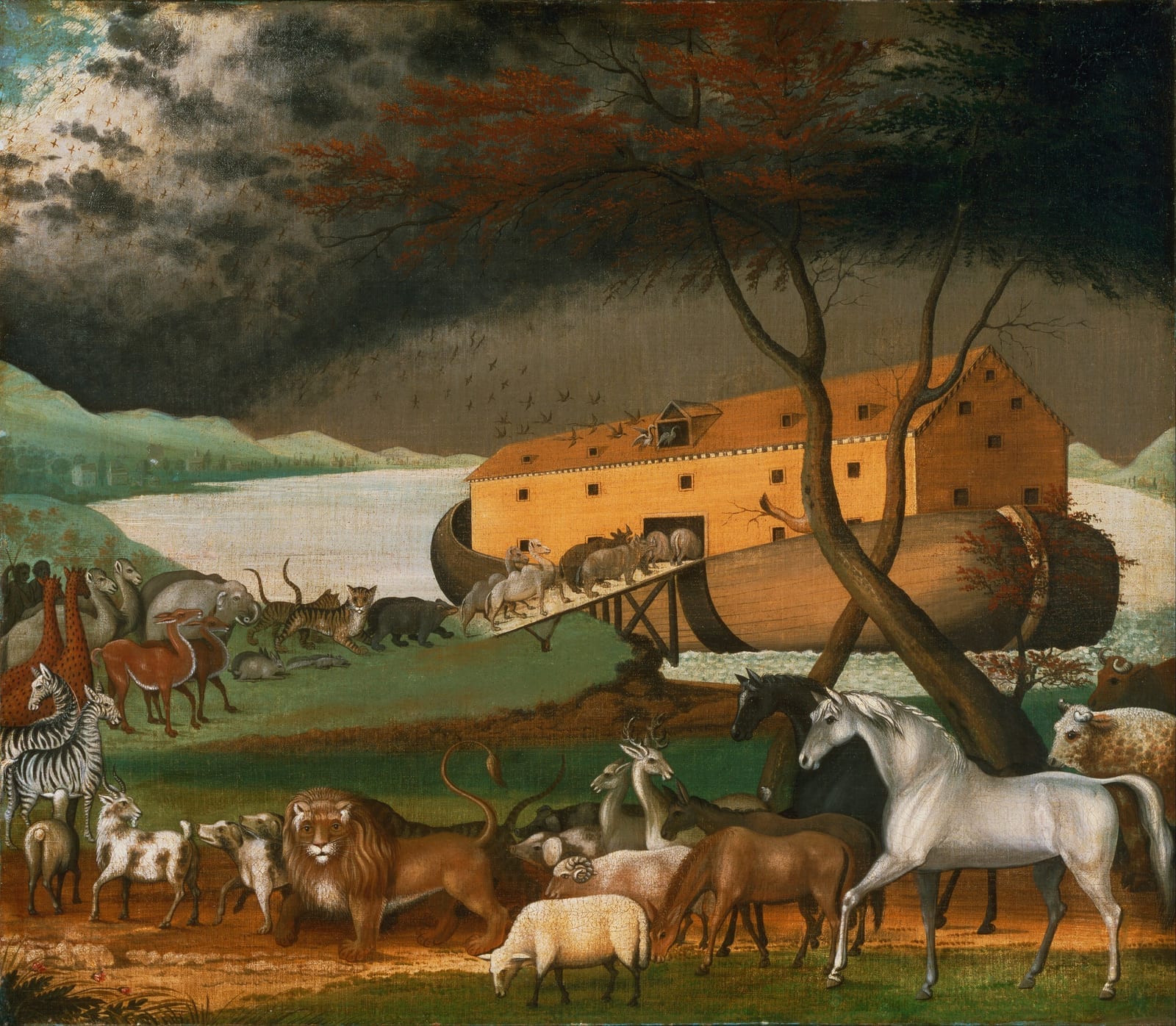
When the wickedness of humankind grew great upon the earth, God resolved to blot out what He had made — sparing only Noah, 'a righteous man, blameless in his generation' (Genesis 6:9). Noah was commanded to build an ark of cypress wood: three hundred cubits long, fifty wide, thirty high, covered with pitch within and without.
Into the ark Noah brought his wife, his three sons and their wives, and pairs of every living thing — clean animals by sevens, unclean by twos. Rain fell for forty days and forty nights; the fountains of the deep burst forth; the earth was covered. After one hundred and fifty days the waters began to recede, and the ark came to rest 'on the mountains of Ararat' (Genesis 8:4) — generally identified with the volcanic massif in eastern Turkey, near the modern border of Armenia and Iran.
When Noah disembarked, he built an altar and offered sacrifices. God set the rainbow in the sky as the sign of a covenant that the waters would never again destroy all flesh. Christian tradition reads Noah's ark as a prefiguration of the Church, through which the faithful are carried safely through the waters of death (1 Peter 3:20–21).
Where the ark came to rest is a question Genesis leaves open. 'The mountains of Ararat' is a region, not a peak — Ararat is the Hebrew form of Urartu, the ancient kingdom around Lake Van — and the oldest traditions did not point at the great volcano at all. Josephus, citing the Babylonian historian Berossus, placed the landing in the Gordyaean mountains of Kurdistan; the Syriac churches kept it at Mount Qardu, the Cudi Dağı above the Tigris, and the Qur'an names the same mountain (al-Jūdī). The identification with Ağrı Dağı, the Ararat of the modern map, grew up in the Middle Ages and is the one most Christians now assume. The Church herself has never said where the ark rested: no council, catechism or papal text identifies a site, and a Catholic is free to hold any view or none. The marker here stands on Ararat because that is the tradition the name carries.
Since 1959 a boat-shaped mound about thirty kilometres south of Ararat's summit, near Doğubayazıt, has been put forward as the ark itself. Spotted by a Turkish army captain, İlhan Durupınar, in aerial survey photographs, the formation is roughly 160 metres long and rises from a hillside at about two thousand metres. It was promoted from 1977 by the American Ron Wyatt and from 1985 by David Fasold, who reported metal-detector readings they took for iron fittings and 'anchor stones' in a nearby village. In 1996 Fasold himself co-wrote, with the geologist Lorence Collins, a peer-reviewed paper concluding that the mound is a natural structure — a fold of altered volcanic rock shaped by uplift and a landslide, its 'iron' the mineral limonite that sets off a detector like metal, its anchor stones cut from local andesite rather than brought from Mesopotamia. That remains the standard geological reading, and it was reached by a man who had gone to Turkey hoping to prove the opposite.
The search reopened in the 2020s under Turkish permit. In 2026 a team led by Prof. Cenker Atila of Sivas Cumhuriyet University, with the American group Noah's Ark Scans, spent about ninety days at the site from late June, took roughly a thousand soil samples, ran ground-penetrating radar, and in September began core drilling to eighteen metres. What the team has announced, in its own words, is subsurface anomalies with fairly regular edges, some meeting at right angles; soil carbon about forty per cent higher inside the outline than outside; 'layers of rich organic material' and cavities in the cores; pottery fragments whose age has not been established; and a hard layer at four to five metres that broke a drill bit. It has said in the same breath that these observations 'will be tested in the laboratory' over the winter of 2026–27, with results promised for 2027. Newspapers in late September reported the team as certain the mound is man-made and ran headlines that the ark's resting place was '100 per cent confirmed'; the team's own release of 23 September claims neither, and the earlier geological explanation of the same features has not been answered in print. This site records the claim as a claim under investigation. A radar anomaly is not a deck, elevated carbon is not wood, and nothing has yet been dated. If the laboratory work bears the claim out, this entry will say so; until then the honest statement is that a scan has been announced and an ark has not been found.