
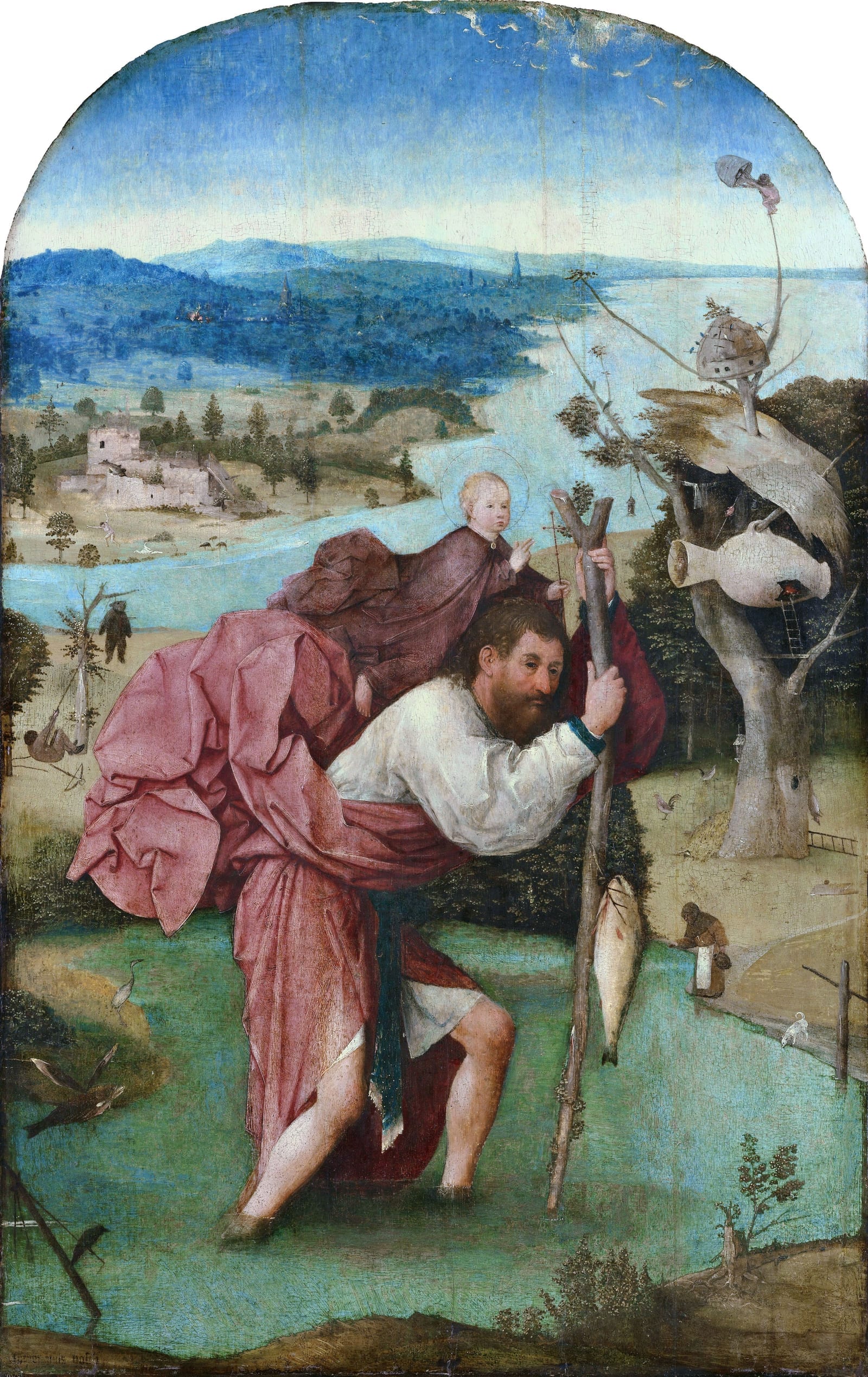
Christopher (Greek Christophoros, 'Christ-bearer') is one of the most-venerated saints of the universal medieval Catholic tradition, and the cult is extraordinarily widespread — but the historical record of his life is extremely thin. The standard medieval legendary account (codified by the late-13th-century Golden Legend of Jacobus de Voragine, but with much earlier antecedents) presents him as a Canaanite giant — over twelve feet tall — named Reprobus, who in his youth resolved to serve only the most powerful king in the world. He served first a worldly king, then the devil himself, then a Christian hermit who taught him that Christ was greater than the devil.
On the hermit's instruction Reprobus took up service at a difficult ford of a great river, where he used his giant strength to carry travellers across. One night he carried a small child across; mid-stream the child became unbearably heavy. Reaching the far bank, the child revealed himself as Christ — bearing the weight of the entire world — and gave Reprobus the new name Christophoros (Christ-Bearer). The hermit baptized him into the Catholic faith. He preached in Lycia and was eventually martyred during the Decian persecution around 251.
The historical core beneath the legend is debated. The earliest cult-evidence (Greek inscriptions, late 4th c.) attests a Lycian martyr named Christopher of the Decian period; the giant-Canaanite-Reprobus-and-ford narrative is a medieval allegorical development. The medieval Latin tradition built one of the most visible cults of the Catholic Church around him: medieval Catholic churches across Western Europe (especially Germany, the Netherlands, and the Alps) carry large painted images of St. Christopher on their exterior walls so that travellers can see them from a distance — the popular medieval belief was that seeing St. Christopher's image on a given day preserved from sudden unprepared death. The 1969 reform of the universal Roman calendar reduced his feast to optional memorial status — sparking widespread controversy and a continued strong popular cult.